


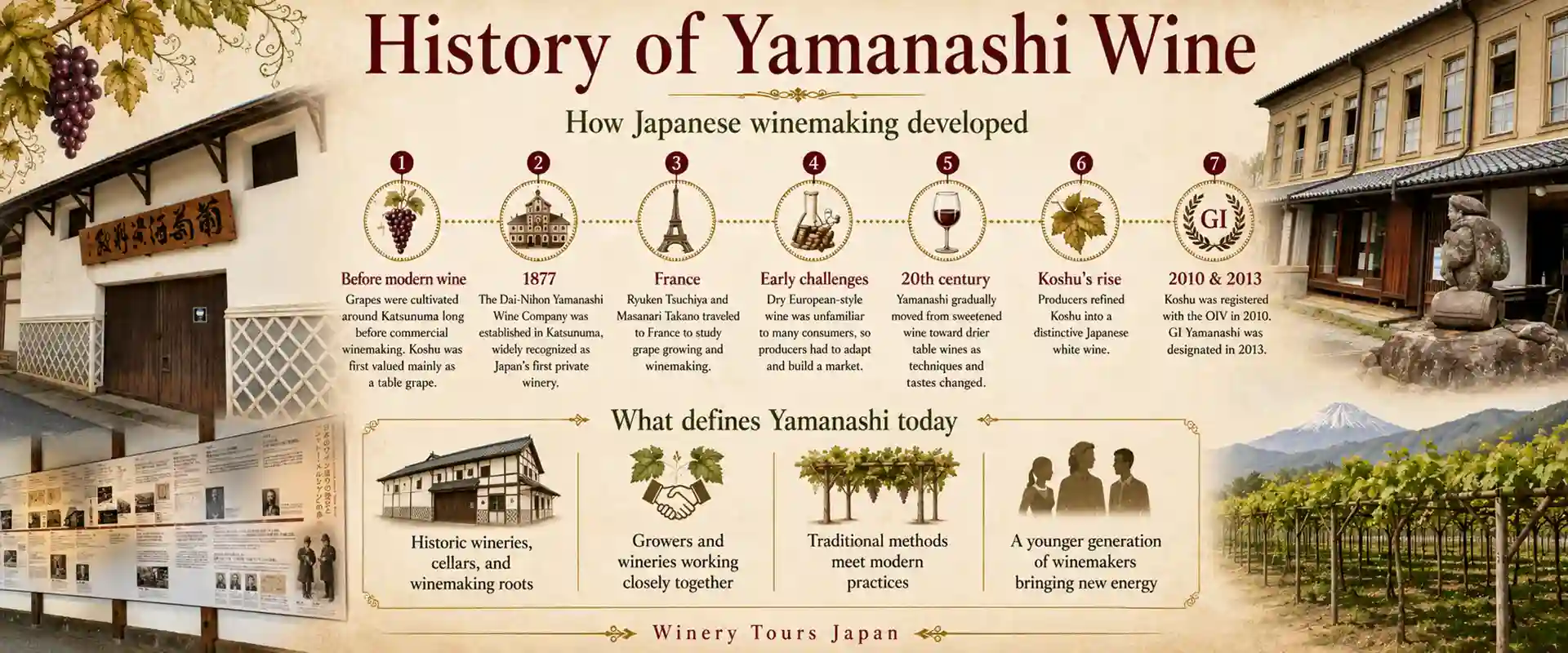
A visual timeline of Yamanashi wine history, from early grape cultivation and the first private winery in 1877 to modern Koshu and GI Yamanashi.
Yamanashi played a central role in the development of modern Japanese wine because grape growing was already part of local life before a commercial wine industry existed. Around Katsunuma, farmers had cultivated grapes for generations, and that agricultural knowledge gave the region a foundation that other parts of Japan did not yet possess.
The history of Yamanashi wine is therefore not simply a sequence of famous wineries and dates. It is a story of table-grape farmers, early entrepreneurs, technical failures, changing tastes, family businesses, research, regulation, and younger winemakers building on the work of earlier generations.
For a broader comparison of Yamanashi with Nagano, Hokkaido, Yamagata, and Japan’s other producing areas, see the Japanese wine regions guide.
Table of contents
- Why Yamanashi Became Central to Japanese Wine
- Grape Growing Before Commercial Winemaking
- The 1877 Beginning of the Modern Industry
- Why the First Wine Business Struggled
- Growers and Wineries Developed Together
- History That Can Still Be Seen
- From Sweetened Wine to Dry Table Wine
- How Koshu Was Reconsidered
- Old and New Vineyard Systems
- A New Generation of Yamanashi Winemakers
- Japan Wine Standards and GI Yamanashi
- What Yamanashi Wine History Looks Like Today
Why Yamanashi Became Central to Japanese Wine
Yamanashi’s importance began with agriculture. The Kofu Basin and the slopes around it offered places where fruit could be grown even when land was less suitable for rice. Mountain protection, long periods of sunshine, differences in elevation, and well-drained sites helped grapes become an important crop, particularly in eastern Yamanashi.
Katsunuma became especially closely associated with grape cultivation. Local traditions place the arrival of grapes much earlier, including stories connected with the Buddhist priest Gyoki and with a farmer named Kageyu Amemiya. These accounts remain part of regional identity, but they are better understood as traditions than as a fully documented beginning of winemaking.
What is clear is that grapes were established long before modern commercial wine. Detailed geography, winery areas, and the relationship between Katsunuma, Enzan, Kofu, and the wider prefecture belong to the Yamanashi wine region guide.
Grape Growing Before Commercial Winemaking
Before wine became the main subject, Koshu was valued primarily as a table grape. Farmers selected fruit for appearance, sweetness, and sale, and they developed cultivation methods suited to Yamanashi’s humid summers and intense heat.
This distinction matters because table-grape farming and wine-grape farming do not always reward the same qualities. A farmer selling premium fruit may prioritize perfect bunches, while a winemaker is concerned with acidity, ripeness, flavor, and how the grapes behave during fermentation. The early wine industry grew inside an agricultural economy that had already been built for another purpose.
In conversations with winery families, I have often heard how earlier generations made wine from fruit that could not be sold as table grapes. What began as a practical use for leftover or lower-grade grapes sometimes became the foundation of a family wine business. Even today, table grapes remain economically important, and carefully cultivated fruit for eating can be more profitable than grapes sold for wine.
The 1877 Beginning of the Modern Industry
The decisive change came during the Meiji era, when Japan was actively studying Western industries. In 1877, the DaiNihon Yamanashi Wine Company was established in Iwai, now part of Katsunuma. It is widely recognized as Japan’s first private winery.
That same year, the company sent two young men from Yamanashi, Ryuken Tsuchiya and Masanari Takano, to France. They studied grape cultivation and winemaking, then returned with technical knowledge that had not previously been available in the region.
Their journey is often presented as the simple birth of Japanese wine, but the reality was more difficult. European methods could be studied and imported, yet they still had to be adapted to Japanese grapes, weather, farming practices, and consumers. The importance of Tsuchiya and Takano lies not in creating an immediate success, but in establishing a direct connection between Yamanashi’s grape culture and modern wine production.
Why the First Wine Business Struggled
The first company did not create an instant market. Dry European-style wine was unfamiliar to many Japanese consumers, production knowledge was still developing, and wineries depended on growers whose best fruit could often earn more as table grapes.
The DaiNihon Yamanashi Wine Company eventually closed in 1886, but its equipment, knowledge, and people did not disappear. Former shareholder Kotaro Miyazaki and members of the Tsuchiya family continued the work through later businesses. Miyazaki also recognized that making wine was only one part of the problem: producers had to explain it, brand it, and find customers.
He opened a sales base in Tokyo and developed Daikoku Wine into a recognizable product. This was an early example of a pattern that continues today. Japanese wine requires not only growers and winemakers, but also people who can communicate why it is different and how it fits Japanese food and drinking culture.
Growers and Wineries Developed Together
Yamanashi wine did not develop through wineries alone. Independent grape growers, agricultural cooperatives, family producers, larger companies, researchers, and local institutions all contributed to the industry.
The relationship was not always simple. Growers wanted a fair return for their fruit, while wineries wanted grapes that suited the wines they hoped to make. A bunch that looked impressive in a market was not automatically the best raw material for a dry wine. Over time, closer cooperation encouraged more discussion about harvest timing, crop levels, grape condition, and the intended style of the finished wine.
Many smaller wineries still reflect this agricultural background. At producers such as Sanyo Wine, Kizan, Haramo Wine, and other family operations, I have seen owners move between vineyard work, cellar work, bottling, sales, and tastings. Permanent teams can remain small, with additional help appearing during harvest. This hands-on structure is one reason the personality of a family or winemaker can be so visible in the finished wine.
History That Can Still Be Seen
One of the distinctive things about Yamanashi is that its wine history remains physically present. It can be seen in old winery buildings, cellars, wooden barrels, presses, labels, photographs, and tools that survived as production changed.
Sanyo Wine traces its history to 1933. Haramo Wine was founded in 1924 by a family already involved in grape growing, and its winery operates from a restored traditional building approximately 140 years old. The building still has the character of an older Yamanashi agricultural home rather than a purpose-built modern visitor facility.
The clearest historical display I have visited is the Château Mercian Wine Museum in Katsunuma. The museum occupies a wooden winery building constructed in 1904, recognized as the oldest surviving wooden winery in Japan. Inside are early bottles, labels, barrels, photographs, and equipment used during the development of Japanese wine.
One preserved room contains a water-powered winemaking machine. The water trough and wheel-driven mechanism remain visible, making the technology easier to understand than a written description alone. Nearby cellar spaces and large wooden barrels show the scale and physical labor involved before stainless-steel tanks, modern pumps, and electronic controls became normal.
From Sweetened Wine to Dry Table Wine
For much of the early commercial period, sweeter wine was easier to sell than dry table wine. Sweetness softened acidity and astringency, and the result was closer to flavors many consumers already understood. These products helped create demand for grapes and allowed wineries to survive while the market for dry wine remained limited.
During the twentieth century, tastes gradually changed. International travel, major events, Western-style restaurants, changing diets, and greater access to imported wine exposed more people to dry styles. Producers also improved hygiene, fermentation control, pressing, temperature management, grape selection, and cellar equipment.
This was not a clean break in which one style suddenly replaced another. Sweetened wine remained commercially important for decades, while dry wine developed through repeated experiments and slow changes in consumer expectations. Established producers, including the company that became Château Mercian, helped make dry wine more familiar and demonstrated that Japanese wineries could compete for recognition beyond their local market.
How Koshu Was Reconsidered
Koshu was central to Yamanashi agriculture, but its future as a serious wine grape was not always secure. The variety could produce delicate wines, and that subtle character was sometimes mistaken for a lack of quality. Producers had to learn how to protect freshness, manage extraction, and avoid overwhelming the grape.
Careful pressing, temperature-controlled fermentation, lees contact, skin contact, barrel use, and better vineyard decisions gave winemakers more options. Rather than forcing Koshu to imitate a powerful international variety, many producers gradually learned to work with its lighter structure, restrained aroma, and compatibility with Japanese food.
In 2010, Koshu was registered on the international OIV list of wine-grape varieties. That recognition made it easier to present the grape by name in European markets and gave Yamanashi producers a clearer international identity. For detailed coverage of the variety, styles, flavors, and food pairings, see the Koshu wine guide.
Old and New Vineyard Systems
The changing industry is also visible in the vineyards. Traditional overhead pergolas remain common in Yamanashi. Raising the canopy allows air to circulate beneath the vines and gives the fruit some protection from intense summer sun and heat. The system also developed in a region where attractive table-grape bunches were economically important.
Alongside pergolas, some producers use vertical shoot positioning and other systems associated with wine-grape production. Neither method tells the whole story. Site, variety, rainfall, labor, vineyard goals, and the wine being made all influence the choice.
During tours, I regularly see old and new systems within a short distance of each other. That coexistence is a useful picture of Yamanashi wine itself: modern equipment and international knowledge have arrived, but they operate inside a landscape shaped by older agricultural practices.
A New Generation of Yamanashi Winemakers
During more than a decade in Yamanashi, I have seen new wineries open and a younger generation enter an industry traditionally associated with older family businesses. Some are children of established winery families, while others are creating new ventures of their own.
Many study or work abroad before returning to Japan. They bring experience with different vineyard systems, fermentation approaches, equipment, laboratory analysis, and small-batch production. Technology now allows closer temperature control, more precise monitoring, and decisions that would have been difficult for earlier generations working with simpler tools.
The most interesting change is not a rejection of tradition. Younger winemakers often rely on the vineyards, relationships, and practical knowledge built by parents and grandparents, then add their own ideas. This creates continuity rather than a complete break between generations.
Established wineries are also changing how they welcome visitors. Katsunuma Jyozo is a good example: its tasting environment feels contemporary while retaining a distinctly Japanese, rustic character. The presentation is newer, but the relationship with Koshu, local food, and family history remains clear.
Japan Wine Standards and GI Yamanashi
As quality and interest increased, clearer definitions became necessary. For many years, consumers could find wine produced in Japan without easily knowing whether the grapes were grown domestically or whether imported wine or grape concentrate had been used.
Modern labeling rules define “Japan wine” as wine produced in Japan using grapes harvested entirely in Japan. The rules also control when a region, grape variety, or vintage may appear on the label.
GI Yamanashi, designated in 2013, adds a more specific regional framework. Qualifying wines must use approved grapes grown in Yamanashi, meet production requirements, be produced, stored, and bottled within the prefecture, and pass regional review. The designation does not make every wine identical, and not every Yamanashi wine carries it. It provides a regulated statement of origin within which producers can continue to make different styles.
What Yamanashi Wine History Looks Like Today
Yamanashi’s wine history is not finished. Historic cellars and family stories remain important, but the industry continues to change through new wineries, younger winemakers, improved equipment, vineyard experiments, and a growing interest in regional identity.
I have also seen wine tourism become more visible during my years in the valley. Wineries receive more local visitors, Japanese travelers, and international guests who come specifically to understand Yamanashi wine. Winery events and tastings in Tokyo have introduced the region to a wider audience, including younger consumers who may be interested in wine but have had few opportunities to learn about it.
Distribution remains part of the challenge. Some Yamanashi wines can be found in Tokyo and other major cities, but many bottles are still easiest to purchase at the winery or through local retailers. That limited availability can make the region seem less developed than it is to people who have never visited.
The strongest way to understand the history is to see how its layers remain connected: table-grape farming beside wine vineyards, old wooden buildings beside modern tasting rooms, small family teams beside established companies, and younger winemakers working with knowledge inherited from earlier generations.
For practical information about the valley, winery areas, and planning a visit, read Koshu Valley: Inside Japan’s Wine Country. For the meeting point, itinerary, inclusions, and booking details, see the One-Day Private Yamanashi Wine Tour from Tokyo.