


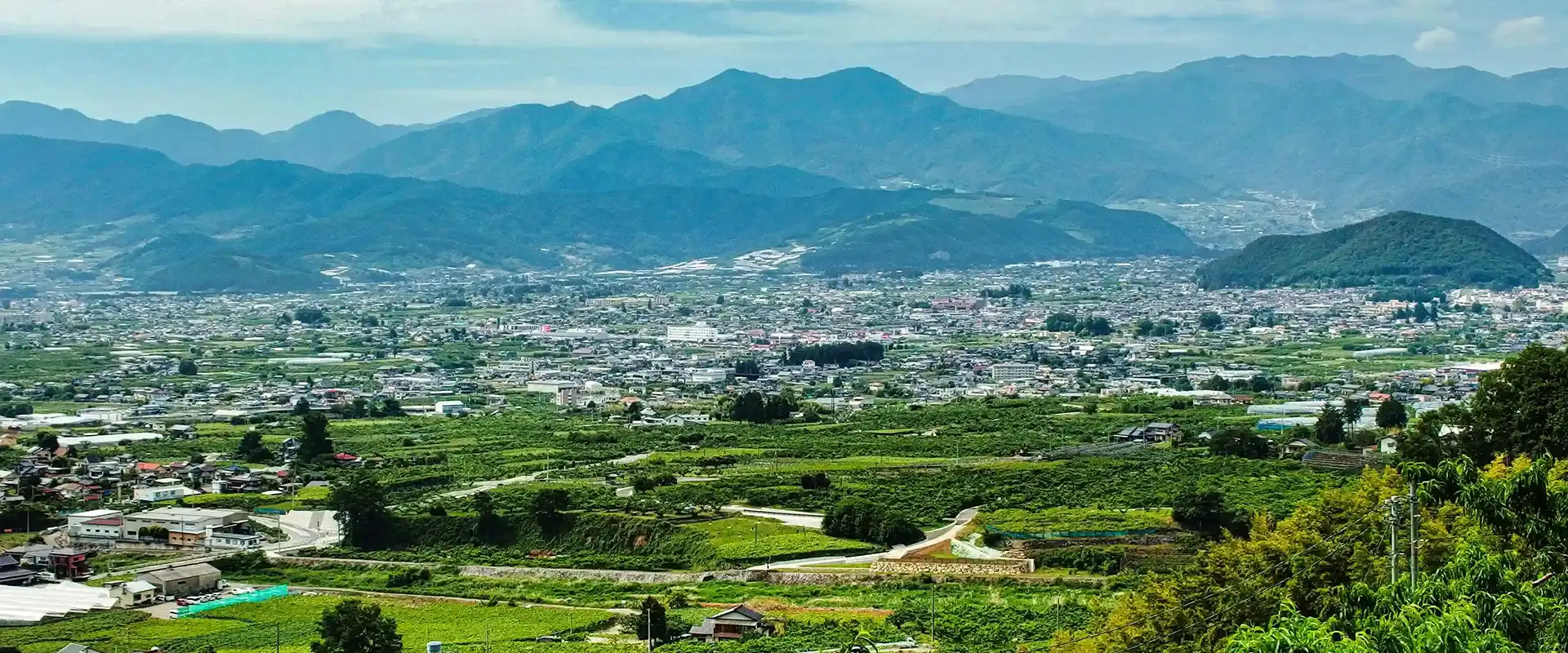
Koshu Valley’s vineyards, farms, towns and surrounding mountains in eastern Yamanashi.
Koshu Valley is the historic center of wine production in Yamanashi and one of the places most closely associated with Japanese wine. It is not a single wine village or compact district that can be understood at a glance. It is a working landscape of vineyards, orchards, homes, small towns, established producers, and family-run wineries spread across eastern Yamanashi.
For many visitors, the first surprise is the sense of place. Vineyards sit beneath mountain ranges, wineries are woven into ordinary communities, and wine production remains closely connected to local agriculture. Understanding that landscape is the starting point for understanding Koshu Valley itself.
What Koshu Valley Means
Koshu Valley is commonly used as a wine and travel-region name rather than the title of one official administrative district. Its best-known core lies around Koshu City, particularly Katsunuma and Enzan, with wineries and vineyards continuing into nearby parts of Yamanashi.
The word “Koshu” can also cause confusion because it is the name of Japan’s best-known native white wine grape. Koshu the place and Koshu the grape are related, but they are not the same thing. The valley produces reds, whites, and sparkling wines from Japanese and international grape varieties.
For the grape itself, see the Koshu wine guide. For broader regional geography and the place of Koshu Valley within Yamanashi, see the Yamanashi wine region guide.
A Wine Landscape, Not a Single Wine Village
Visitors sometimes imagine a wine region as one main street lined with tasting rooms. Koshu Valley feels different. Most of the wineries sit around Enzan and Katsunuma, but producers are spread across towns, slopes, vineyard areas, and residential neighborhoods. Some are close to major roads or stations, while others sit among orchards, fields, and quiet local communities.
On a tour day, I will often visit one or two wineries nearer Kofu Station after meeting guests before continuing into the valley proper. That change in setting gives an early sense of how dispersed the region really is.
After living here for more than a decade, I still think that dispersed character is the valley’s defining quality. Grapes grow alongside peaches and table grapes, and many local families keep their own vegetable gardens. Wine is one part of the farming year here, not a separate industry built for visitors.
Enzan and Katsunuma are both small towns and feel like small towns: local markets, garden centers, restaurants serving the people who live here, older neighborhoods, and agricultural work happening throughout the year. That is the texture no single photograph of a vineyard can capture.
The Wineries Do Not All Feel the Same
Koshu Valley includes long-established producers, larger wineries with extensive facilities, and smaller family-run businesses producing limited quantities. Their buildings, tasting spaces, winemaking approaches, and relationships with visitors can be very different.
Some wineries present several styles in a formal tasting area. Others feel more personal and closely connected to the family or small team behind the wine. One producer may be known for delicate Koshu wines, while another may place greater emphasis on red varieties, sparkling wine, estate vineyards, or experimental small-batch production.
Most are small and unhurried. Midweek, it is often possible to taste without a crowd, and there are afternoons when I do not see another foreign visitor. For a region so closely connected with Japanese wine, it remains surprisingly untouristed, which is a large part of its appeal.
Some winemakers have trained abroad and speak English, which can make conversation easier than visitors expect. Even so, the strongest winery experience is usually not about visiting the greatest possible number of places. It comes from contrast: seeing how two producers in the same region make different choices about grapes, production, scale, and style.
For a closer look at the types of producers found across the region, see the guide to wineries in Yamanashi.
What Visitors Notice Beyond the Wine
Wine is the reason many people first search for Koshu Valley, but the place is broader than the tasting glass. Vineyards share the landscape with fruit farms, local restaurants, family businesses, mountain scenery, and communities that do not exist only for tourism.
What surprises many guests is how versatile Japanese wine can be. People arrive expecting Koshu and encounter a wider range of styles and flavor profiles than they had anticipated. Koshu itself is often the revelation: elegant, fresh, restrained, and particularly well suited to food and warm-weather drinking.
The setting changes how those wines are understood. Seeing where grapes are grown, hearing how a producer works, and noticing the scale of a winery can make a wine more memorable than tasting it without context. Local food adds another layer because many Japanese wines are made with balance, freshness, and the dining table in mind.
Why Local Knowledge Changes the Experience
Winery information can change with opening schedules, production work, reservations, staffing, and seasonal conditions. English-language information also varies, and the most useful explanation is not always written on a label or tasting sheet.
The valley is also well placed. Tokyo is close, but so are Kofu, the Southern Alps, and the Fuji Five Lakes, which matters when Koshu Valley is one part of a longer trip.
Local knowledge connects the individual stops: why a winery matters, how its approach differs from the previous producer, what a grape or winemaking choice means, and how the wines relate to Yamanashi’s wider development.
Furuya-san at Haramo Wine is a long-standing friend and a member of the Katsunuma Wine Association. He speaks English, has traveled in Australia, Singapore, and Europe, and when his schedule allows, he makes a point of coming out to talk with guests. Because many visitors have connections to those places, the conversation often becomes more personal than a formal tasting. He is also a serious classic rock fan, which has started more than one unexpected exchange.
That kind of meeting is never guaranteed. Winery work comes first, and schedules change. But it shows the difference between simply tasting a wine and understanding something about the person who made it.
Long-standing local relationships do not guarantee access to a particular producer, cellar, owner, or winemaker. Their value lies in current knowledge, interpretation, realistic coordination, and the ability to shape a coherent experience around the conditions of the day.
I have lived in the Koshu Valley for more than a decade and personally guide every Winery Tours Japan experience as a Bilingual English-Speaking Local Guide. I introduce guests to Japanese wine, local food, regional culture, and the people and places that give the valley its character.
Discover Koshu Valley with Winery Tours Japan
Koshu Valley rewards visitors who look beyond a list of winery names. Its identity comes from the relationship between vineyards, producers, towns, agriculture, food, and the people working across the region.
For details of the bookable experience, including the meeting point, schedule, inclusions, and enquiry process, see the One-Day Private Yamanashi Wine Tour from Tokyo.