


The Yamanashi wine region is the part of Japan most closely associated with domestic wine. Koshu Valley, centered on Katsunuma and Enzan, is its historical center and contains the prefecture’s largest concentration of wineries.
Koshu Valley is where Yamanashi’s vineyards, fruit farming, wineries and local communities are most visibly connected. Katsunuma contains the region’s best-known concentration of vineyards and producers, while neighboring Enzan has a quieter and more dispersed character shaped by farms, temples, residential communities and mountain approaches.
The wider Yamanashi wine region extends beyond Katsunuma and Enzan. Vineyards and wineries also appear through Fuefuki, Yamanashi City and the higher grape-growing slopes of Makioka, Kofu, Kai, western Yamanashi and the cooler northern areas around Nirasaki and Hokuto. These places share a prefectural identity but differ in winery density, elevation, landscape and wine-growing conditions.
After living in the Koshu Valley for more than a decade and guiding guests throughout Yamanashi, Morey sees those differences as practical rather than simply geographical. A route through Katsunuma feels different from a day in Enzan, Makioka, western Yamanashi or the higher northern vineyards. Understanding that internal structure is essential to understanding Yamanashi wine as a whole.
Table of contents
- Yamanashi wine region at a glance
- Yamanashi, Koshu Valley, Koshu City and the Koshu grape
- The geography behind Yamanashi wine
- Koshu Valley: the historical center of the Yamanashi wine region
- Wine areas beyond Koshu Valley
- Grapes and regional identity
- What changes from place to place
- Discover Yamanashi wine country
Yamanashi wine region at a glance
| Location | Central Honshu, immediately west of Tokyo |
| Main winery concentration | Koshu Valley in eastern Yamanashi |
| Core wine areas | Katsunuma and Enzan within Koshu City |
| Central landscape | The Kofu Basin, surrounding slopes, river terraces and mountain foothills |
| Other wine areas | Fuefuki, Yamanashi City and Makioka, Kofu, Kai, western Yamanashi, Nirasaki and Hokuto |
| Defining white grape | Koshu |
| Important Japanese red grapes | Muscat Bailey A and Yama Sauvignon |
| Regional character | Mountain-ringed vineyards, varied elevations, fruit-growing communities and wineries ranging from established producers to smaller family businesses |
Most visitors encounter Yamanashi wine through Koshu Valley because most of the prefecture’s wineries are concentrated around Katsunuma and Enzan. The wider prefecture remains important, but it should not be presented as though every area has the same density of vineyards, wineries or visitor facilities.
Yamanashi, Koshu Valley, Koshu City and the Koshu grape
Several related names appear when people discuss Yamanashi wine. They describe different places or subjects and should not be treated as interchangeable.
- Yamanashi is the prefecture and the broad wine region covered by this page.
- Kofu Basin is the mountain-ringed basin containing much of Yamanashi’s population, agriculture and wine activity.
- Kofu is the prefectural capital on the western side of the central basin.
- Koshu City is the municipality in eastern Yamanashi containing Katsunuma, Enzan and Yamato.
- Katsunuma is the best-known concentration of vineyards and wineries within Koshu City.
- Enzan is another part of Koshu City, with wineries spread through a quieter and more rural landscape.
- Makioka is a long-established grape-growing area within Yamanashi City, located on higher slopes north of the eastern basin.
- Koshu Valley is the practical visitor-facing name used by Winery Tours Japan for the eastern wine country around Katsunuma, Enzan and nearby communities.
- Koshu grape is Japan’s signature pale-skinned grape variety, used primarily to make white wine.
The word Koshu can therefore refer to a geographical or historical identity, the present municipality or the grape variety, depending on context. On this site, we use Koshu City, Koshu Valley and Koshu grape separately whenever the distinction matters.
Detailed information about the variety, its character and the different wines produced from it belongs in our separate guide to Koshu wine and the Koshu grape.
The geography behind Yamanashi wine
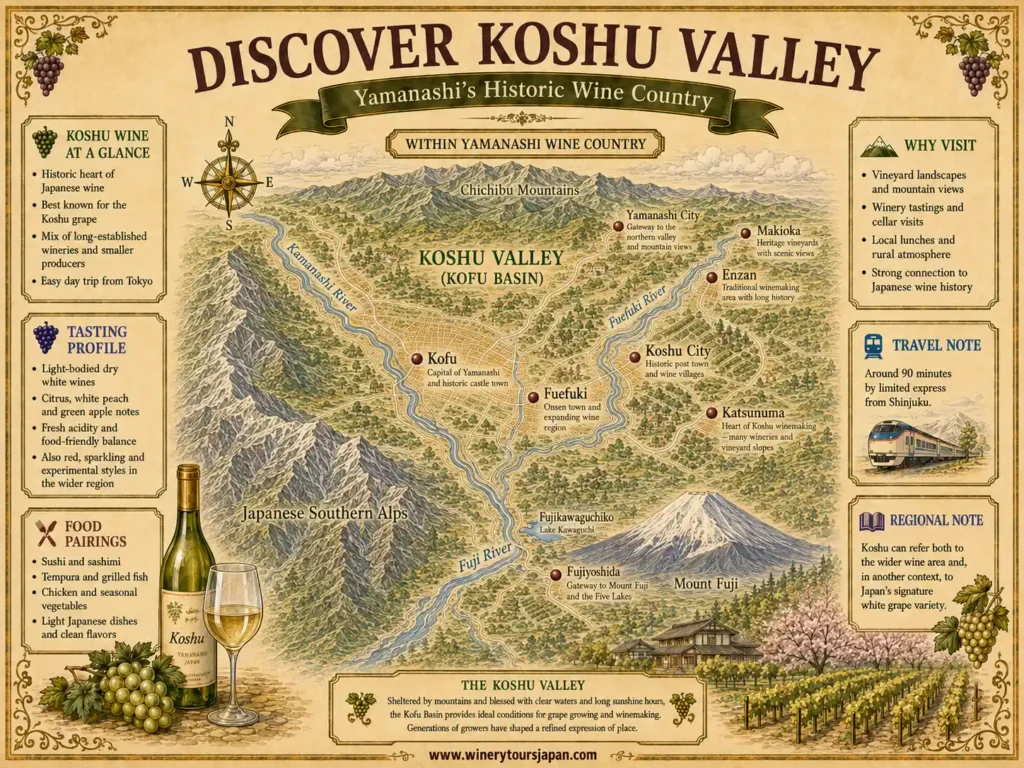
Yamanashi is enclosed by mountains, with the Kofu Basin forming the central lowland around which many of its vineyards, farms and communities are arranged. The Japanese Southern Alps rise to the west, mountain ranges continue around the northern and eastern sides, and Mount Fuji lies south and southeast of the basin.
The Kamanashi River descends through the western side of the basin, while the Fuefuki River enters from the northeast and crosses its eastern side. They converge in the south of the basin to form the Fuji River, which continues toward Shizuoka Prefecture and Suruga Bay. Together with their tributaries, these rivers have carried material from the surrounding mountains, helping form river terraces, slopes and broad alluvial fans across the region.
There is no single soil description that represents every Yamanashi vineyard. Sites may contain different mixtures of gravel, sand, clay and river-deposited material. Elevation, slope direction, drainage, airflow and distance from the basin floor also vary over relatively short distances.
These changes are visible when traveling between wineries. Parts of Katsunuma rise above the basin with open vineyard slopes and broad mountain views. Enzan is more broken up by farms, neighborhoods and approaches to the surrounding mountains. Makioka occupies higher, sloping agricultural land farther north, while vineyards and wineries in western and northern Yamanashi become increasingly separated from one another.
The basin receives strong sunshine and is comparatively dry by Japanese standards, but Yamanashi still faces humid summers, seasonal rainfall and difficult weather during the growing season. Vineyard structure and canopy management therefore remain important parts of grape cultivation.
Traditional overhead pergolas remain a familiar feature, particularly in vineyards growing Koshu and Muscat Bailey A. Some producers also use vertical training systems where the vineyard site, grape variety and intended wine style make them suitable. Older farming methods and newer approaches can often be seen within the same area.
Koshu Valley: the historical center of the Yamanashi wine region
Koshu Valley forms the center of Yamanashi’s winery landscape. Most of the prefecture’s wineries are concentrated around Katsunuma and Enzan, making this the clearest area in which to see how vineyards, wineries and local communities connect within Yamanashi.
Katsunuma
Katsunuma has Yamanashi’s most recognizable concentration of vineyards, wineries and wine-related facilities. Established companies, family wineries, smaller producers, vineyards and fruit farms occupy the slopes and communities surrounding the central area.
Although the concentration is visible, Katsunuma is not one compact pedestrian wine district. Some wineries are reasonably close together, while others sit on separate slopes or beyond practical walking distance. Elevation, local roads and winery opening arrangements all influence how the area can realistically be explored.
From years of traveling through Katsunuma, Morey finds that its apparent density can be misleading. Vineyards and wineries occupy different slopes and neighborhoods, so places that appear close on a map can feel more separated on the ground.
Enzan
Enzan belongs to the same municipality but has a different rhythm. Its wineries are more dispersed among farms, temples, homes and rural roads, and the surrounding landscape feels less concentrated than central Katsunuma.
This quieter setting is part of Enzan’s character. Smaller producers and established local wineries are spread across the area, but traveling between them normally requires more planning. A visitor who approaches Enzan in the same way as central Katsunuma may underestimate the distance and time between stops.
In Morey’s experience, Katsunuma and Enzan complement one another. Katsunuma shows the density and public face of Yamanashi wine, while Enzan reveals a more dispersed relationship between wineries, agriculture and everyday community life.
For named producers, winery types and the differences between places visitors may encounter, continue to our guide to Yamanashi wineries.
Wine areas beyond Koshu Valley
Koshu Valley contains the main winery concentration, but it is not the whole Yamanashi wine region. Other areas contribute different landscapes, vineyard conditions, grape varieties and producer identities.
Fuefuki
Fuefuki lies immediately west and southwest of the main Koshu City wine area and is one of Yamanashi’s principal fruit-growing centers. Vineyards, orchards and wineries extend across the city, connecting it agriculturally with Katsunuma while retaining its own communities and terrain.
Yamanashi City and Makioka
Yamanashi City continues the vineyard landscape north of the eastern basin. Within the city, Makioka deserves particular attention as a long-established grape-growing area with higher, sloping vineyard sites and a distinct agricultural identity.
Makioka’s grape-growing history is older than its association with any one modern variety. Koshu and Muscat Bailey A remain important, while Yama Sauvignon has become one of the area’s distinctive modern red grapes. Merlot, Cabernet Sauvignon, Chardonnay and other European varieties are also cultivated in local vineyards.
The presence of both Japanese and international grapes gives Makioka a broader identity than a single-variety district. It connects Yamanashi’s long history of grape cultivation with more recent experimentation in red and white wine production.
Makioka should not be treated as a separate municipality or as a minor extension of Katsunuma. It is part of Yamanashi City, but its vineyards and wineries are distributed across higher rural slopes and separate communities, creating a more dispersed wine-growing landscape with its own character.
From Morey’s experience traveling through the area, the change from the denser vineyard landscape around Katsunuma to Makioka’s higher and more widely separated sites is immediately visible. The setting feels more agricultural and less concentrated, with longer distances between individual winery locations.
Kofu, Kai and the central basin
Kofu is the prefectural capital and the principal transport center for the wider region. Urban development dominates much of the immediate city, but agricultural land, vineyards and winery sites appear quickly beyond the center.
Kai and the surrounding central-basin communities lie between the major river systems. Wineries are less densely grouped than in Koshu Valley, but they remain part of Yamanashi’s broader grape-growing and wine-producing landscape.
Western Yamanashi
The western side of the basin faces the Japanese Southern Alps and includes broad agricultural areas shaped by the Kamanashi River and its tributaries. Vineyards are mixed with other farming and are generally more widely spaced than those around Katsunuma.
Traveling west from Kofu changes the visual and practical character of a winery route. The Southern Alps become more dominant, producer locations are less concentrated, and more time is required to travel between individual stops.
Nirasaki and Hokuto
Nirasaki and Hokuto extend toward higher and generally cooler terrain in northwestern Yamanashi. These areas have become increasingly important for vineyards planted at greater elevation and for varieties suited to cooler nights and stronger day-to-night temperature differences.
They should not be described as extensions of Katsunuma. Their vineyard settings, travel distances, climate and winery pattern are different. From Morey’s perspective, northern Yamanashi represents another expression of the prefecture rather than a secondary version of Koshu Valley.
Grapes and regional identity
Koshu is the defining white grape of Yamanashi and remains central to the region’s identity. Its skins range from pale pink to reddish purple, although it is most commonly used to make white wine.
The grape does not produce one fixed style. Yamanashi wineries make dry, sparkling, barrel-aged, skin-contact and other interpretations. Vineyard source, crop level, harvest timing and cellar decisions can create noticeably different results.
Muscat Bailey A is the region’s most important Japanese red grape. Yama Sauvignon has particular relevance in Makioka as part of the area’s modern red-wine identity. Delaware, Chardonnay, Merlot, Cabernet Sauvignon, Petit Verdot, Kai Noir and other Japanese and international varieties further broaden the prefecture’s wine production.
Years of conversations with winery owners and winemakers have reinforced for Morey that a prefectural name or grape variety alone does not explain a wine. Two producers working with the same grape may make very different choices about vineyard sourcing, yields, fermentation, aging and intended style.
This page keeps grape and wine-style detail at regional level. The wines of Yamanashi guide compares the prefecture’s principal white, red and sparkling styles in greater depth.
Yamanashi also has an official geographical indication for wine, connecting eligible wines with grapes grown in the prefecture and defined production and quality requirements. The designation supports regional identity, but not every wine produced in Yamanashi carries it. Our guide to geographical indications in Japanese wine explains how these protections work.
The development of grape cultivation, early wineries, agricultural institutions and modern winemaking belongs to a separate historical subject. Read the history of the Yamanashi wine region for that chronology.
What changes from place to place
A map shows where Yamanashi’s wine areas sit, but it does not fully explain how they feel on the ground. The differences become clearer when traveling between them.
- Winery concentration: Katsunuma has the greatest density, while Enzan, Makioka and the wider prefecture require more travel between producers.
- Landscape: Eastern vineyard slopes, Makioka’s higher agricultural sites, central-basin farmland, western river fans and higher northern vineyards create visibly different settings.
- Elevation: Warmer basin locations and cooler higher vineyards create different growing conditions within the same prefecture.
- Grape varieties: Koshu and Muscat Bailey A remain regionally important, while Makioka and other areas also cultivate Yama Sauvignon and a range of European varieties.
- Agricultural setting: Vineyards share the landscape with orchards, farms, residential communities and mountain foothills in different proportions across the prefecture.
- Climate: Warm basin locations, exposed slopes and cooler higher sites experience different conditions, while summer humidity and seasonal rainfall affect the wider region.
For Morey, the clearest way to understand Yamanashi is to notice how quickly the landscape changes between its wine areas: concentrated vineyard slopes in Katsunuma, more dispersed rural settings in Enzan, the higher grape-growing slopes of Makioka, broader agricultural land across the central and western basin, and cooler sites farther north.
Discover Yamanashi wine country
Yamanashi is best understood as one wine region with a clear historical center and several distinct surrounding areas. Koshu Valley, particularly Katsunuma and Enzan, contains most of its wineries and provides the strongest introduction to the prefecture. Makioka, Fuefuki, the wider basin, western foothills and higher northern vineyards add important regional diversity without replacing that eastern center.
For stations, local transport, winery access and the practical structure of an independent visit, continue to our Koshu Valley wine-country planning guide.
To experience the region through a carefully selected group of wineries, see the private one-day Yamanashi wine tour. Each itinerary is personally planned and guided by Morey, a Bilingual English-Speaking Local Guide, according to the group’s wine interests, experience and preferred pace.