


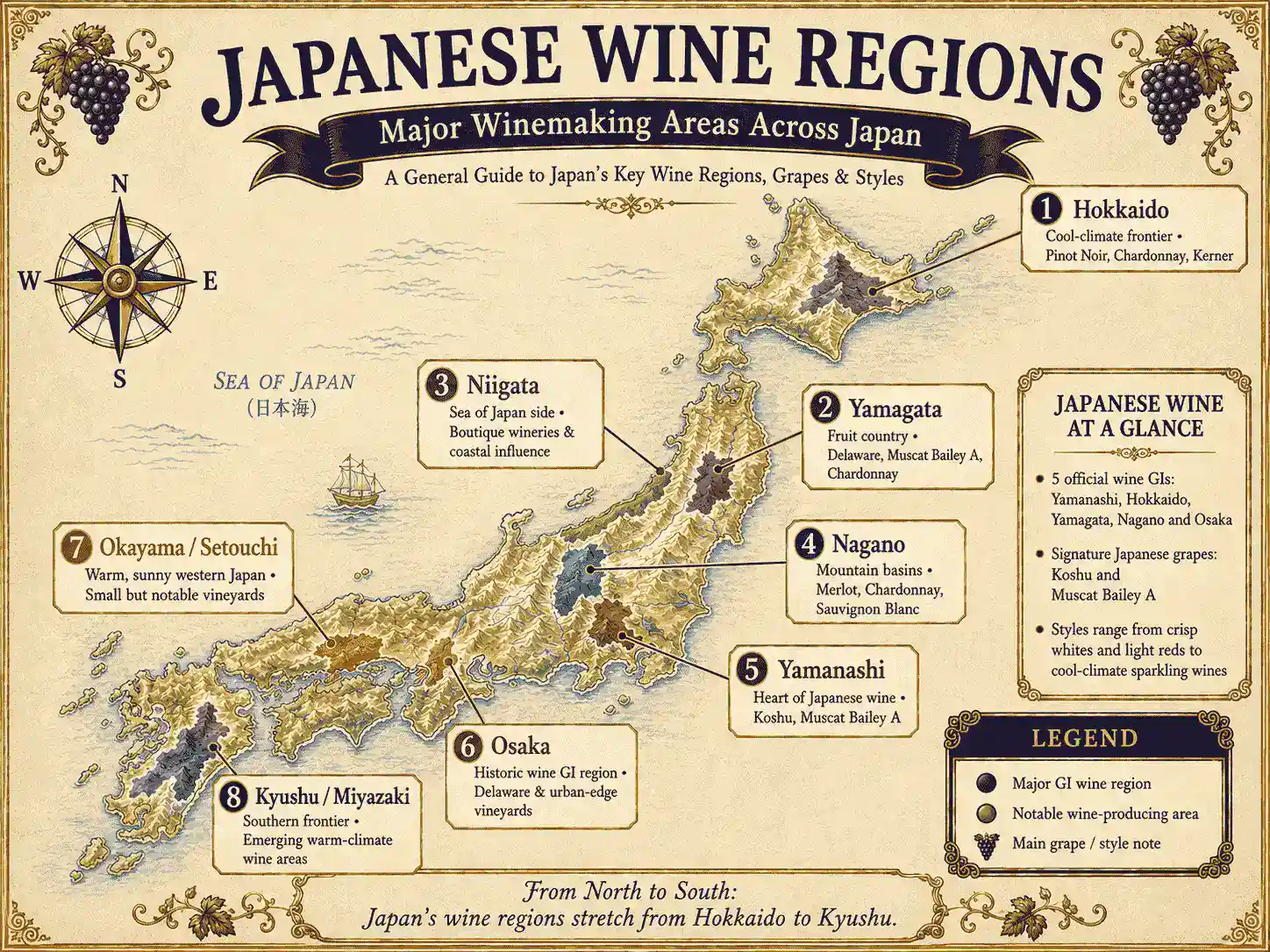
Japan’s wine regions are defined by contrasts. Mountain-ringed basins in Yamanashi, Nagano’s inland valleys, Hokkaido’s northern vineyards, Yamagata’s long-established fruit-growing districts and Osaka’s urban-edge agricultural history have produced different grapes, wine styles and approaches to vineyard management.
Understanding these differences is more useful than ranking regions or assuming that Japanese wine has a single taste. This guide compares where wine is made, how vineyards respond to local conditions, what each region contributes to the country’s winemaking history and what an official geographical indication (GI) means on a wine label.
Winery Tours Japan is based in Yamanashi. Our direct winery experience is concentrated in the Koshu Valley and surrounding Yamanashi wine areas; the broader national comparisons here draw on regional histories and official wine GI specifications, not claims that we operate tours across Japan.
Table of contents
- How to read Japan’s wine map
- Japanese wine regions at a glance
- Yamanashi: Japan’s historic wine center
- Nagano: mountain valleys and European grape varieties
- Hokkaido: cold-climate wine and winter adaptation
- Yamagata: fruit-growing continuity and refreshing acidity
- Osaka and other western and southern wine areas
- Which Japanese wine region should you explore first?
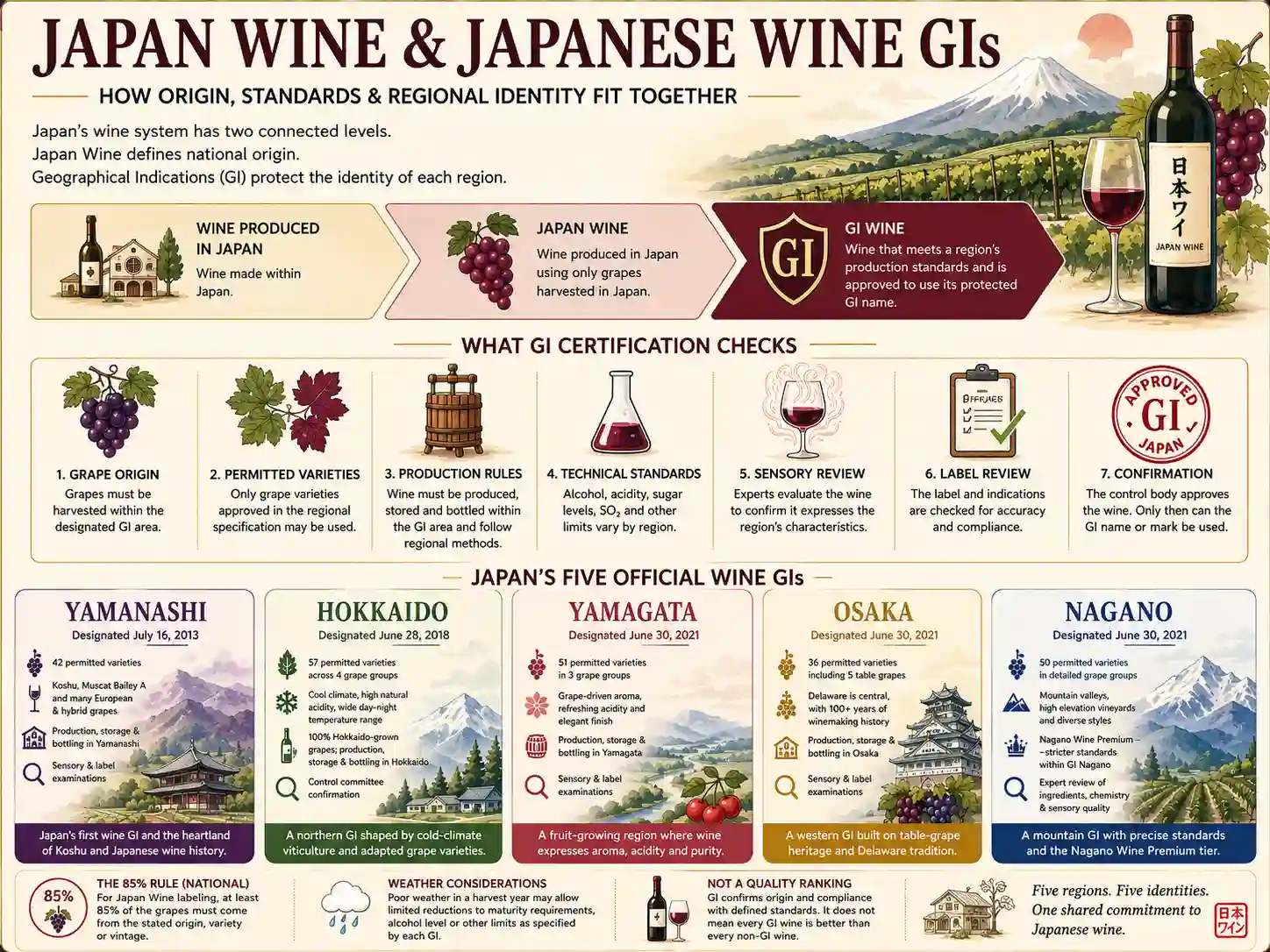
- Japanese wine geographical indications
- A national picture, not one wine style
How to read Japan’s wine map
Look first at geography, then grapes, then local production history. A cool northern coast cannot be judged by the same conditions as a sheltered inland basin. Some areas have a compact concentration of wineries; others are spread across several valleys or districts separated by long drives.
Five prefectures have official wine GIs: Yamanashi, Hokkaido, Yamagata, Osaka and Nagano. That designation protects qualifying regional wines under defined rules; it does not mean these are Japan’s only wine-producing prefectures or that every wine made there is GI-certified. Other producing areas, including parts of Niigata, Okayama and Kyushu, add to the national story.
Japanese wine regions at a glance
| Region | Representative grapes | What distinguishes it |
|---|---|---|
| Yamanashi | Koshu, Muscat Bailey A, Chardonnay, Merlot | Japan’s historic wine center; concentrated wineries around Katsunuma and Enzan |
| Nagano | Merlot, Chardonnay, Sauvignon Blanc, Pinot Noir | Several inland wine valleys and varied vineyard elevations |
| Hokkaido | Pinot Noir, Kerner, Chardonnay, Zweigelt, Yamasachi | Northern growing conditions, winter protection and widely separated districts |
| Yamagata | Delaware, Muscat Bailey A, Chardonnay, Cabernet Sauvignon, yama-budo | Long-established fruit farming, historic wineries and distinctive mountain grapes |
| Osaka | Delaware, Koshu, Muscat Bailey A and other varieties | Table-grape heritage and wine production close to a large urban market |
These are representative associations, not exclusive grape lists. Each region contains differences in soils, exposure, producer decisions and wine styles that cannot be reduced to one prefectural label.
Yamanashi: Japan’s historic wine center
Yamanashi has the deepest continuous association with Japan’s modern commercial wine industry. Nineteenth-century efforts to make wine from locally cultivated grapes developed into an extensive regional network of growers, wineries, research and practical vineyard knowledge. Its position west of Tokyo also makes it one of the more accessible places for visitors to experience Japanese wine at its source.
Much of the industry is associated with the Kofu Basin and, within its eastern reaches, the Koshu Valley around Katsunuma and Enzan. Mountains enclose the basin, while river terraces, alluvial fans, slopes and foothills create differences in drainage, elevation and air movement. Summer rain and humidity still demand careful farming. There is no single soil, altitude or vineyard layout that describes all of Yamanashi.
The Koshu grape produces a broad range of wines, from delicate dry whites to sparkling, skin-contact and barrel-influenced interpretations. Muscat Bailey A remains an important Japanese red variety, typically offering expressive fruit and gentle tannins in lighter styles. Chardonnay, Merlot, Cabernet Sauvignon, Petit Verdot, Yama Sauvignon and other grapes add further variety. The range reflects individual growers and winemakers as much as the regional climate.
Different parts of the prefecture should not be confused. Katsunuma has a visible concentration of established wineries and vineyards, while Enzan’s producers are more dispersed among farms and neighborhoods. Makioka, Fuefuki, western Yamanashi and northern districts such as Hokuto introduce other elevations, vineyard patterns and producer identities. After years of guiding in this area, the contrast in travel distances and winery settings is as meaningful to us as the differences between grapes.
Visitors encounter these differences immediately. A vineyard and winery in Katsunuma may sit close to an established neighbor, while an Enzan or mountain-foot vineyard can require a longer journey. Winery access, tasting arrangements and opening hours also differ by producer. That is why a region with many wineries is not automatically a walkable tasting district, and why grape varieties alone cannot substitute for knowledge of where the grapes grow and how each winery works.
For more detailed local information, see the Yamanashi and Koshu Valley regional guide, the Koshu grape guide and the history of Yamanashi wine.
Nagano: mountain valleys and European grape varieties
Nagano provides a different model from the more concentrated core of Yamanashi. Its vineyards occupy mountain valleys and inland basins that vary considerably in elevation, daily temperature range and exposure. Rather than one continuous wine district, the prefecture is best understood through several producing areas, including Kikyogahara, Chikumagawa, the Japan Alps and Tenryugawa districts.
Kikyogahara is closely associated with Merlot, while other parts of Nagano have developed strong reputations for Chardonnay, Sauvignon Blanc, Pinot Noir, Cabernet Franc and further European varieties. Cooler nights can support acidity as fruit ripens, but altitude alone does not guarantee a particular wine style; site selection and vineyard management still matter.
Older growers, established wineries and smaller projects coexist across those separate districts. The resulting wines may emphasize the expression of a single vineyard, familiar varietal characters or blends suited to local conditions. Distances between areas are substantial, so a trip through Nagano wine country calls for a different approach from visiting a cluster of wineries around Katsunuma.
Merlot is closely associated with Kikyogahara, but Nagano’s wine story extends across districts growing several grape varieties. A visitor comparing its wines should therefore pay attention to the individual valley and vineyard location, not only the prefecture name.
The Nagano wine region guide remains the separate home for its detailed valleys, producers and travel geography.
Hokkaido: cold-climate wine and winter adaptation
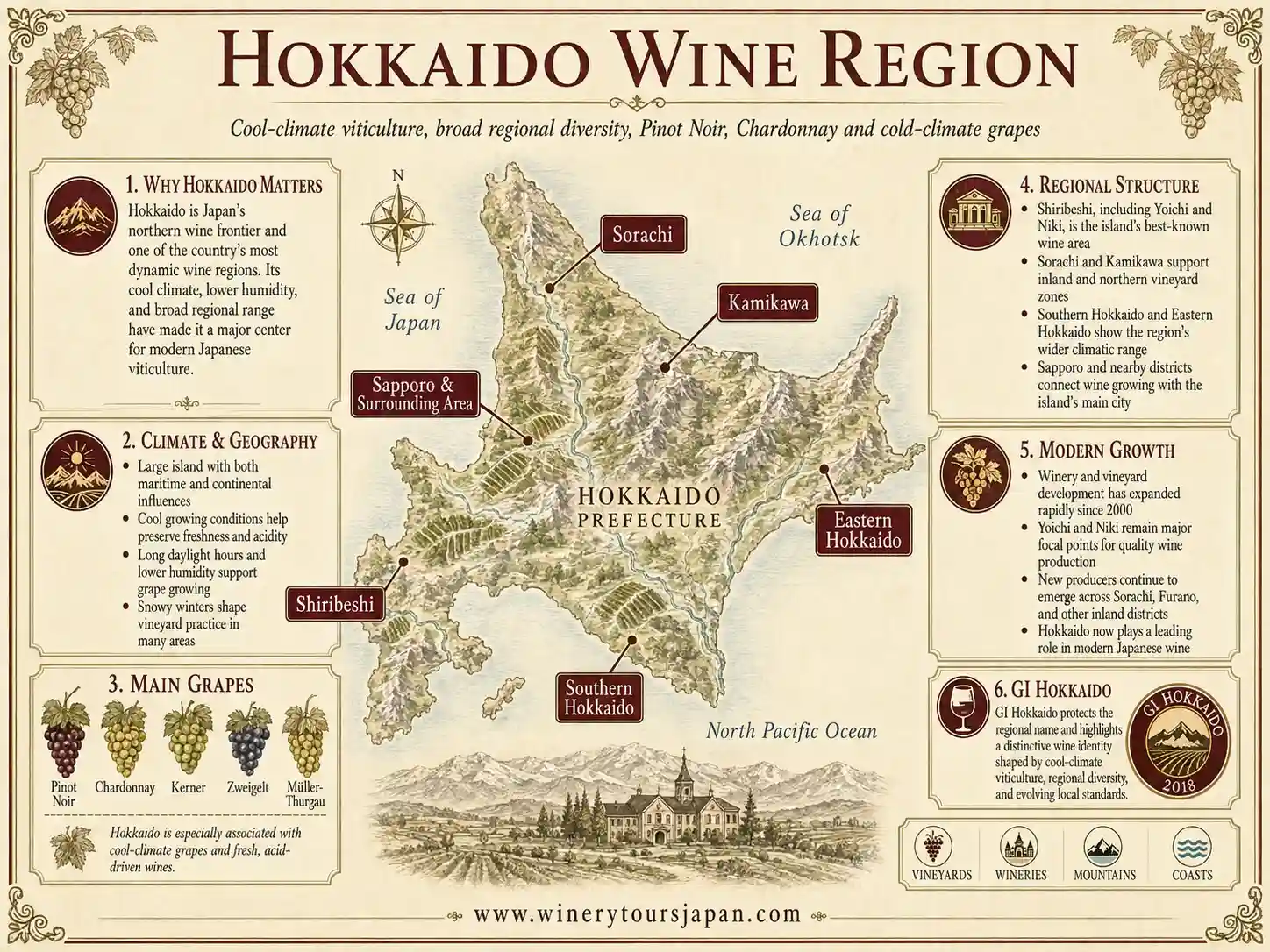
The Hokkaido wine region is Japan’s northernmost major wine-producing area, but its vineyards are far from uniform. The island includes coastal growing districts, heavy-snow inland basins, very cold eastern plains and comparatively moderate southern sites. Differences in winter snow cover, wind, drainage and length of the growing season influence both grape choice and whether a vine can survive outside through winter.
Western Hokkaido: Shiribeshi, particularly Yoichi and Niki, combines an established fruit-growing economy with a newer small-winery movement. Contract growers and estate producers have built on local farming knowledge, with Pinot Noir, Chardonnay, Kerner and other varieties appearing in wines from different coastal and hillside sites. Domaine Takahiko and the 2011 Yoichi wine special-zone designation illustrate the development of small-scale winemaking here; neither implies that every producer offers public tastings.
Inland Hokkaido: Sorachi includes wine areas around Iwamizawa, Mikasa and Urausu, where snowfall and pronounced seasonal contrasts affect vineyard decisions. Kamikawa, including Furano, has a history of municipal wine projects and experiments with cold-adapted grapes, including Furano No. 2. Sapporo and surrounding districts have a more dispersed set of vineyards and a strong role as a market for wines produced elsewhere on the island.
Eastern and southern Hokkaido: Tokachi includes Ikeda’s municipal wine-research tradition, with varieties selected or bred for cold conditions. Kiyomi and Yamasachi are important examples; Yamasachi has an identity distinct from international varieties such as Pinot Noir. Around Hakodate and other southern sites, maritime conditions and newer investment have supported plantings of Chardonnay and Pinot Noir, including the de Montille & Hokkaido project.
Winter protection helps explain these differences. In some snowy districts, growers lower canes toward the ground to take advantage of insulating snow. In areas where extreme cold is not matched by reliable snow cover, soil protection or other methods may be necessary. There is no single technique that works everywhere on the island.
Pinot Noir is a prominent modern red grape, but established varieties such as Zweigelt and cold-adapted local grapes remain significant. Kerner is important among whites, alongside Chardonnay and other European grapes. Hokkaido produces still, sparkling, rosé and sweet wines; acidity is often notable, but the region should not be reduced to one high-acid wine style. Wine projects around Sapporo began during the early Meiji period, while Ikeda’s work in the 1960s helped create a basis for later expansion. Official GI Hokkaido recognition came in 2018. As of February 2026, the prefecture reported 75 wineries, a dated illustration of rapid growth rather than a permanent count.
The Tokachi story helps show why regional grape names matter. Kiyomi was selected through work with cold-resistant vine material, and Yamasachi was developed using Kiyomi and a hardier vine parent. Yamasachi received international OIV variety registration in 2020. Further trials in Furano and elsewhere produced varieties adapted to specific northern conditions, including Kiyomai. Meanwhile, small grower-winemakers have expanded the range of producers in Yoichi and other districts. The growth of independent wineries does not make public tasting available at every property; visits depend on the producer and season.
Yamagata: fruit-growing continuity and refreshing acidity
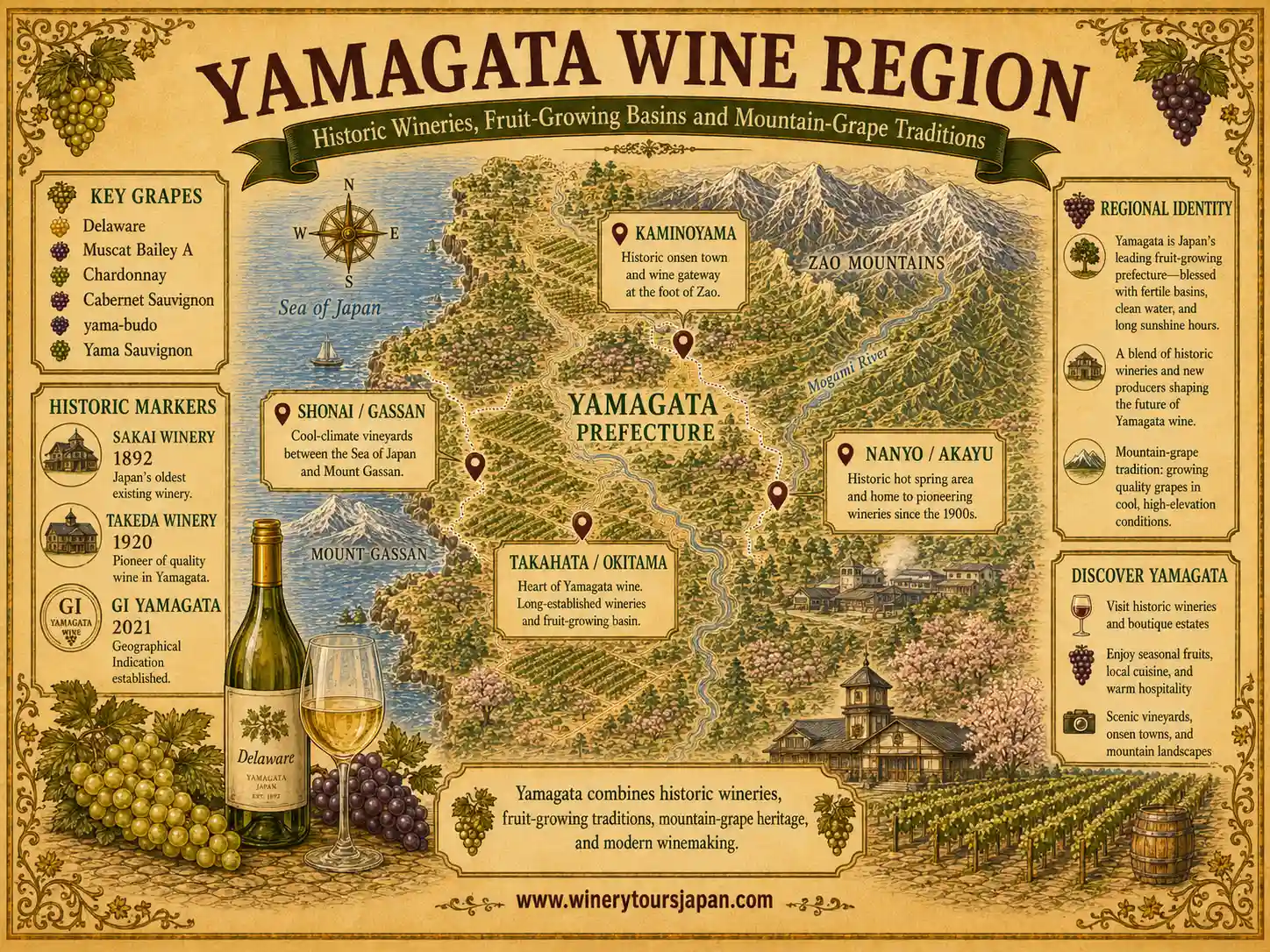
The Yamagata wine region developed from a broader tradition of fruit and grape farming. The prefecture’s inland basins and the Mogami River system connect vineyards with communities better known internationally for their orchards. Wine production has developed alongside that agriculture rather than replacing it, with both long-established wineries and newer small producers contributing to the region.
Southern Okitama is central to the wine story. Nanyo and Akayu have a particularly long association with Delaware grapes and regional winemaking; Takahata adds another established southern district. Murayama, including Kaminoyama, combines historical vineyards with more recent plantings. Shonai, Tsuruoka and the Gassan area offer a different mountain and coastal-influenced setting, including traditions of cultivating Japanese mountain grapes. These subregions do not share identical growing conditions.
Yamagata has some of Tohoku’s oldest wineries. Sakai Winery began making wine in Akayu in 1892, while Takeda Winery’s history in Kaminoyama dates to 1920. Older local accounts also describe Koshu vines in Akayu long before commercial production; the exact route by which those vines arrived should not be treated as settled fact. Through different phases of Japanese wine history, farming knowledge developed around table grapes, sweeter wines and later dry-wine production.
Delaware remains important for both agriculture and winemaking, including dry, sweet and sparkling interpretations. Muscat Bailey A and Niagara continue to represent long-established grape choices. Chardonnay, Cabernet Sauvignon and Merlot demonstrate the growing importance of European varieties, but suitability depends on the vineyard rather than on a blanket claim about the prefecture.
Yama-budo is a native mountain grape with a long Tohoku association. Yama Sauvignon is different: it was developed at the University of Yamanashi from a 1978 cross involving yama-budo and Cabernet Sauvignon, registered as a new variety in 1990, and has also been cultivated in Yamagata, including the Gassan area. Its relationship to mountain-grape traditions helps distinguish Yamagata from the Pinot Noir focus often associated with Hokkaido. Pergola-trained grapes, vertical trellises and local winter-protection practices further reflect Yamagata’s mix of established and newer viticulture.
These training choices have practical roots. Overhead pergolas remain familiar in Delaware and other fruit-grape vineyards, while vertical trellises are used in many newer wine-grape plantings. Sites facing winter snow, summer moisture or disease pressure require different approaches. Early vineyard setbacks, including phylloxera, also shaped the region’s reliance on adapted planting material and its long experience with American grape varieties.
Yamagata wineries range from long-established producers to newer projects such as Takahata Winery, Gassan Wine, Grape Republic and Yellow Magic, reflecting different generations of regional activity. Local wine-zone measures introduced in 2016 also made small-scale licensing more accessible in parts of the prefecture. Yamagata received wine GI status in 2021; the protected regional standards and permitted varieties are explained in the GI section below, rather than duplicated here.
Osaka and other western and southern wine areas
Osaka belongs in a national guide even though it is less often featured in international wine-travel discussions. Grape cultivation around Kawachi, on the foothills east and southeast of the Osaka Plain, helped create a local table-grape economy that also supported winemaking. Delaware became especially important; Koshu, Muscat Bailey A and international varieties broaden the mix.
Osaka differs from the mountain and northern prefectures because vineyards developed next to a large urban market. Its official wine GI recognizes a history in which table-grape experience and wine production overlap. The prefecture should neither be treated as an afterthought nor given the same vineyard geography as Yamanashi.
Wine is also made beyond the five wine-GI prefectures. Niigata, Okayama, the Seto Inland Sea area and parts of Kyushu have wineries and their own local traditions, but they are not additional national wine GIs. Readers planning winery visits in Yamanashi can explore the Yamanashi winery guide.
Which Japanese wine region should you explore first?
Choose Yamanashi for Japan’s foundational wine history, Koshu, Muscat Bailey A and a relatively concentrated group of accessible wineries. Nagano appeals to visitors interested in mountain valleys, Merlot and European grape varieties. Hokkaido offers contrasting northern districts and technical adaptations to cold winters. Yamagata brings older fruit-growing and winery traditions together with Delaware and mountain-grape wines. Osaka adds a western, city-adjacent perspective.
The most useful choice depends on whether the aim is winery travel, grape history, regional styles or wine-label education. Winery Tours Japan offers private guided wine tours in Yamanashi, where we work locally in the Katsunuma and Enzan area. The other regions on this page are destinations to understand and explore independently, not standard WTJ tour routes.
Japanese wine geographical indications
Japan Wine and GI are different categories. “Japan Wine” means wine produced in Japan from grapes harvested in Japan. A bottle produced domestically using imported grape material does not qualify for that specific origin category merely because it was bottled in Japan. A wine GI goes further: it protects a regional name and requires the wine to meet the specification for that geographical area.
Japan’s national labeling rules allow a geographical grape-origin statement under defined conditions, including a general 85% threshold. That must not be confused with the regional GI rules: a GI wine must satisfy its own tighter grape-origin, permitted-variety, production and verification requirements. A producer’s address, grape name, stated growing area and protected GI name are separate facts that a label may communicate. For grape variety and vintage statements, national Japan Wine rules generally also apply an 85% threshold to the specified variety or harvest year; this is separate from eligibility for a regional GI.
For example, a winery operating in Yamanashi can make wine from grapes grown outside the prefecture, but that does not make the wine eligible to display GI Yamanashi. Conversely, a bottle made from Japanese-grown grapes may correctly qualify as Japan Wine without having any GI designation. The meaningful distinction is proven origin and production compliance, not a hierarchy in which a wine without a GI is automatically inferior.
What qualifies for a GI? The grapes must come from the designated area and must be varieties approved under the applicable specification. The wine must be produced under the region’s defined rules, which can also address grape maturity, permitted additions, storage, bottling and technical characteristics. A regional control body checks conformity before the protected name may be used. The details differ among prefectures; not every wine produced in a GI region qualifies automatically.
| Wine GI | Designation | Distinctive context |
|---|---|---|
| Yamanashi | 16 July 2013 | First Japanese wine GI; Koshu, Muscat Bailey A and longstanding wine production |
| Hokkaido | 28 June 2018 | Northern viticulture, adapted varieties and cold-climate identity |
| Yamagata | 30 June 2021 | Fruit-growing heritage and a range of grapes associated with fresh acidity |
| Osaka | 30 June 2021 | Delaware and the region’s historic table-grape-to-wine connection |
| Nagano | 30 June 2021 | Detailed variety rules and a stricter Nagano Wine Premium indication |
Why the five standards differ: Yamanashi recognizes its established grapes, including Koshu, alongside European and Japanese varieties. Hokkaido’s rules reflect vinifera grapes, American-derived grapes, cold-adapted hybrids and native-vine traditions. Yamagata’s GI permits 51 listed grape varieties, including Delaware, Muscat Bailey A, Chardonnay, Cabernet Sauvignon, Yama Sauvignon and others. Osaka’s specification reflects an unusually important Delaware tradition. Nagano’s detailed categories distinguish different grape groups; its Wine Premium indication is a stricter level within GI Nagano, not a sixth geographical indication.
Reading a bottle: First check whether it says Japan Wine. Then identify the grape origin, variety and vintage, and look for a GI name if one is claimed. For example, Koshu is a grape name, Katsunuma is a place and GI Yamanashi is a protected regional designation: those labels should not be treated as interchangeable. GI is evidence of compliance with regional standards, not a guarantee that every certified bottle is superior to every non-GI wine.
A GI does not by itself certify a winery as historic, family-owned, organic or open to the public. Nor does it imply that all wines from one prefecture should share identical aromas. The geographical name is supported by an agreed production standard and regional verification; the final wine still reflects the grape, harvest year, site and decisions of its maker.
A national picture, not one wine style
Japanese wine is better understood as several regional traditions sharing a national framework. Yamanashi provides historical depth and close engagement with Koshu; Nagano shows the diversity of mountain valleys; Hokkaido demonstrates cold-weather vineyard ingenuity; Yamagata preserves the link between fruit farming, historic wineries and mountain grapes; Osaka introduces an urban-edge wine history with deep table-grape roots.
Each region brings a different perspective to Japanese wine, from grapes and climate to agricultural history and protected origin. For winery visits, the location and the individual producer matter just as much as the prefecture shown on a map.