


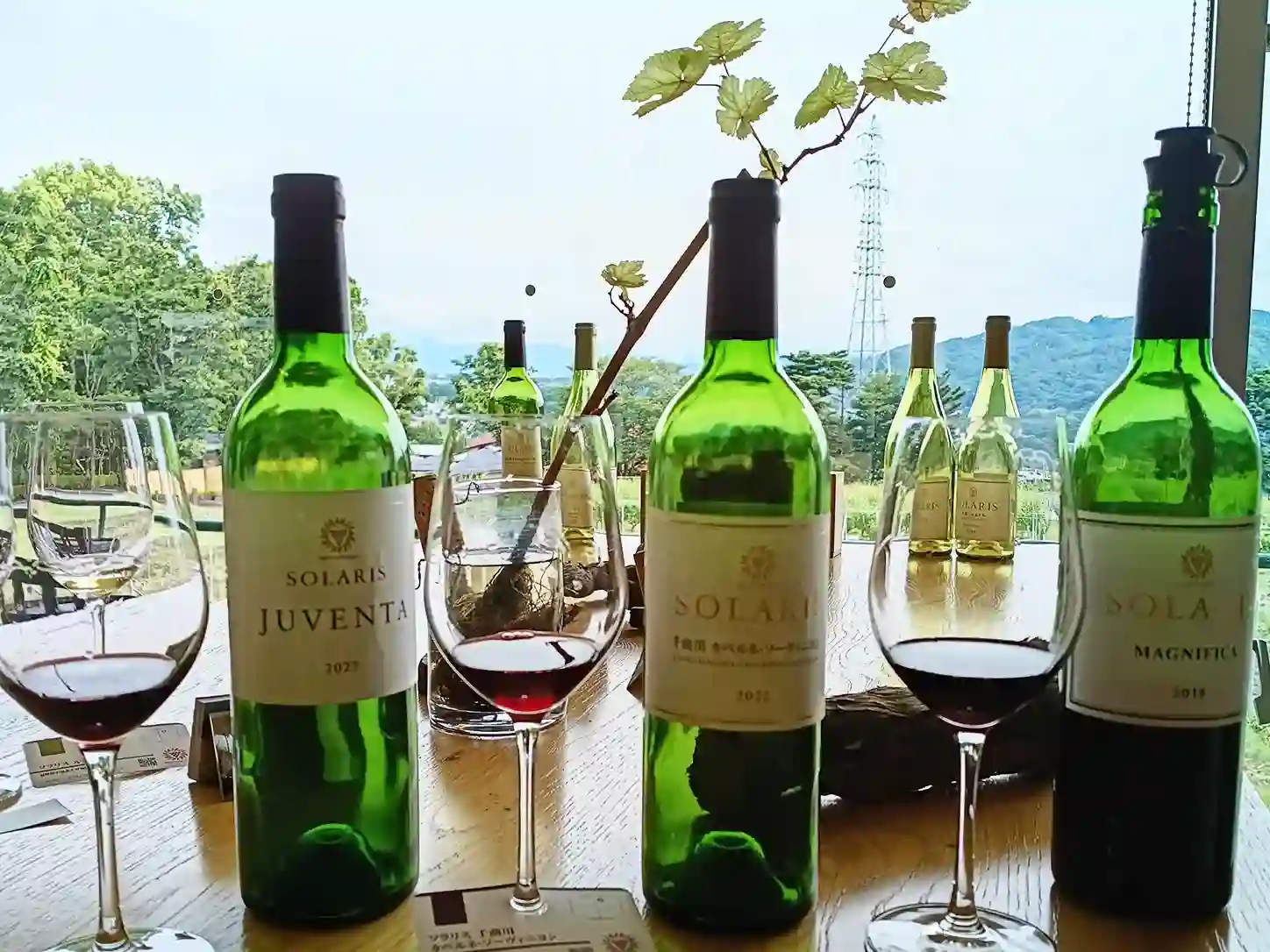
Tasting Manns SOLARIS Japanese wines.
You can taste Japanese wine in Tokyo, at restaurants and wine bars in other major cities, at specialist wine shops, at producer events, or by traveling into one of Japan’s wine-producing regions.
I spent about 20 years living in Tokyo and have enjoyed wine in many different settings around the city. I now live in Yamanashi and guide guests through the wineries of the Koshu Valley. Tokyo is convenient if you simply want to try Japanese wine, but if wine is an important part of your trip and you have a full day, I recommend coming to Yamanashi.
Here you can compare producers in the region where the wine is made and experience the wineries, countryside and local setting together. For me, that connection between the wine and the place is what makes the experience different from simply ordering a Japanese bottle in a city restaurant or wine bar.
This guide explains the main ways to taste Japanese wine in Japan and why Yamanashi is the option I recommend for travelers who want more than a city introduction.
Where Can You Taste Japanese Wine in Japan?
Japanese wine is available in more places than many visitors expect. You do not need to visit a winery just to try it, and you do not need a full day outside a major city.
| Where to taste | Useful when | What to expect |
|---|---|---|
| Wine bar | You have an evening or a few free hours | Japanese wines by the glass or bottle, sometimes from several regions |
| Restaurant | You want Japanese wine with a meal | A smaller selection chosen to work with the restaurant’s food |
| Wine shop or department store | You want to browse bottles or buy wine | Regional and producer selections vary, and occasional tastings may be available |
| Producer or wine event | Your travel dates match an event | A chance to encounter several producers without traveling into wine country |
| Winery or wine region | You have a full day and Japanese wine matters to your trip | The wines can be experienced alongside the producers and region where they are made |
City venues are convenient and can provide a useful introduction. A wine-region visit adds the producers, wineries and local setting behind the wines, which is why I recommend Yamanashi when time allows.
Tasting Japanese Wine in Tokyo
Tokyo is the easiest starting point for many international visitors. Japanese wine can be found in restaurants, hotel lounges, dedicated wine bars, specialist shops and some department-store wine sections. Depending on the venue, you may find Koshu, Muscat Bailey A, sparkling wine and wines made from international grape varieties.
During the years I lived in Tokyo, I drank wine in everything from larger hotel lounges and restaurants to small neighborhood bars. Wine is easy to find in the city, but large selections are usually dominated by imported wine. Good Japanese wine is available, although the depth of the Japanese selection depends very much on the individual venue.
If you have only an evening available, tasting in Tokyo makes sense. You can enjoy Japanese wine with dinner, order something by the glass or bottle, or spend an evening trying several wines without changing your travel plans.
I have also met guests who first encountered Japanese wine in a Tokyo hotel or restaurant, became curious about it, and then decided they wanted to visit Yamanashi to understand where the wine came from.
For actual Tokyo venues and more detail about my experience drinking wine in the city, see Wine Tasting in Tokyo and Near Tokyo.
What Changes When You Taste Wine in Yamanashi?
The biggest difference is context.
In Tokyo, the wine reaches you after it has left the producer. In Yamanashi, you can taste at the wineries themselves and see more of the region where those wines were made.
You begin to notice the scale of each producer, the tasting space, the surrounding agriculture, the landscape and the differences between wineries that may be located relatively close to one another.
That does not mean every winery visit includes a vineyard walk, cellar tour or conversation with a winemaker. Wineries are working businesses, and access depends on the producer, staffing and what is happening that day. I do not promise those experiences unless they have actually been arranged.
What you do gain is the opportunity to compare wines while remaining inside the region that produced them.
Two wineries in Yamanashi may approach Koshu very differently. One may make a light, clean stainless-steel version while another uses oak. The same is true with Muscat Bailey A. A bright, fruit-forward wine and an oak-aged version can leave very different impressions even though they come from the same broad region.
That kind of comparison is much more useful to me than simply counting how many wines we can taste. The grape is only part of the story. The producer and its winemaking decisions change what eventually ends up in the glass.
For a closer look at how winery tastings actually differ in Yamanashi, see Japanese Winery Tasting in Yamanashi.
Why Yamanashi Works Well From Tokyo
Yamanashi is where I live and guide, so it is naturally the Japanese wine region I know most closely. The Koshu Valley includes long-established producers, family-run wineries, vineyards, orchards and towns such as Katsunuma and Enzan, with other wineries spread through surrounding parts of the prefecture.
For travelers staying in Tokyo, one major practical advantage is access. Limited Express trains connect Shinjuku with Kofu in around 90 minutes, depending on the service. That makes it realistic to leave Tokyo in the morning, spend a full day in Yamanashi and return to the city afterward.
The wineries themselves are not arranged along one convenient pedestrian street. They are spread through a working agricultural region, and opening days, reservations and tasting arrangements vary between producers.
This is one reason I do not describe Yamanashi as a simple wine village where you arrive at one station and casually walk between wineries all day. Planning matters if you want to visit several producers.
For the geography, transportation realities and character of the area, see my Koshu Valley wine-country guide.
What I Look for When Tasting at Yamanashi Wineries
When I taste with guests, I am more interested in useful contrasts than in trying to accumulate samples.
Koshu is a good example. I personally enjoy stainless-steel Koshu because I feel it can show the grape very clearly. But tasting it beside an oak-influenced Koshu immediately shows how much the winemaking approach can change the result.
The same comparison works with Muscat Bailey A. A lighter stainless-steel version can show a bright, fresh side of the grape, while an oak-aged version may feel quite different.
Other wines can broaden the comparison further. Depending on the producers and what is available, you may encounter sparkling Koshu, Chardonnay, Merlot, Japanese-bred red varieties and smaller-production wines that are not always easy to find in city restaurants or shops.
Different winery sizes also contribute to the experience. A larger established producer and a small family-run winery can have very different tasting rooms, production styles and histories.
This is why visiting several wineries can reveal much more about Japanese wine than tasting isolated bottles without the producer context.
For producers I know and visit in the region, see Yamanashi Wineries to Visit.
Japanese Wine Is More Than Yamanashi
Yamanashi is not Japan’s only wine region. Nagano, Hokkaido and Yamagata all have their own growing conditions, grape varieties, producers and regional character.
If your itinerary already takes you to one of those regions, tasting wine there can be a natural part of the trip. Someone spending significant time in Hokkaido, for example, does not need to travel across the country simply because Yamanashi is more convenient for visitors based in Tokyo.
My recommendation of Yamanashi is based on two things: it is the region I know most deeply from first-hand experience, and it is especially practical for travelers staying in Tokyo who want to spend a full day in Japanese wine country.
For the wider national picture, see the Japanese Wine Regions guide.
Why I Recommend Yamanashi When Japanese Wine Matters to Your Trip
If you have only an evening or a few free hours, tasting Japanese wine in Tokyo makes sense. But if Japanese wine is an important part of your trip and you have a full day available, I recommend going into Yamanashi wine country.
In Yamanashi, you can compare several producers while seeing the agricultural landscape and winery settings behind the wines. The experience is not simply about tasting more wine. It is about understanding how different producers approach the grapes and seeing the region where those wines are made.
Yamanashi is particularly worthwhile when:
- You have a full day available from Tokyo.
- You want to compare several Japanese wineries rather than individual bottles selected by one city venue.
- You are interested in the landscape, agriculture and people behind the wine.
- You want to understand how different producers approach the same grapes.
- You want the winery and regional context that a city bar or restaurant cannot reproduce.
For travelers staying in Tokyo, the practical advantage is that Kofu is around 90 minutes from Shinjuku by Limited Express. That makes a full day in Yamanashi realistic without needing to change hotels.
Independent Winery Visits or a Guided Day?
Independent winery visits can work well if you are comfortable researching opening days, reservations and transportation and you only want to visit one or two producers.
For a day involving several wineries, the main difficulty is geography. The producers are spread across the region rather than concentrated around one convenient station or street.
My role on Winery Tours Japan tours is not simply to move guests between wineries. As a Bilingual English-Speaking Local Guide, I help explain what we are tasting, interpret when useful and give context to the differences between producers, grape varieties and styles.
I do not guarantee winery-owner or winemaker meetings, cellar access or specific bottles because all of those depend on the producer and what is happening on the day.
For visitors who want the organized private option, the current inclusions, meeting arrangements and booking information are on the Private Yamanashi Wine Tour from Tokyo page rather than repeated here.
So, Where Should You Taste Japanese Wine in Japan?
If your goal is simply to try a glass of Japanese wine, Tokyo is convenient. You can enjoy a Japanese wine with dinner or visit a wine bar without restructuring your itinerary.
If you want to understand Japanese wine through its wineries, producers and local setting, I recommend making the trip into Yamanashi wine country.
After living in Tokyo for about 20 years and now guiding in Yamanashi, that is the distinction I see from my own experience: Tokyo can introduce you to Japanese wine; Yamanashi lets you experience it closer to its source.