


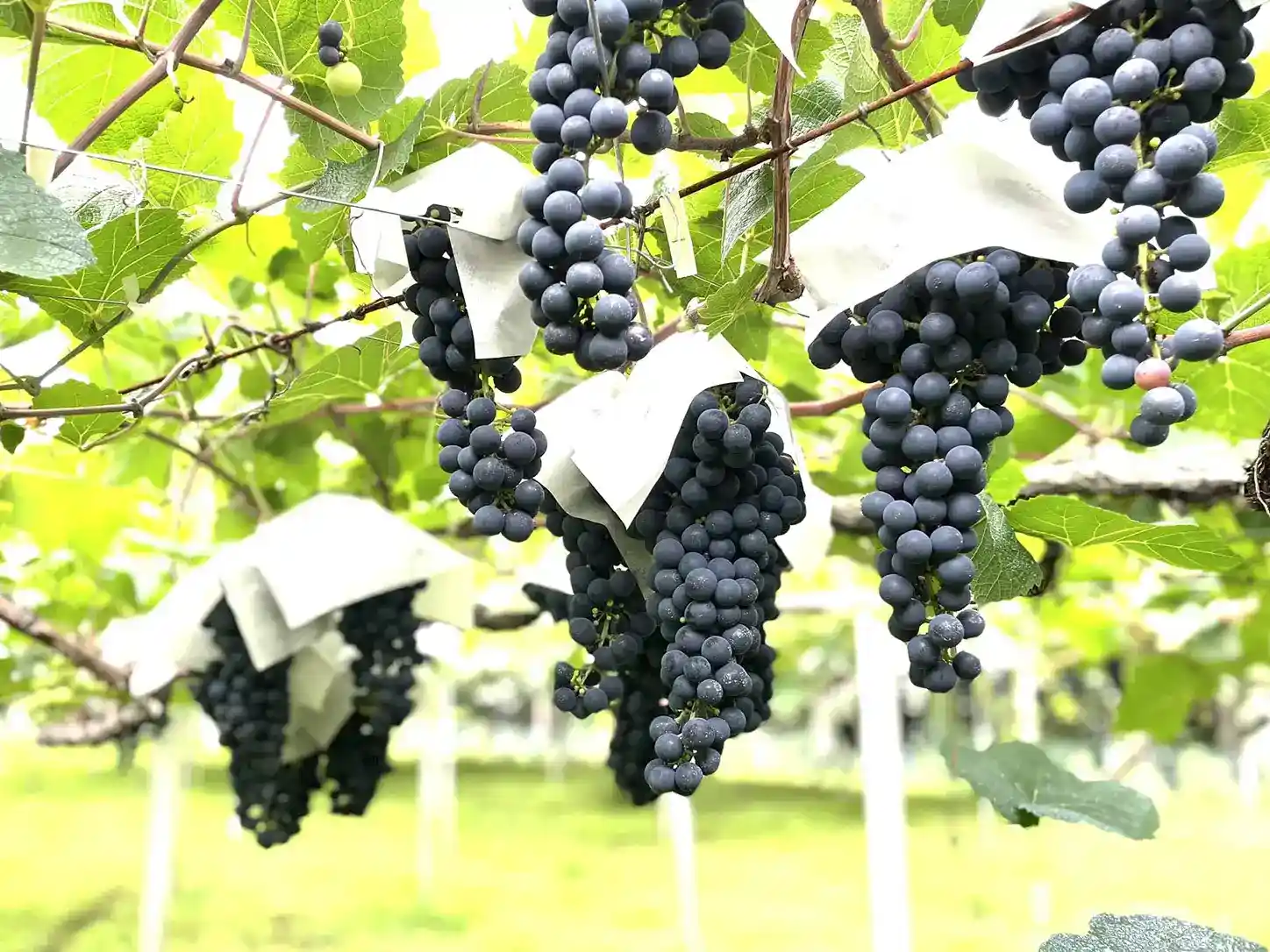
Muscat Bailey A grapes nearing harvest in Yamanashi, protected with individual paper covers beneath the vineyard trellis.
The best time to visit Yamanashi wine country depends on what you want to see and experience. After living and guiding in the Koshu Valley for many years, I do not think there is one perfect month for everyone. The vineyards, weather, winery schedules and mountain views change constantly through the year, and each season has its own advantages.
If I had to choose my favorite period overall, I would pick October and November. The weather is usually cooler, the countryside begins to change color, and there is still a strong harvest-season feeling in the valley. Spring, especially March through early May, is another very good time. Summer is beautifully green but can be hot, humid and rainy, while winter offers bare vineyards, quiet roads and some of the clearest mountain views of the year.
No season guarantees particular weather, vineyard access or winery experiences. Harvest dates change with the grape variety, vineyard and weather, and individual winery schedules can change at short notice. For transportation, reservations and general route planning, see the separate Koshu Valley wine travel guide.
Table of contents
- Yamanashi Vineyards Month by Month
- Spring: March to May
- Summer: June to August
- Autumn: September to November
- Winter: December to February
- When Does Harvest Take Place?
- How Rain and Weather Shape the Vineyard
- How Season Affects Winery Access
- When Is Mount Fuji Easiest to See?
- Which Season Would I Choose?
Yamanashi Vineyards Month by Month
One of the biggest differences between seasons is simply what the vineyards look like. Visitors sometimes arrive expecting green vines and visible grapes at any time of year, but the landscape changes much more than that.
| Period | What I normally see in the vineyards | What it means for visitors |
|---|---|---|
| January–February | Bare, dormant vines | Quiet countryside, cold weather and often clear winter skies |
| March | Mostly bare vines; growth has not fully restarted | Early spring atmosphere, with cool mornings still common |
| April | Buds begin to appear as the weather warms | Cherry blossom season can overlap with the beginning of vineyard growth |
| May–June | Shoots and leaves develop quickly | The valley becomes noticeably greener from week to week |
| July–August | Dense green growth and clearly visible grape clusters | Classic green vineyard scenery, but also heat, humidity and rain |
| Late August–September | Ripening grapes and the main harvest period for many vineyards | The strongest sense of active wine production, although winery staff may be very busy |
| October–November | Harvest winding down or complete, changing leaves and gradually quieter vineyards | Cooler weather, autumn color and a lingering harvest-season atmosphere |
| Late November–December | Leaves fall and the vines become bare again | Transition into the quiet winter landscape |
These are practical observations rather than fixed agricultural dates. A warm spring, prolonged rain, extreme summer heat or a late typhoon can move the vineyard calendar forward or backward.
Spring: March to May
March can still feel more like the end of winter in the vineyards. Many vines remain bare, mornings can be cold, and an occasional frost or even late snow is possible. By April, warmer days begin to wake the vineyards up. Buds appear, shoots begin to develop and the landscape starts changing quickly.
Cherry blossom season is one of the nicest times to be in Yamanashi. Some wineries have sakura trees on or near their grounds, and the combination of blossoms, warming weather and often-clear spring skies gives the valley a very different atmosphere from harvest season. Blossom timing changes every year, so I never promise that a particular date will coincide with peak flowering.
May is when the vineyards begin to look properly alive again. Leaves expand, shoots lengthen and the rows become progressively greener. For visitors who want comfortable weather without summer heat, late March, April and early May are among the periods I most often recommend.
Summer: June to August
By June, the vines are growing strongly. Leaves fill out the rows and the buds and developing fruit become much easier to see. During July and August, grape clusters are clearly visible and the vineyards are at their greenest.
This is beautiful wine-country scenery, but summer in the Koshu Valley can be very hot and humid. June and part of July also overlap with Japan’s first rainy season. A rainy day does not mean the wine day is lost—we simply work around the weather, adjust the order of stops when needed and spend less time standing outside when conditions are uncomfortable.
Summer haze and cloud can also reduce mountain visibility. If seeing Mount Fuji is an important part of the day, winter and some spring or autumn mornings are usually more favorable than humid midsummer conditions.
Autumn: September to November
Autumn is my favorite overall period in Yamanashi wine country. Late August can bring the beginning of harvest, but September is when much of the work happens. Depending on the grape and the year, harvesting can continue into early October. By October and November the weather is usually cooler, autumn colors develop across the valley and there is still a strong sense of the agricultural year coming to completion.
One of the things visitors often do not realize is that Yamanashi’s wine-grape harvest overlaps with its table-grape season. Roadside grape stands are plentiful at this time of year. When the timing and route work, I like to make an unplanned stop, let guests taste local table grapes, meet the people selling them and sometimes pick up a few bunches for the group. Those spontaneous encounters are often as memorable as the scheduled parts of the day.
Autumn does require realistic expectations. Harvest is work. A winery that is normally easy to visit may suddenly have staff occupied with picking, sorting, pressing or cellar work. Being in wine country during harvest does not automatically mean more access to production areas or winemakers.
Winter: December to February
Winter is completely different. The vines are bare, the fields are quiet and the structure of the vineyards becomes easier to see. December, January and February are cold, but daytime weather is often sunny with clear blue skies.
Those clear winter conditions can produce some of the best mountain views of the year. It is also a comfortable season for visitors who are more interested in tasting wine, talking with producers and enjoying lunch than walking through green vineyards.
The main planning issue is Japan’s year-end and New Year holiday period. Many wineries close for several days around the last week of December and the first week of January. Some close for about a week; others close for a shorter period. The exact schedule varies by producer, so these dates require more careful advance checking than an ordinary winter week.
When Does Harvest Take Place?
There is no single Yamanashi harvest date. In a typical year, I begin seeing wine-grape harvesting from late August, with a large amount of the work taking place during September. Some grapes remain on the vines into late September or early October.
Weather is one of the biggest reasons the dates change. Late-season rain and typhoons create a difficult decision for growers. If heavy rain is coming, waiting longer can become risky. If the forecast remains dry, some grapes can stay on the vine longer and continue ripening.
That was particularly noticeable in 2025. From what I observed in Yamanashi, the second rainy and typhoon period was milder and drier than it can be. Some growers were able to leave grapes on the vine longer instead of rushing to pick before heavy rain. That extra time can help fruit accumulate more sugar, whereas too much water close to harvest can swell the berries and dilute sugar concentration.
This is why I never tell visitors that “September means you will see harvest.” The general season is predictable; the exact day is not.
How Rain and Weather Shape the Vineyard
Growing grapes in Yamanashi means dealing with a combination of heat, humidity, rain, strong sunlight, typhoons and occasional spring frost. Even early spring snow is possible. The vineyards are not simply waiting for good weather; growers constantly manage around these conditions.
One system I often point out is Manns Rain Cut. In vineyards using a traditional vertical trellising system, a plastic sheet is supported by a steel frame above an entire row of grapes. It helps protect the fruit from excessive rain and also from intense sunlight. Manns uses and shares this approach with other vineyards working with the same type of row system.
In vineyards using overhead trellising, another familiar sight is individual grape bunches wrapped in paper. Each bunch has to be covered by hand and the protection removed again at harvest. It is labor-intensive work, but it shows how much hands-on care can go into protecting fruit through Yamanashi’s humid growing season.
Koshu and Muscat Bailey A are deeply established in the region, and vineyard practices have developed around the valley’s different microclimates. Heat, rainfall and moisture are not occasional problems here; they are part of the environment growers work with every year.
How Season Affects Winery Access
For most of the year, winery access in Yamanashi is workable with advance planning. The bigger changes are usually caused by production schedules, private events, staff availability and national holidays rather than by the season alone.
- Harvest: staff may be busy in the vineyard, winery or cellar, so production-area access and meetings can become more difficult.
- Rainy or typhoon periods: the route may need to change, and outdoor vineyard time can be shortened.
- Summer heat: long outdoor stops may be uncomfortable, so the day works better with shorter vineyard viewing and more time inside tasting rooms.
- Year-end/New Year: this is the most predictable closure period, with many wineries taking several days off around late December and early January.
A winery being open also does not necessarily mean that every tasting, tour, cellar visit or staff meeting is available. The Yamanashi wineries guide explains the different visitor styles of individual producers.
When Is Mount Fuji Easiest to See?
Mount Fuji is never guaranteed from the Koshu Valley. In my experience, the best chance is usually on a clear morning before cloud or haze builds. Winter is particularly good for clear blue skies, and spring and autumn can also provide excellent mornings.
There are only a limited number of places where Fuji is visible from the valley itself. The Enzan side gives the more useful Fuji viewpoints on the routes I use. Around Katsunuma, the broader mountain scenery is more often toward the Minami Alps. Occasionally an evening view of Fuji can also be very good, but morning remains the more reliable time to look.
Which Season Would I Choose?
If someone asks me for the best overall time, I usually say October and November. The heat has eased, autumn colors are developing, the countryside still feels connected to harvest and it is simply a comfortable time to move around the valley.
My next choice would be March, April and early May. Spring brings cherry blossoms, fresh vineyard growth, cooler temperatures and often clear skies. It is a very different experience from autumn, but equally enjoyable.
June and July are beautiful because the vineyards are intensely green, but visitors should be prepared for rain, humidity and heat. Winter is underrated if green vines are not essential: the vineyards are bare, but the atmosphere is quiet and clear-weather mountain views can be excellent.
Every season brings its own challenges to the vineyard—rain, humidity, heat, frost, snow, typhoons—and that is part of what makes wine country interesting. There is no month when everything is perfect. The better question is what you most want to see.
For general eligibility, meeting and booking information, see the Winery Tours Japan FAQs. If you are planning a private day in Yamanashi, the private one-day Yamanashi wine tour is arranged around the travel date, current winery availability and the interests of the group.