


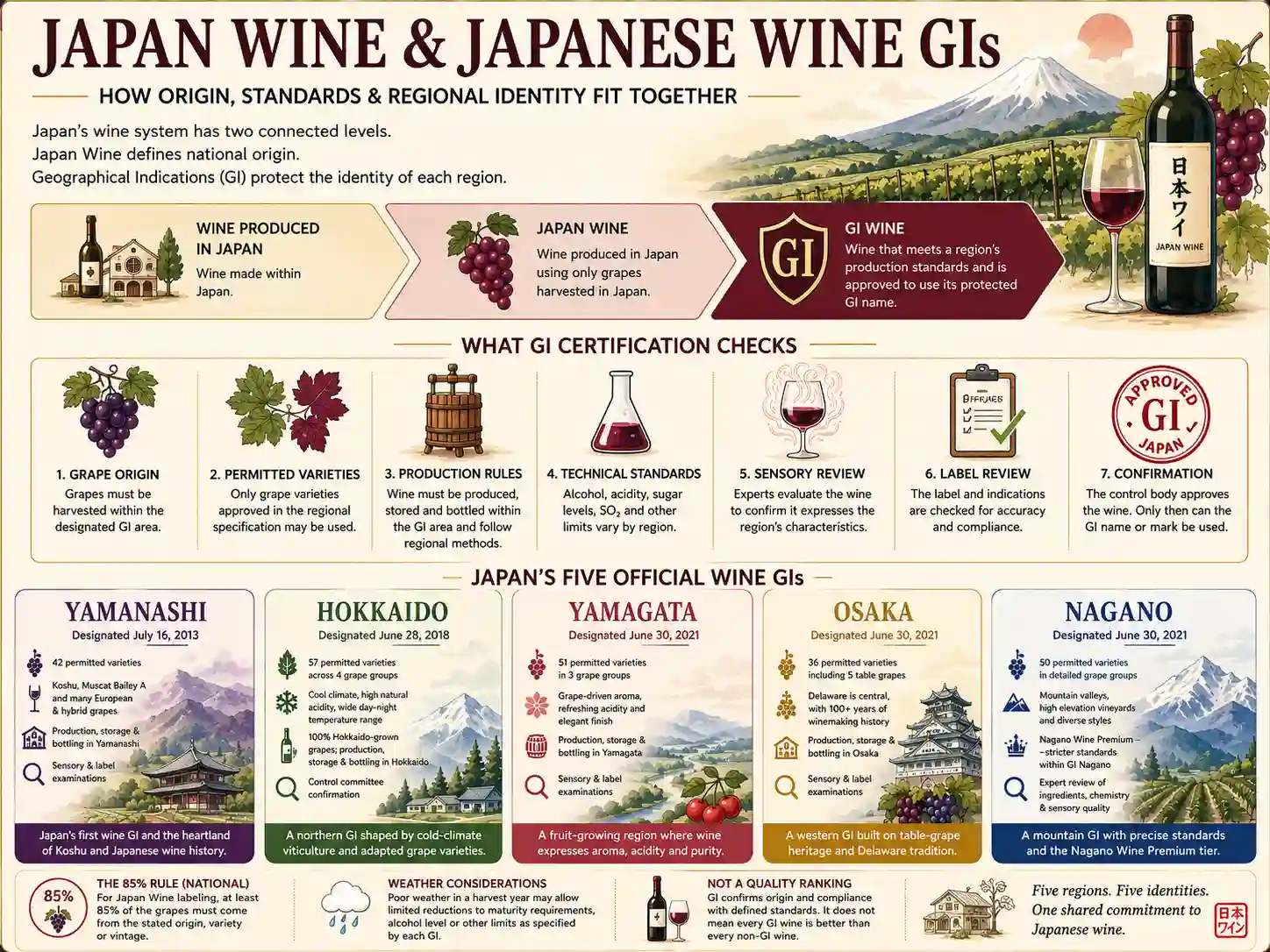
Japan Wine and geographical indications, usually shortened to GI, explain two connected but different levels of origin in Japanese wine. Japan Wine is the national category for wine produced in Japan using grapes harvested in Japan. A wine GI adds a protected regional identity governed by a separate production specification and confirmation process.
The distinction is useful because several places can appear in the story of one bottle. The winery may be located in one prefecture, the grapes may have been grown in another, and the wine may carry a regional name without qualifying for that region’s GI. Understanding the difference between grape origin, production location and protected geographical indication makes Japanese wine labels much easier to read.
This article explains the system behind Japan’s regional wine map. For the broader geographical picture—including the climate, grapes, history and wine styles of the main producing areas—begin with our guide to Japanese wine regions.
Table of contents
- Japan Wine and GI at a glance
- What Japan Wine means
- How Japan Wine labeling works
- What a wine GI means in Japan
- How a Japanese wine qualifies for GI
- Japan’s five official wine GIs
- How the five GI standards differ
- How to read a Japanese wine label
- What a wine GI guarantees—and what it does not
- How GI connects Japan’s wine regions
- FAQ
Japan Wine and GI at a Glance
| Question | Japan Wine | GI wine |
|---|---|---|
| Main level | National | Regional |
| Basic meaning | Wine produced in Japan from grapes harvested in Japan | Wine approved to use a protected regional name |
| Grape origin | Japan | The defined GI area |
| Production | Japan | Must meet the regional GI specification |
| Regional name protection | Not automatically provided | Yes |
| Confirmation | National labeling rules | Regional control-body confirmation before the GI name is used |
The relationship is best understood as a hierarchy. Wine produced domestically is the broadest category. Within it, Japan Wine is tied specifically to Japanese-grown grapes. Within Japan Wine, qualifying bottles may use one of Japan’s protected regional wine GIs.
- Wine produced in Japan
- Japan Wine made from grapes harvested in Japan
- GI wine meeting the rules of a protected Japanese wine region
A wine can qualify as Japan Wine without qualifying for a GI. The absence of a GI does not automatically indicate poor quality. It may mean that the wine falls outside a designated area, uses grapes or methods not covered by the specification, or was not submitted through the regional confirmation process.
What Japan Wine Means
Japan Wine is wine produced in Japan using only grapes harvested in Japan. It is distinct from the broader category of domestically produced wine, which can include wine made in Japan using imported grape juice, concentrated must or imported wine materials.
This distinction was introduced to make origin clearer. The words “produced in Japan” tell the reader where the winemaking occurred, but they do not necessarily identify where the grapes were grown. The Japan Wine category connects the finished bottle directly to Japanese vineyards.
The category also gives Japan’s regional differences greater meaning. Once the grapes must be grown domestically, climate, elevation, rainfall, grape adaptation and local cultivation methods become part of the wine’s origin rather than background information.
That is why Japan Wine matters to the regional series. Yamanashi’s inland basins, Nagano’s high mountain valleys, Hokkaido’s northern climate, Yamagata’s fruit-growing landscapes and Osaka’s table-grape heritage represent different ways of growing grapes and producing wine within the same national category.
How Japan Wine Labeling Works
Japan’s national wine-labeling rules distinguish the origin of the grapes from the place of production. They also set conditions for displaying a geographical name, grape variety and vintage.
Geographical Origin
Under the general Japan Wine rules, a geographical name can describe the grape-growing origin when at least 85% of the grapes were harvested in the stated area. When the wine was not produced inside that area, the wording must make clear that the name refers to the grapes rather than the winemaking location.
This is why wording such as “Yamanashi grapes” and “produced in Yamanashi” should not automatically be treated as the same statement.
Grape Variety
A named grape variety or group of named varieties must account for at least 85% of the grapes used. Additional rules govern how two or more varieties are listed and the order in which they appear.
Vintage
A harvest year may be displayed when grapes from that year account for at least 85% of the wine.
These national rules create a useful base level of transparency. A GI can go further by requiring all qualifying grapes to come from the designated region, limiting the permitted varieties and setting additional production and confirmation requirements.
What a Wine GI Means in Japan
A geographical indication protects the name of a place whose wine has qualities, characteristics or a reputation connected to that geographical origin. The regional name is treated as a shared asset of the producing area rather than as a general expression available to any producer.
The Commissioner of the National Tax Agency designates a GI following an application from a producers’ organization. The application must define the geographical area, describe the wine characteristics connected to that area, specify the permitted ingredients and production methods, and establish a system for maintaining those characteristics.
Designation of a region and approval of an individual wine are separate steps. Once a region has received GI status, an individual bottle can use the protected name only when it meets the applicable specification and receives confirmation through the regional control body.
GI is therefore more than a geographical statement. It connects four elements:
- A defined geographical area
- Approved regional grapes and production rules
- Characteristics attributed to the region
- A system for checking conformity before the GI name is used
How a Japanese Wine Qualifies for GI
Each of Japan’s five wine GIs has its own production specification. The details differ, but the process follows a common structure.
1. Regional Grape Origin
The grapes must be harvested within the protected geographical area. This is stricter than the general 85% threshold used for geographical-origin statements under the wider Japan Wine labeling rules.
2. Permitted Grape Varieties
Each GI lists the varieties that may be used. These lists reflect local history, established cultivation, climate adaptation and the styles the region has developed. The lists are not identical: a grape permitted in one GI may not qualify in another.
3. Grape Maturity
The specifications set minimum grape-juice sugar levels. Requirements may differ among vinifera grapes, Labrusca grapes, Japanese hybrids, native vines and specific varieties such as Koshu or Delaware. Several GIs allow a defined reduction when poor weather affects a harvest year.
4. Regional Production
Qualifying wines must be produced within the GI area. The current specifications also contain regional requirements for storage and bottling, helping maintain the connection between the protected name and the producing region through the final stages of production.
5. Technical and Production Rules
The specifications can regulate alcohol, total acidity, volatile acidity, sulfur dioxide, sugar addition, acidification, deacidification and the use of grape juice or concentrated grape juice. These rules vary by region rather than following one identical national formula.
6. Regional Characteristics
Each specification describes the sensory characteristics associated with the geographical origin. These descriptions do not require every wine to taste identical, but they establish the general regional qualities that the GI is intended to maintain.
7. Control-Body Confirmation
Before the protected name is used, the relevant control body confirms that the wine meets the regional requirements. Depending on the regional system, this process can include document checks, technical confirmation, sensory evaluation and label examination.
Some regional organizations also use a GI logo, seal or certification mark to help identify approved wine. The exact appearance and use of those marks differ by region, so the clearest common signal remains the protected GI name on the bottle.
Japan’s Five Official Wine GIs
Japan currently has five official wine geographical indications. Yamanashi was designated first in 2013, followed by Hokkaido in 2018. Yamagata, Osaka and Nagano were all designated on June 30, 2021.
| Wine GI | Designation date | GI-specific identity |
|---|---|---|
| Yamanashi | July 16, 2013 | Japan’s first wine GI, rooted in Koshu, Muscat Bailey A and a long-established regional wine industry |
| Hokkaido | June 28, 2018 | A northern GI shaped by high natural acidity, cold-climate viticulture and a broad range of adapted grapes |
| Yamagata | June 30, 2021 | A fruit-growing GI associated with grape-derived aroma and refreshing acidity |
| Osaka | June 30, 2021 | A western GI built on table-grape cultivation, Delaware and more than a century of winemaking |
| Nagano | June 30, 2021 | A mountain GI with a detailed grape-classification system and the stricter Nagano Wine Premium indication |
GI Yamanashi
Yamanashi became Japan’s first wine GI in July 2013. It remains the clearest established example of how the national Japan Wine category and a protected regional system work together.
The current specification lists 42 permitted varieties. These include Koshu, Muscat Bailey A, Black Queen, Delaware, Yamanashi-developed hybrids and a broad selection of European varieties. All qualifying grapes must be harvested in Yamanashi.
The required minimum grape-juice sugar level differs by grape group: Koshu, vinifera varieties and other permitted varieties have separate thresholds. The specification also sets conditions for sugar addition, acidification and deacidification, and requires the wine to be produced, stored and bottled within Yamanashi.
GI Yamanashi is particularly useful for understanding the role of regional examination. The regional management committee conducts quality checks that include sensory assessment and label examination. A wine must pass the required review before it can display GI Yamanashi.
The official sensory description reflects the diversity of the region rather than reducing Yamanashi to one taste. Koshu wines are associated with gentle fruit, citrus notes and crisp acidity in dry styles. Muscat Bailey A contributes red-purple color, a sweet-fruited aroma and mild tannin, while approved European varieties add further white and red wine styles.
The GI covers Yamanashi Prefecture as a whole. Katsunuma may appear as a more specific grape-growing origin and Koshu may identify the grape variety, but neither is currently a separate official wine GI.
Explore the region’s geography, winery areas and wider identity in the Yamanashi wine region guide. The grape itself has a separate owner in the Koshu wine and grape guide.
GI Hokkaido
Hokkaido received wine GI status in June 2018. Its specification reflects conditions that differ substantially from Japan’s central and western wine regions.
Hokkaido’s growing season is comparatively cool, and many vineyard areas experience wide differences between daytime and nighttime temperatures. Grapes can retain substantial acidity while ripening, and the region’s generally cooler storage conditions can help preserve fruit character after fermentation.
The current specification lists 57 permitted varieties across four groups: vinifera grapes, Labrusca grapes, wild-vine varieties and hybrids. This breadth reflects both imported wine-grape cultivation and decades of work with grapes adapted to winter cold, snowfall and northern growing conditions.
Minimum juice-sugar requirements differ among the four grape groups. Vinifera grapes carry the highest general threshold, followed by wild-vine and hybrid grapes, with a separate level for Labrusca varieties. The specification allows a limited reduction when poor weather affects the growing season.
Qualifying wine must be produced, stored and bottled in Hokkaido. The rules also reflect the naturally high acidity common in the region: acid addition is tightly limited and is not intended simply to increase the wine’s sensory acidity.
The official regional description emphasizes fruity white, red and rosé wines with clear acidity. White wines may show floral, green-apple or citrus character, while reds are generally moderate or light in body with fresh acidity and mild astringency.
The wider climate, grape varieties and principal producing areas are explained in the Hokkaido wine region guide.
GI Yamagata
Yamagata was designated as a wine GI on June 30, 2021. The protected area covers Yamagata Prefecture and connects the region’s winemaking with its longer history of fruit and grape cultivation.
The current specification lists 51 permitted varieties. They are divided among vinifera grapes, Labrusca grapes and other varieties that include Japanese hybrids, Koshu, table grapes and native-vine material.
The grape-sugar requirements reflect these groups. Vinifera varieties have one minimum, Labrusca varieties—including Delaware—a lower minimum, and the remaining varieties a separate middle level. As in several other GIs, a limited weather-related adjustment may be approved for a difficult harvest year.
The specification requires qualifying wine to be Japan Wine produced in Yamagata from approved grapes harvested in the prefecture. It also sets limits for sugar addition, acidification, deacidification and technical factors such as alcohol, total acidity, volatile acidity and sulfur dioxide.
Yamagata’s defined sensory identity centers on the original aroma and flavor of the grapes together with a refreshing acid-driven finish. White wines are described through floral and citrus-like aromas and balanced acidity. Red wines combine fruit and refreshing acidity with mild astringency, while rosé styles retain a light, fruit-led character.
This profile is connected to Yamagata’s inland basins, sloping vineyards, cool harvest conditions and wide day-to-night temperature changes. It also reflects continued work by growers and winemakers to improve the quality of Delaware, European varieties and regionally established grapes.
Discover that longer agricultural and winemaking story in the Yamagata wine region guide.
GI Osaka
Osaka became a wine GI on June 30, 2021. It deserves a full place in the national GI story because its regional identity developed through a different agricultural and historical path from the better-known mountain and northern wine regions.
Grape cultivation expanded in the Kawachi area during the late nineteenth and early twentieth centuries. The introduction of Delaware in 1914 became particularly important, and Osaka developed into one of Japan’s major table-grape areas. Winemaking grew partly as a way to use grapes that did not meet the appearance standards of the fresh-fruit market.
That history is not simply background. It remains visible in the GI specification. The current list contains 36 permitted varieties, including five table-grape varieties—Delaware, Koshu, Muscat Bailey A, Kyoho and Pione—alongside European and hybrid grapes.
Delaware receives its own maturity requirement, while Koshu, early-harvest Delaware and other varieties are treated separately. This allows the specification to recognize several different uses of grapes, including fresher early-picked Delaware styles and wines made from riper fruit.
All qualifying grapes must be harvested within Osaka, and the wine must be produced, stored and bottled in the prefecture. The regional organization conducts sensory and label examinations before approving wine to use GI Osaka.
The official regional description emphasizes concentrated fruit, mild acidity, moderate umami and an easy relationship with food. Delaware wines can range from fresh, citrus-like expressions made from earlier-picked grapes to richer and sweeter-fruited styles made from grapes harvested at greater maturity. White wines from non-table varieties tend toward rich fruit and a soft finish, while reds are described through mellow aroma, moderate tannin and rounded fruit.
Osaka therefore represents more than an additional point on the GI map. It shows how Japan’s table-grape knowledge, urban proximity and western agricultural history developed into a protected wine identity of their own.
GI Nagano
Nagano received wine and sake GI status on June 30, 2021. It was the first time in Japan that wine and sake from the same region were designated simultaneously.
The designation did not begin from nothing. Nagano Prefecture had operated its own appellation-control system since 2002, covering wine, sake and other regional products. The wine and sake sections of that earlier system became the foundation for the transition to GI Nagano.
The current wine specification lists 50 permitted grape varieties. They are organized into detailed groups covering vinifera grapes, Labrusca grapes and Japanese crossbred varieties. Each group has its own grape-sugar requirements, with separate thresholds for standard Nagano Wine, Nagano Wine Premium and sparkling wine.
This grouped approach reflects the diversity of Nagano’s wine landscape. Merlot and Chardonnay occupy an important position, but the system also recognizes grapes such as Cabernet Sauvignon, Pinot Noir, Kerner, Concord, Niagara, Ryugan, Koshu, Muscat Bailey A and several regionally developed varieties.
Qualifying wine must be made in Nagano from approved grapes harvested in the prefecture. The specification also regulates grape maturity, permitted additions, acid adjustment, storage, bottling and technical wine characteristics. Confirmed products may carry the GI Nagano wine mark.
The official sensory description emphasizes clear expression of the grape variety. Red wines are generally associated with concentrated flavor, structured tannin and moderate acidity. White wines are described through distinct varietal aroma and fresh, lively acidity.
Nagano’s mountain geography, vineyard elevations and five wine valleys are covered in detail in the Nagano wine region guide.
Nagano Wine Premium
Nagano Wine Premium is not a sixth Japanese wine GI. It is a stricter indication available within GI Nagano.
The Premium level sets higher grape-maturity requirements for many variety groups and tighter conditions in several areas of production. For example, its rules restrict permitted additions more closely, impose stricter sulfur limits for most wines and do not permit acidification or deacidification.
The official sensory description also sets a higher stylistic expectation: varietal character should combine with an elegant aroma, concentrated fruit and a deeper finish.
Where grape juice or concentrated juice is used within the permitted production framework, the Premium rules connect it more narrowly to the same grape variety, harvest year and municipal area as the wine grapes. This strengthens the connection between the Premium indication and a more precisely defined origin.
How the Five GI Standards Differ
Japan’s wine GIs are connected by a common principle, but they are not copies of one another. Each specification translates regional conditions and established practices into a different set of rules.
- Yamanashi separates maturity and sugar-addition rules for Koshu, vinifera grapes and other approved varieties.
- Hokkaido recognizes vinifera, Labrusca, wild-vine and hybrid groups, reflecting its long work with cold-adapted grapes.
- Yamagata uses three broad grape groups and defines a regional sensory identity centered on grape aroma and refreshing acidity.
- Osaka gives particular attention to Delaware, early-harvest fruit and a table-grape tradition that remains central to its wine identity.
- Nagano uses the most detailed group structure and adds the stricter Nagano Wine Premium level.
The specifications also differ in their technical limits. Alcohol, sulfur dioxide, volatile acidity, total acidity, sugar addition and acid adjustment are not governed by one identical number across all five regions.
These differences are not inconsistencies. They are part of the purpose of the GI system. A protected regional name should express conditions and practices connected to that particular place rather than impose one uniform national wine style.
How to Read a Japanese Wine Label
A useful reading order is to move from the broad national category toward the bottle’s more specific regional and production information.
1. Look for Japan Wine
The Japan Wine indication tells you that the wine was produced in Japan from grapes harvested in Japan.
2. Look for the GI Name
GI Yamanashi, GI Hokkaido, GI Yamagata, GI Osaka or GI Nagano indicates that the bottle has qualified under the relevant protected regional system. Some regions also use a recognizable logo or certification seal.
3. Check the Grape Origin
Do not rely only on the winery address. A producer can make wine in one location using grapes grown elsewhere. The wording should distinguish where the grapes were harvested from where the wine was produced.
4. Check the Grape Variety
A named variety on Japan Wine normally reflects the national 85% labeling rule. A GI bottle must also use varieties permitted by its regional specification.
5. Check the Vintage
A displayed harvest year normally indicates that at least 85% of the grapes came from that vintage. Weather matters greatly in Japan, so vintage can be particularly useful when comparing acidity, ripeness and regional growing conditions.
6. Separate Place, Variety and Certification
“Koshu,” for example, usually identifies a grape variety. “Katsunuma” may identify a grape-growing place. “GI Yamanashi” identifies the protected geographical indication. Those terms can appear together, but they do not make the same claim.
What a Wine GI Guarantees—and What It Does Not
What GI Confirms
- The wine has qualified to use a protected regional name.
- The grapes meet the origin and variety requirements of the GI.
- The wine meets the applicable regional production rules.
- The wine conforms to the technical requirements in the specification.
- The relevant control body has confirmed the wine under its regional process.
- The regional name carries a more exact meaning than a general place reference.
What GI Does Not Confirm
- That every wine made within the prefecture qualifies.
- That all wines carrying the GI taste alike.
- That every GI wine is better than every non-GI wine.
- That the producer is small, historic or family owned.
- That a winery uses only traditional methods.
- That the winery accepts visitors or provides public tastings.
- That the bottle will match every person’s taste or preferred style.
A GI is a regulated statement of regional origin, defined characteristics and conformity. It is not a universal ranking of wineries or an automatic guarantee that one bottle will be preferred over another.
How GI Connects Japan’s Wine Regions
The Japanese wine-region series explains how climate, geography, grape cultivation and winemaking developed differently across the country. The GI system adds another layer by showing how five regions have formally defined and protected their wine identities.
Yamanashi provides the oldest wine GI and the clearest connection among Koshu, Muscat Bailey A and Japan’s historical wine center. Nagano uses a detailed mountain-region framework and a stricter Premium indication. Hokkaido translates northern climate and cold-adapted viticulture into its specification. Yamagata connects a wide grape range with fruit-led aroma and refreshing acidity. Osaka protects a wine identity built from table-grape expertise, Delaware and a distinct western history.
These are not five versions of one regional style. They are five different expressions of how place, grapes, production and shared standards can fit within the national category of Japan Wine.
The national regions guide and the individual regional articles provide the broader climate, geography, grape and winemaking context behind Yamanashi, Nagano, Hokkaido and Yamagata. This page retains the separate role of explaining the Japan Wine and GI framework that connects them.
A Clearer Way to Understand Japanese Wine
Japan Wine and GI describe two different levels of origin. Japan Wine establishes that a wine was produced in Japan using grapes harvested in Japan. GI adds a protected regional name supported by its own grape rules, production standards, defined characteristics and confirmation system.
That distinction makes Japanese wine easier to understand without reducing it to one national style. A bottle can be read through several layers: the country in which it was produced, the origin of its grapes, the variety, the vintage and, where applicable, the protected GI region.
Japan’s five wine GIs show how varied those regional systems can be. Yamanashi, Hokkaido, Yamagata, Osaka and Nagano each protect a different relationship among landscape, grapes, human knowledge and wine production. Together, they give the regional map of Japanese wine greater definition while leaving room for high-quality Japan Wine outside the GI system.
FAQ
What does Japan Wine mean?
Japan Wine means wine produced in Japan using only grapes harvested in Japan. It is distinct from domestically produced wine that may use imported grape juice, concentrated must or other imported wine materials.
Is every Japan Wine a GI wine?
No. Japan Wine is the broader national category. A GI wine must also qualify under the specification and confirmation system of one of Japan’s protected wine regions.
What are Japan’s five official wine GIs?
Japan’s official wine geographical indications are Yamanashi, Hokkaido, Yamagata, Osaka and Nagano.
Does every wine from a GI prefecture qualify?
No. The wine must use approved grapes harvested within the GI area, meet the regional production specification and receive confirmation through the applicable control body.
Does GI mean the wine is better than non-GI wine?
GI confirms regional origin and conformity with a defined specification. It does not mean that every GI wine is superior to every non-GI wine, and many well-made Japan Wines are produced outside the GI system.
Is Nagano Wine Premium a separate GI?
No. Nagano Wine Premium is a stricter indication within GI Nagano. It has additional requirements, but it is not a separate geographical indication.
Are Katsunuma and Koshu separate wine GIs?
No. The current official designation is GI Yamanashi, covering Yamanashi Prefecture. Katsunuma can identify a more specific place of grape origin, while Koshu most commonly identifies the grape variety.