


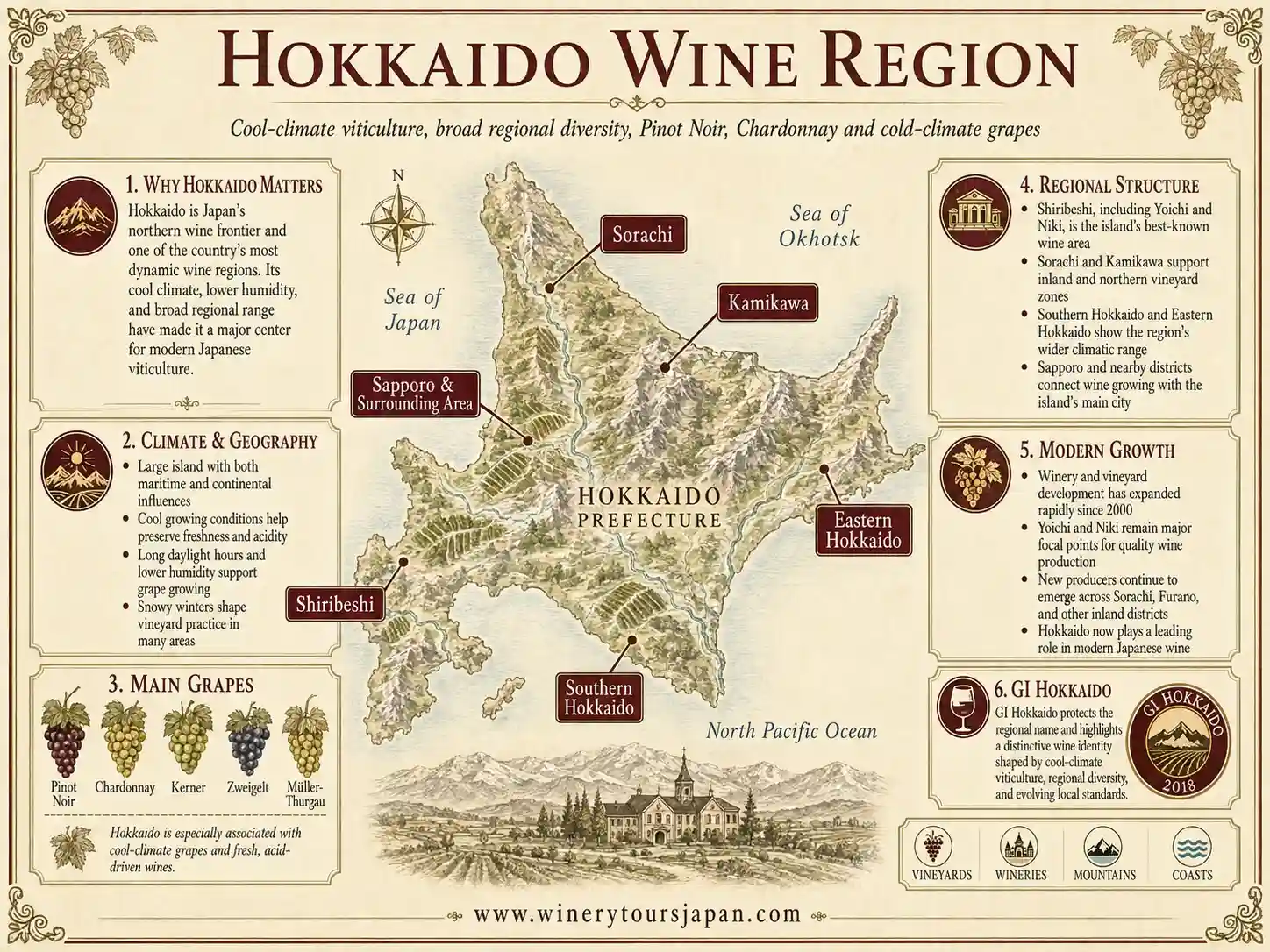
Hokkaido wine region at a glance, showing six broad wine areas, cold-climate vineyards, winter vine protection and principal grapes.
The Hokkaido wine region cannot be understood as one valley or a single vineyard belt. Vineyards are scattered across a vast island, from the coastal fruit-growing districts of Yoichi and Niki to snowy Sorachi, inland Furano, the exposed Tokachi Plain and comparatively mild sites around Hakodate. Distance, winter survival and local farming history matter as much as latitude.
By February 2026, Hokkaido had 75 wineries, approximately three times the number recorded ten years earlier. The increase is important, but the number alone does not explain the region. Much of Hokkaido’s recent development comes from small wineries, grower-winemakers, contract growers and regional projects working with sharply different local conditions.
Hokkaido’s wine identity is therefore built from several separate stories: European grapes grown under cold-climate conditions, native and hybrid varieties adapted to severe winters, fruit-growing communities that supplied grapes before opening wineries, and newer producers trying to understand individual sites. For the national context, begin with the guide to Japan’s major wine regions.
Table of contents
- An Island of Separate Wine Landscapes
- Winter Viticulture: Snow Can Protect or Fail to Protect
- Six Broad Wine Areas
- From Early Sapporo Experiments to Modern Expansion
- Yoichi and a Grower-Led Winery Model
- Grapes with Different Jobs Across the Island
- Wine Styles Shaped by Acidity, Scale and Place
- GI Hokkaido and Regional Identity
- What Hokkaido Adds to Japanese Wine
An Island of Separate Wine Landscapes
Hokkaido is colder than Japan’s other principal wine-producing prefectures, but “cold” does not describe every vineyard in the same way. The official GI Hokkaido specification places the prefecture broadly within Winkler Region I, a low-heat climate category. Major grape-growing districts also receive long summer daylight and substantial differences between daytime and nighttime temperatures.
The island’s size creates major internal contrasts. Western coastal districts are influenced by the Sea of Japan and can receive deep winter snow. Inland basins experience wider temperature swings. The Tokachi Plain can be intensely cold while receiving less dependable snow cover. Southern Hokkaido is comparatively moderate and is influenced by surrounding seas.
These differences affect more than grape selection. They influence whether vines can remain on the trellis through winter, whether snow can act as insulation, how much frost protection is needed, which slopes drain well, and whether a vineyard can ripen Pinot Noir, Chardonnay or a more cold-resistant variety consistently.
Hokkaido’s regional identity begins with this variation. The island is not becoming one uniform Pinot Noir region. It is developing several wine landscapes at the same time.
Winter Viticulture: Snow Can Protect or Fail to Protect
Winter survival is one of the most distinctive parts of Hokkaido viticulture. Severe cold can damage trunks, buds and graft unions, but deep snow can also protect vines by insulating them from the coldest air.
In snowy districts such as Shiribeshi and parts of Sorachi, growers may detach canes from support wires and lower them toward the ground so that winter snow covers them. Slanted or low horizontal training can make this seasonal work more practical. The aim is not simply to bury a vineyard under snow, but to place vulnerable vine wood where a dependable snowpack can moderate temperature extremes.
Eastern Hokkaido presents a different problem. Parts of Tokachi can be colder but less reliably protected by snow. Growers may lower vines and cover them with soil after harvest, then uncover and reposition them in spring. This is labor-intensive, and repeated handling can place stress on trunks and vineyard infrastructure.
These practices help explain why cold-hardy hybrids and locally selected grapes remain important. They also show why Hokkaido’s vineyard development is technical as well as stylistic. Before a producer can refine harvest dates or barrel use, the vines must survive the winter in a form suited to that particular site.
Six Broad Wine Areas
For practical orientation, Hokkaido can be read through six broad wine areas. They are not identical legal subappellations, and each contains considerable local variation. Their value is geographic: they show why an island-wide description is never enough.
Shiribeshi: Yoichi, Niki and the Western Coast
Shiribeshi includes Yoichi, Niki, Otaru, Rankoshi, Niseko and surrounding districts. It contains a major concentration of vineyards and wineries and has become closely associated with small wineries, contract growers and Pinot Noir.
The landscape is complex rather than flat and uniform. Coastal influence, hills, volcanic formations, sedimentary material, granite and river deposits create varied sites. Yoichi’s long fruit-growing history provided experienced farmers and established agricultural land before the present small-winery movement began.
Pinot Noir is prominent, but Shiribeshi also supports Chardonnay, Kerner, Zweigelt and other grapes. Individual vineyards differ in elevation, exposure, drainage and distance from the sea, which is why “Yoichi style” should not be treated as one fixed flavor profile.
Sorachi: Snowy Inland Vineyards
Sorachi includes wine activity around Iwamizawa, Mikasa, Urausu, Kuriyama and other districts east and northeast of Sapporo. It combines parts of the Ishikari Plain with hillier vineyard sites and a strongly continental seasonal pattern.
Snowfall can be heavy, while the difference between summer and winter temperatures is substantial. Vineyards occupy varied slopes and soils, including volcanic material, sedimentary rock and clay-rich areas where drainage requires close attention.
Pinot Noir and Chardonnay are important to Sorachi’s modern development, and Sauvignon Blanc has attracted growing interest in selected sites. The area’s sharper inland conditions can produce wines with pronounced acidity, but producer choices and vineyard position remain decisive.
Kamikawa: Furano and the Northern Interior
Kamikawa includes Furano, Asahikawa, Takasu, Nayoro and other inland districts. Mountain ranges divide this part of Hokkaido into basins and valleys with cold winters, long summer days and large seasonal temperature differences.
Furano played an important role in twentieth-century trials of German and Austrian grapes. Its regional history includes the development of Furano No. 2 and continued work with varieties suited to cool continental conditions.
Kamikawa also demonstrates that Hokkaido wine is not limited to the western coast. Its established municipal projects and newer small producers contribute white, red, sparkling and sweet wines, including true ice wine made from grapes frozen naturally on the vine.
Eastern Hokkaido: Tokachi and Severe Cold
Eastern Hokkaido includes Tokachi, Obihiro, Memuro, Ikeda, Kitami and Teshikaga. The Tokachi Plain is broad and dry by Hokkaido standards, with long sunshine hours, severe winter temperatures and less dependable snow protection than many western districts.
Ikeda’s municipal wine project became the foundation of the modern Tokachi wine story. Research focused on grapes capable of surviving local conditions, leading from Kiyomi to later varieties including Yamasachi.
Yamasachi combines practical cold resistance with a distinct regional identity. It is not simply a substitute for Pinot Noir or another European grape. It represents a northern Japanese response to winter conditions that require different breeding and vineyard decisions.
Sapporo and the Surrounding Area
Sapporo and nearby districts form a less concentrated wine area, connecting scattered vineyards and wineries with Hokkaido’s largest urban market. Some producers work with nearby fruit, while others source grapes from established areas such as Yoichi.
The city’s importance is partly practical. Sapporo restaurants, wine bars and retailers can provide access to small-production Hokkaido wines that may be difficult to find at wineries or outside the prefecture. This matters because many small producers have limited opening schedules, selective distribution or no regular public tasting operation.
Southern Hokkaido: Hakodate and New Vineyard Investment
Southern Hokkaido includes Hakodate, Hokuto, Nanae, Okushiri and other sites around the Oshima Peninsula and nearby islands. Winters are generally milder than in the interior, and some districts receive less snow. Maritime influence, volcanic soils and newly planted slopes have attracted interest in Chardonnay and Pinot Noir.
The de Montille & Hokkaido project illustrates this newer phase. The project began in 2016, planting started in Hakodate in 2019, and winemaking from the project’s own Hakodate vineyard began in 2023. Its winery was completed in 2024, followed by the first release made from Hakodate-grown grapes in December 2025.
This project is significant because it combines overseas vineyard experience with local farming, climate knowledge and long-term site development. It does not replace Hokkaido’s domestic foundations; it adds another form of exchange to a region already shaped by research, municipal projects and grower-led wineries.
From Early Sapporo Experiments to Modern Expansion
Hokkaido’s wine history began during the early Meiji period. A government wine facility opened in Sapporo in 1876, and fuller production using American grapes followed in 1877. The early industry did not continue without interruption, however, and Hokkaido entered the twentieth century without the same continuous wine culture found in Yamanashi.
The modern revival began in Tokachi. Ikeda Town started grape-growing work in 1960 after repeated agricultural difficulties, and its grape and wine research institute received an experimental fruit-wine license in 1963. The project linked wine to local economic recovery and to research on grapes that could withstand severe cold.
During the 1970s, Furano and other projects expanded trials with European varieties, while Hokkaido Wine developed a larger vineyard and production base. Research, municipal involvement and producer cooperation established practical knowledge before the recent wave of small wineries.
A different growth pattern became visible after 2000. New wineries opened in Shiribeshi, Sorachi, Kamikawa, southern Hokkaido and the east. Custom-crush facilities allowed growers to make wine without immediately constructing a complete winery, while special wine-zone rules reduced production thresholds for qualifying small businesses.
GI Hokkaido followed in 2018. By early 2026, the prefecture’s winery total had reached 75. This modern expansion is rapid, but it rests on older layers of agricultural research, municipal investment, contract growing and adaptation to winter.
Yoichi and a Grower-Led Winery Model
Yoichi is central to Hokkaido’s recent small-winery movement because grape growing came before many of the wineries. Fruit farmers and contract growers supplied wine grapes to producers inside and outside the prefecture, creating a base of vineyard knowledge and commercial demand.
Domaine Takahiko opened in 2010 and helped focus attention on estate-grown Pinot Noir and close vineyard involvement. Yoichi then became Hokkaido’s first approved wine special zone in 2011. The designation reduced the minimum annual production requirement for qualifying fruit-wine businesses, making small-scale entry more practical.
The result is not one winery model. Yoichi contains established companies, independent growers, estate wineries, vineyard-only businesses and producers using custom-crush arrangements. Some wines come from one vineyard or a small number of parcels, and production can be limited.
This scale has encouraged close attention to farming and site, but it also affects visitors. A small Hokkaido winery should not automatically be treated as a public tasting destination. Opening days, reservations and direct sales vary widely, and some producers are not open to visitors.
Grapes with Different Jobs Across the Island
Pinot Noir
Pinot Noir has become a prominent modern red variety in Hokkaido. Its planted area moved ahead of Zweigelt from 2019, reflecting increased activity in Shiribeshi, Sorachi and selected southern sites.
Its significance is regional rather than uniform. Yoichi’s maritime influence, Sorachi’s inland conditions and southern Hokkaido’s milder sites do not produce one identical expression. Winter survival, drainage, harvest weather and vineyard management remain as important as the grape name.
Kerner and Chardonnay
Kerner remains Hokkaido’s largest white wine-grape planting and one of the clearest links between twentieth-century variety trials and the present industry. It can produce aromatic wines with clear acidity and remains important even as newer projects focus attention on Chardonnay.
Chardonnay plantings have increased across western, central and southern Hokkaido. Producers use it for still wines, sparkling wines and blends. Its role is expanding, but style depends on site and cellar decisions rather than on a single island-wide formula.
Zweigelt and Other European Varieties
Zweigelt was Hokkaido’s most widely planted red wine grape before Pinot Noir overtook it and remains part of the region’s established identity. Müller-Thurgau, Bacchus, Sauvignon Blanc, Pinot Gris, Gewürztraminer, Merlot and other European grapes add further range.
Their distribution is uneven. Sauvignon Blanc is receiving attention in parts of Sorachi, while several German and Austrian varieties remain connected to older northern and inland trials.
Kiyomi, Yamasachi and Other Cold-Adapted Grapes
Kiyomi was selected from Seibel 13053 through Tokachi’s cold-climate research. Yamasachi was later developed from Kiyomi and the cold-hardy species Vitis amurensis. Its OIV registration in 2020 gave international recognition to a grape created for northern Japanese conditions.
Furano No. 2, Kiyomai and other locally developed or selected grapes add further regional depth. These varieties are valuable not because they imitate European models, but because they show how Hokkaido growers have responded to frost, winter exposure and short growing seasons.
Niagara and Other Labrusca Grapes
Niagara, Campbell Early, Concord and other Labrusca grapes remain part of Hokkaido’s agricultural and wine history. They account for a large share of total grape production, although much of that fruit serves early-drinking, sweet or locally familiar styles rather than the small-production vinifera wines that receive more international attention.
Keeping these grapes in the regional picture prevents Hokkaido wine from being reduced to Pinot Noir and Chardonnay alone.
Wine Styles Shaped by Acidity, Scale and Place
Hokkaido produces dry whites, light- to medium-bodied reds, rosé, sparkling wine, sweet wine and experimental small-batch styles. Natural acidity is a recurring feature, but it should not be turned into a claim that every wine is sharp, pale or delicate.
Traditional-method sparkling wine has historical roots in Tokachi, while pét-nat and other lightly sparkling styles have become common among newer small wineries. Chardonnay, Kerner, Kiyomi and Labrusca grapes can all contribute to sparkling production depending on the producer.
White wines range from aromatic Kerner and Bacchus to Chardonnay-based still wines and blends. Pinot Noir receives the most attention among reds, but Zweigelt and cold-adapted hybrids can produce darker, spicier or more structured alternatives.
True ice wine is possible in selected inland areas where grapes freeze naturally on the vine. Furano and Tokachi have both developed wines through this method. These wines belong to a specific climatic and production context and should not be confused with ordinary sweet wine made by other techniques.
GI Hokkaido and Regional Identity
Hokkaido received geographical-indication protection for wine on June 28, 2018. The designation provides one prefecture-wide framework while allowing wines from different districts and grapes to retain their own character.
To use the GI Hokkaido name, wine must be made from approved grapes harvested in Hokkaido. Production, storage and bottling must also take place within the prefecture, and the wine must meet defined compositional and production requirements.
The approved varieties include European grapes, Labrusca grapes, wild-vine selections and hybrids. That breadth suits Hokkaido because its identity is not based on one grape. Pinot Noir from Shiribeshi, Kerner from another district and Yamasachi from Tokachi can all belong to the protected region without being presented as the same wine.
The wider relationship between domestic grape origin and regional protection is explained in Japan Wine and Geographical Indications.
What Hokkaido Adds to Japanese Wine
Hokkaido adds a northern model that cannot be explained through one historic center, one grape or one compact route. Its wine culture is dispersed across coastal hills, snowy inland districts, municipal research projects, fruit-growing communities and newly planted southern vineyards.
Its strongest contribution is the connection between climate and practical adaptation. Snow can protect vines in one area and be insufficient in another. European varieties may succeed in selected sites, while hybrids and locally developed grapes remain essential elsewhere. Small wineries can focus attention on individual vineyards, but larger and older projects continue to provide research, production capacity and historical continuity.
Hokkaido is therefore best understood as a group of developing wine landscapes rather than a single northern style. Visitors beginning with Japan’s historical wine center can explore a private one-day Yamanashi wine tour, while using Hokkaido as a separate regional chapter shaped by distance, winter and adaptation.