


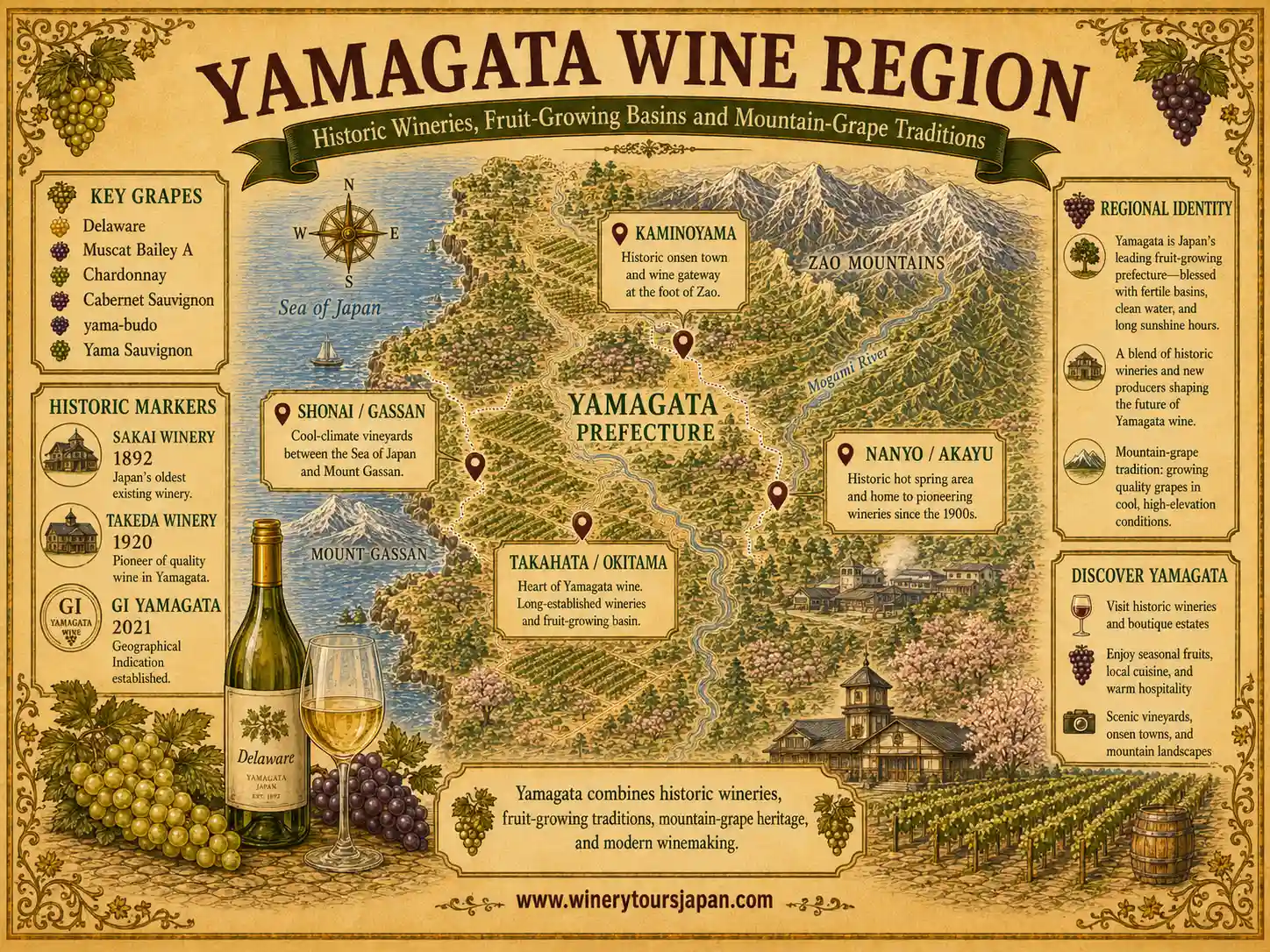
Yamagata wine region at a glance, showing its main wine areas, key grape varieties, historic wineries and mountain-grape traditions.
The Yamagata wine region combines some of Tohoku’s oldest wineries with a modern community of producers working within one of Japan’s most important fruit-growing prefectures.
Its identity has developed through several connected traditions. Yamagata has long produced table grapes and other fruit, maintained wineries with histories reaching back to the nineteenth and early twentieth centuries, and gradually built a more diverse wine culture around Delaware, Muscat Bailey A, Chardonnay, Cabernet Sauvignon, yama-budo and other varieties.
The region is now changing again. Long-established wineries remain important, but smaller producers, younger winemakers and new vineyard projects are expanding the range of styles and places represented by Yamagata wine.
This guide examines Yamagata’s fruit-growing foundations, historical wineries, principal wine areas, grape varieties, mountain-grape tradition, GI protection and modern development. For the wider national context, begin with the guide to Japan’s major wine regions.
Table of contents
- Why the Yamagata Wine Region Matters
- Fruit Growing, Basins and Climate
- Some of Tohoku’s Oldest Wineries
- Yamagata’s Main Wine Areas
- Delaware, Muscat Bailey A and Traditional Grapes
- Cabernet Sauvignon, Chardonnay and Modern Wine
- Yama-Budo, Yama Sauvignon and Mountain-Grape Wines
- Established Producers and a New Generation
- GI Yamagata and Regional Standards
- Yamagata in the Wider Japanese Wine Story
Why the Yamagata Wine Region Matters
Yamagata matters because it demonstrates how a strong wine identity can emerge from a wider agricultural culture rather than from a wine-only landscape.
The prefecture is widely associated with cherries, pears, apples, peaches, grapes and other fruit. Vineyards therefore developed alongside orchards and mixed farming rather than replacing them. This gave grape growers substantial experience with seasonal weather, fruit quality, crop selection and demanding inland conditions before wine became a major regional subject in its own right.
Yamagata’s wine identity is also unusually layered. It includes traditional commercial grapes, European varieties, Japanese hybrids, native mountain grapes, wineries with more than a century of history and recently established small producers.
No single grape or town explains the whole region. Delaware remains central to its agricultural and winemaking history. Cabernet Sauvignon and Chardonnay demonstrate its capacity for vinifera wines. Yama-budo and Yama Sauvignon connect wine production with the mountain environment of Tohoku.
This breadth gives Yamagata a distinct role. It is neither a copy of Yamanashi nor a smaller version of Nagano. Its modern wine identity has grown from fruit farming, historical continuity and gradual improvement across several different wine areas.
Fruit Growing, Basins and Climate
Yamagata is enclosed by mountain systems and organized around the Mogami River, which runs north from southern Okitama before turning west across Shonai toward the Sea of Japan. The prefecture is commonly divided into four broad areas: Shonai in the northwest, Mogami in the northeast, Murayama around Yamagata City and Kaminoyama, and Okitama in the south around Yonezawa, Takahata and Nanyo.
Most of the prefecture’s established wine activity is concentrated in Okitama and Murayama, particularly around Nanyo, Takahata and Kaminoyama. A smaller but distinctive group of producers works in Shonai, where coastal and mountain influences create a different setting for grape growing and wine production.
This means Yamagata does not have one uniform vineyard climate. Southern inland sites around Nanyo and Takahata experience warm summers and substantial winter snow, while Murayama sites around Kaminoyama generally have a somewhat different balance of heat, snowfall and elevation. Shonai faces the Sea of Japan and is shaped more directly by coastal weather and nearby mountain systems.
Many inland vineyards sit on basin edges, foothills and sloping ground where airflow and drainage can be better than on the flat valley floor. Daytime warmth can support ripening, while cooler nights later in the season can help grapes retain acidity. Results still depend on the individual vineyard, exposure and growing year.
Rainfall, summer humidity and winter snow require active management. Growers must consider drainage, disease pressure, frost, snow load and harvest timing together rather than relying on a single climatic advantage.
How Yamagata Vineyards Are Trained
Yamagata’s vineyard systems reflect both its table-grape heritage and its newer wine-focused plantings. Delaware is still commonly trained on overhead pergolas, a familiar system in Japanese fruit farming that spreads the canopy above the grower and can help manage vigorous growth.
Yama Sauvignon and many vinifera varieties are more often grown on vertical trellises, but producers do not follow one rigid model. Some wineries are also experimenting with pergola-trained vinifera, partly to lift fruit farther from humid ground and improve airflow around the bunches.
Winter practice changes by location. In heavier-snow districts, growers may lower vines from trellises or use other protective methods to reduce snow damage. These practical choices show how Yamagata viticulture is being adapted vineyard by vineyard rather than copied from a single regional template.
Yamagata wines are often associated with clear fruit character and refreshing acidity. That general profile is recognized within the GI Yamagata specification, but the prefecture still produces a wide range of dry, sweet, still and sparkling wines.
Some of Tohoku’s Oldest Wineries
Yamagata’s historical foundations are stronger than its relatively modest international profile might suggest.
Regional wine histories place Koshu vines in Akayu by the early eighteenth century. One longstanding explanation is that people traveling from Yamanashi’s mining districts brought vines with them during the Edo period. The exact route is difficult to prove, but the account helps explain why Koshu cultivation appeared in Akayu long before commercial winemaking began.
More systematic grape cultivation followed in the Meiji era. Experimental vineyards introduced American and European material, while local growers continued working with grapes suited to table use and the inland climate.
Sakai Winery began wine production in Akayu in 1892 and is recognized by the Yamagata wine association as the oldest winery in Tohoku. Early production reflected local demand: sweeter wine was easier to sell than unfamiliar European-style dry wine. Its continued presence makes the Nanyo area one of the most important historical reference points for wine in northern Japan.
The arrival of phylloxera in the early twentieth century interrupted vineyard expansion and encouraged the use of resistant planting material. Delaware subsequently became deeply established in Yamagata, particularly around Akayu, where growers developed a strong reputation for fruit quality.
Takeda Winery has operated its vineyard in Kaminoyama since 1920. Its early production drew on the local grape economy, including Muscat Bailey A and surplus fruit, before the estate developed a more vineyard-centered approach. Its long history provides another line of continuity between Yamagata’s early industry and its present regional identity.
These wineries developed during a period when Japanese wine was very different from the industry seen today. Sweetened wines, table-grape agriculture and practical commercial production were significant parts of the market. Dry regional wine made entirely from Japanese-grown grapes had not yet become the clearly defined category it is now.
From the 1980s and 1990s, research groups, producer associations and wineries placed greater emphasis on dry-wine quality, vineyard selection and European varieties. That work helped prepare the ground for the more diverse regional scene that emerged after 2000.
That early history should not be dismissed. It preserved vineyards, farming knowledge and local production through periods when wine remained a small part of Japanese drinking culture.
Yamagata’s development also belongs within the broader national history described in the guide to the history of Yamanashi wine. Yamanashi remained the central force in the emergence of modern Japanese wine, while Yamagata built a separate northern tradition through its own growers, wineries and fruit-growing communities.
Yamagata’s Main Wine Areas
Yamagata’s wineries are distributed across several parts of the prefecture rather than contained within one formal wine valley.
Nanyo and Akayu
Nanyo, including Akayu, is the clearest historical center of Yamagata wine. The area combines old wineries, established grape-growing slopes and newer producers working with both traditional and European varieties. Akayu is especially associated with Delaware, whose long local history links table-grape farming with several generations of winemaking.
Akayu’s importance comes from continuity. It is a place where vineyards, local growers and wineries have remained connected over several generations, allowing the area to retain a recognizable wine culture even as production styles changed.
Takahata and the Okitama Area
Takahata forms another important part of the southern Okitama wine landscape. The area contributes vineyard land, substantial production and established winery activity. Together with Nanyo, it anchors the prefecture’s strongest concentration of wineries and grape growers.
Its presence broadens southern Yamagata beyond the historic Akayu center and helps demonstrate that the prefecture contains a connected group of wine-producing towns rather than one isolated district.
Kaminoyama
Kaminoyama lies south of Yamagata City and has a long viticultural history associated with Takeda Winery and other producers. Vineyards occupy basin edges, foothills and sloping sites near the Zaō mountain system. The area has long worked with Muscat Bailey A and now supports a broader range of vinifera plantings.
The area is important for both traditional grapes and vinifera varieties, adding another established center to Yamagata’s inland wine geography.
Shonai and the Gassan Area
The Shonai side of Yamagata has a different landscape and wine history. Mountain areas around Tsuruoka and Asahi are closely connected with yama-budo cultivation, Gassan Wine and other locally adapted grapes.
Parts of Tsuruoka also retain an old Koshu-growing tradition. This does not make Shonai a northern extension of Yamanashi, but it shows how grape material and cultivation knowledge traveled between regions over time. The broader history of that grape is covered in the Koshu wine guide.
Delaware, Muscat Bailey A and Traditional Grapes
Traditional and commercially established grapes remain central to Yamagata wine.
Delaware
Delaware is one of the most important grapes in Yamagata’s agricultural and winemaking history. It has long been grown as a table grape, but local wineries also use it for dry, sweet and sparkling wines.
Its importance should not be treated as a leftover from an earlier period. Long experience with Delaware has allowed growers and winemakers to explore harvest timing, sweetness, acidity and different production methods.
Modern Yamagata Delaware can range from simple and fruit-forward to dry, lightly sparkling or more deliberately structured styles. Growers and winemakers can adjust harvest timing, vineyard yield and fermentation choices to retain acidity or build greater texture. The grape links everyday local agriculture with the region’s current movement toward greater quality and variety.
Muscat Bailey A
Muscat Bailey A provides another connection between Yamagata and the wider history of Japanese wine. It is used for light and medium-bodied reds, rosé wines, sparkling styles and blends.
As in other regions, the final character depends on vineyard conditions, ripeness and winemaking. Its continuing role demonstrates that Yamagata’s modern identity does not depend entirely on imported European varieties.
Niagara and Other Established Grapes
Niagara and other American or hybrid grapes also remain part of Yamagata’s wider production. Some are used for aromatic dry wines, sweet wines or distinctive local bottlings.
These grapes reflect the practical history of northern Japanese viticulture, where winter survival, disease resistance, reliable yields and local demand were often as important as international prestige.
Cabernet Sauvignon, Chardonnay and Modern Wine
European grape varieties have become increasingly important to Yamagata’s modern quality identity.
Cabernet Sauvignon
Cabernet Sauvignon has a meaningful place in suitable inland sites, particularly where warm summers, exposure and drainage provide enough opportunity for ripening.
It should not be presented as equally successful everywhere in the prefecture. In well-matched vineyards, however, it can produce structured wines with clear fruit, acidity and moderate weight. It is also used in blends with Merlot and other red varieties.
Chardonnay
Chardonnay is one of Yamagata’s most important modern white varieties. It is grown in several inland areas and can be made in fresh, direct styles or with fermentation and maturation in oak.
The grape provides a useful expression of differences in site and producer approach. Some wines emphasize acidity and restrained fruit, while others develop greater texture and weight.
Merlot and Other Vinifera Varieties
Merlot, Sauvignon Blanc, Pinot Noir and other vinifera grapes contribute further range, although their importance differs by location and producer.
Yamagata’s strength is not that every international variety performs equally well. It is that growers now have enough experience to make increasingly deliberate decisions about which grapes belong in particular vineyards.
That process is continuing. Some producers are testing varieties such as Albariño, Petit Manseng, Syrah and Viognier in small quantities. Petit Manseng has attracted particular interest in Kaminoyama because its loose bunches and relatively strong resistance to rot may suit humid growing conditions. These plantings remain experimental rather than defining features of the region.
Yama-Budo, Yama Sauvignon and Mountain-Grape Wines
Yamagata has a significant living tradition of cultivated yama-budo and mountain-grape wine.
Yama-budo is a native Japanese wild grape found in mountainous areas of Japan, with a particularly strong tradition in Tohoku. It did not originate exclusively in Yamagata, but the prefecture has developed a strong local culture around its cultivation and use.
In the Asahi area of Tsuruoka, growers have cultivated selected yama-budo vines for more than 40 years, particularly for Gassan Wine. Earlier production relied partly on fruit gathered from wild vines, but cultivated selections offered more dependable ripeness and yields.
Yama-budo can produce deeply colored wines with pronounced acidity and distinctive fruit. Its importance lies not only in flavor, but also in its relationship with the mountain environment and the agricultural history of northern Japan.
Yama Sauvignon
Yama Sauvignon must be distinguished from yama-budo itself. It is a Japanese red-wine grape developed at the University of Yamanashi from a 1978 cross between yama-budo and Cabernet Sauvignon. After selection and evaluation, it was registered as a new grape variety in 1990.
Gassan Wine began cultivating Yama Sauvignon mainly in the Asahi area around 1997. The grape combines deep color and clear acidity with characteristics inherited from both parent varieties.
It was not created in Yamagata, but Yamagata has become an important place for its cultivation and regional expression. Together, yama-budo and Yama Sauvignon give the prefecture a grape story that differs meaningfully from those of Yamanashi, Nagano and Hokkaido.
Established Producers and a New Generation
Yamagata’s current wine scene combines historical continuity with visible modern growth.
Sakai Winery and Takeda Winery provide links to the region’s earliest commercial history. Takahata Winery, Gassan Wine and other established producers contribute scale, specialized grape work and wider recognition.
Alongside them, smaller and newer wineries are broadening the region’s identity. The prefectural association includes producers such as Grape Republic, Yellow Magic Winery, HOCCA Winery, Domaine Keros, DROP and other recently established projects.
These wineries do not all follow the same model. Some work closely with locally grown table-grape varieties, some emphasize vinifera, some explore low-intervention production, and others are rooted in orchards or small mixed farms.
The prefectural wine association currently lists 23 wineries. The number is useful, but the more important change is the increasing diversity of producers, vineyard sources and winemaking approaches.
Policy has also supported smaller-scale entry. In 2016, both Kaminoyama and Nanyo received wine special-zone designations that reduced the minimum production threshold for qualifying fruit-wine licenses. This did not create quality by itself, but it lowered one practical barrier for new local producers and helped reinforce the growth of small wineries.
This combination of old and new is central to Yamagata. The region is not abandoning its historical grapes or wineries in order to appear modern. It is building new work on top of an agricultural and winemaking foundation that already existed.
GI Yamagata and Regional Standards
GI Yamagata for wine was designated on June 30, 2021.
To use the GI Yamagata name, qualifying wine must be made from approved grapes grown within the prefecture and produced within Yamagata under defined regional requirements. The system also includes compositional standards and verification by a designated control body.
The approved grape list reflects Yamagata’s diversity. The current specification permits 51 designated varieties, including Delaware, Muscat Bailey A, Merlot, Chardonnay, Cabernet Sauvignon and Yama Sauvignon.
The official specification describes Yamagata wines as retaining grape-derived aromas and a refreshing expression of acidity. White, red, rosé, sweet and sparkling wines can all qualify when they satisfy the relevant requirements.
GI protection does not mean that every Yamagata wine should taste alike. Its purpose is to protect the regional name and establish shared standards while allowing wineries to express different grapes, vineyards and production styles.
Yamagata in the Wider Japanese Wine Story
Yamagata adds a distinct agricultural and historical dimension to Japanese wine.
Yamanashi remains the central historical region and the home most closely associated with Koshu. Yamagata’s development followed a different route through mixed fruit farming, traditional grapes, old local wineries and gradual modern renewal.
The Nagano wine region is more strongly structured around mountain wine valleys and a broad group of European varieties. The Hokkaido wine region is defined by colder conditions, rapid winery growth and emerging vineyard areas.
Yamagata contributes something different: some of Tohoku’s oldest wineries, an important Delaware tradition, successful work with Cabernet Sauvignon and Chardonnay, and a living connection with yama-budo and mountain-grape wine.
Its modern scene is also becoming more varied. Historical wineries, larger established producers, small new projects and growers working with very different grapes now share the same regional framework.
Yamagata therefore deserves to be understood as a significant wine region in its own right. Its value does not depend on outranking another prefecture. It lies in the way history, fruit agriculture, mountain landscapes and contemporary winemaking continue to develop together.
Visitors beginning with Japan’s historical wine center can explore a private one-day Yamanashi wine tour, while using Yamagata as a separate Tohoku chapter in understanding the wider development of Japanese wine.