


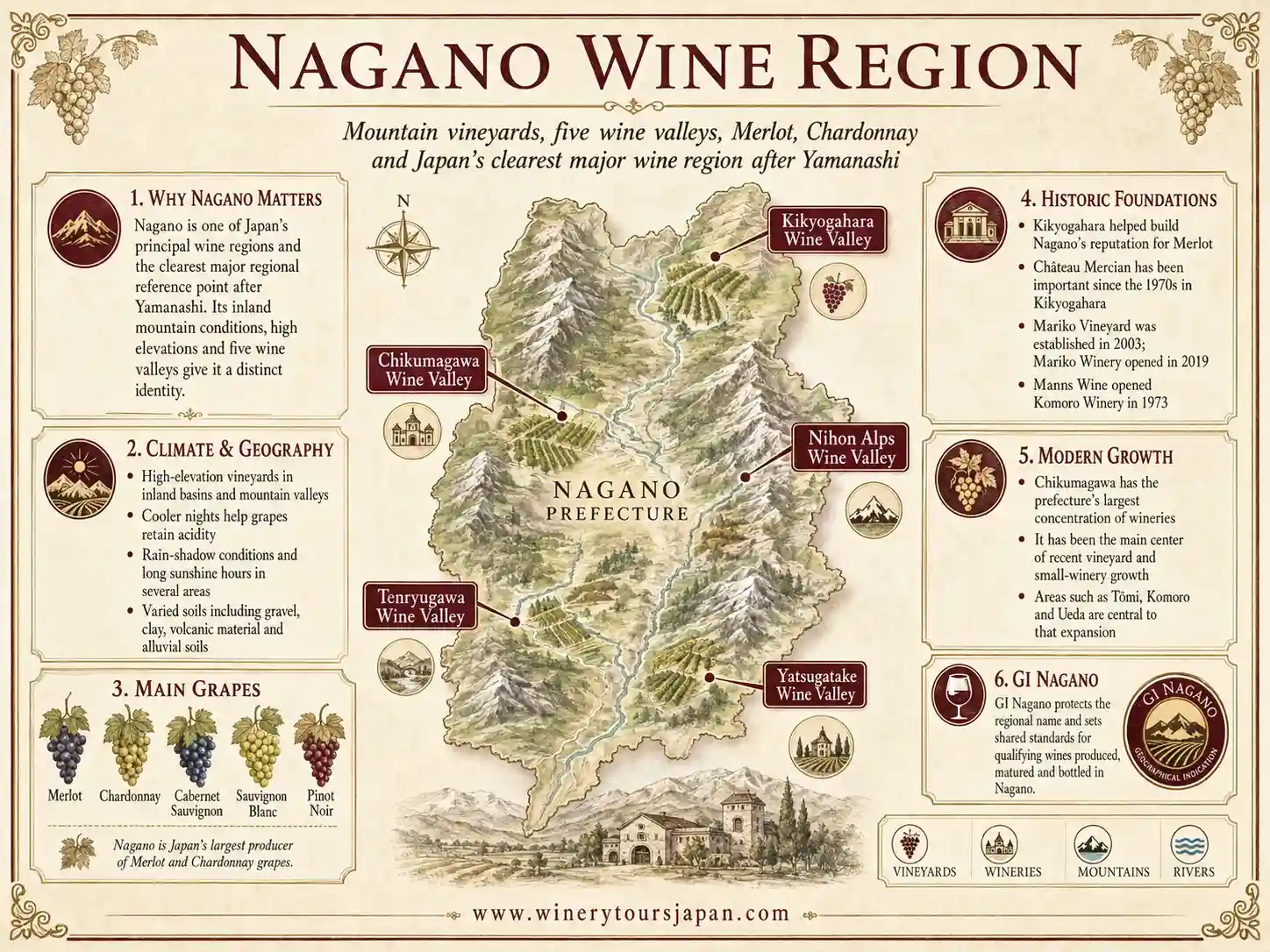
Nagano wine region at a glance, showing its five wine valleys, mountain vineyards, key grapes, historic foundations and modern winery growth.
The Nagano wine region is one of Japan’s principal winemaking areas and the clearest major regional reference point after Yamanashi. Its importance comes from mountain vineyards, varied elevations, five distinct wine valleys and a growing community of producers working with both established and emerging grape varieties.
The region has deep agricultural and winemaking foundations. Long-established producers such as Manns Wine and Château Mercian maintain important wineries and vineyards in Nagano, while many smaller wineries and grower-winemakers have brought new energy, detailed vineyard work and increasingly site-focused wines.
Nagano is particularly associated with Merlot and Chardonnay, but those varieties do not tell the complete story. Cabernet Sauvignon, Sauvignon Blanc, Cabernet Franc and Pinot Noir are also important, especially in the expanding vineyards of Chikumagawa and selected high-elevation sites.
This guide examines the Nagano wine region within the wider structure of Japan’s major wine regions, focusing on its climate, wine valleys, historic producers, small wineries, principal grapes and future potential.
Table of contents
Why Nagano Matters in Japanese Wine
Nagano has one of Japan’s largest concentrations of wineries and has developed a strong reputation for European grape varieties grown in inland mountain conditions.
Its importance cannot be explained by one grape or one production area. Nagano contains established wine districts, major historical producers, agricultural cooperatives, independent vineyards and a rapidly growing group of small wineries. These different parts of the industry have developed together rather than following one uniform model.
Nagano is Japan’s largest producer of Merlot and Chardonnay grapes. It is also increasingly important for Cabernet Sauvignon, Sauvignon Blanc, Cabernet Franc and Pinot Noir. The suitability of each variety depends heavily on elevation, exposure, growing-season conditions and the individual vineyard.
This combination of established strength and continuing experimentation makes Nagano one of the most important regions for understanding the future of Japanese wine.
Mountain Geography and Climate
Nagano lies in central Honshu and is surrounded by major mountain ranges. Its vineyards are distributed across inland basins, river valleys, plateaus, slopes and highland areas rather than concentrated in one continuous wine district.
Many vineyards are located at relatively high elevations. Individual sites vary greatly, but cooler nights and substantial differences between daytime and nighttime temperatures can help grapes retain acidity while developing flavor during the growing season.
Mountain ranges also create rain-shadow effects in several areas. Parts of Nagano receive relatively low rainfall by Japanese standards and benefit from long sunshine hours. These conditions have supported the expansion of European grape varieties, although humidity, rainfall and autumn weather still require careful vineyard management.
There is no single Nagano soil type or climate profile. Gravel, clay, volcanic material and alluvial soils occur in different locations. Vineyard direction, slope, drainage, wind exposure and altitude all contribute to the character of individual sites.
This geographic variation is one of Nagano’s main strengths. It allows producers to match different grapes with different elevations and growing conditions rather than depending on one variety across the entire prefecture.
Nagano’s Wine Valleys
Nagano’s wine industry is organized around five wine valleys:
- Kikyogahara Wine Valley
- Chikumagawa Wine Valley
- Nihon Alps Wine Valley
- Tenryugawa Wine Valley
- Yatsugatake Wine Valley
The current five-valley framework includes both long-established wine districts and newer highland vineyard development. The Nagano wine valleys differ considerably in their histories, geography, producer structure and present direction.
Kikyogahara is closely connected with Nagano’s established grape-growing history and the development of Merlot. Chikumagawa has the prefecture’s largest concentration of wineries and has been the main center of recent vineyard and small-winery growth.
Nihon Alps includes vineyards around the Matsumoto Basin, Azumino and surrounding mountain-influenced areas. Tenryugawa extends through southern Nagano and retains a broader mixture of fruit-growing traditions, hybrids and locally adapted varieties. Yatsugatake represents newer highland vineyard development along the mountain foothills.
The wine-valley framework helps explain Nagano as a network of connected but distinct growing areas. It should not be interpreted as meaning that every part of the prefecture shares the same climate, grapes or winemaking culture.
Historic Producers and Vineyards
Nagano’s current momentum rests partly on work carried out over several decades by established wineries, grape growers and agricultural communities.
Kikyogahara, around Shiojiri, has one of the prefecture’s oldest recognized wine identities. American grape varieties were planted in the wider area during the nineteenth century, and Niagara and Concord became important to its agricultural economy.
Merlot cultivation expanded during the twentieth century through sustained experimentation by local growers and wineries. The success of Kikyogahara Merlot helped establish Nagano as a serious source of European red varieties under Japanese growing conditions.
Château Mercian played an important role in this development. Its work with Kikyogahara Merlot began during the 1970s, and the producer now operates the Château Mercian Kikyogahara Winery in Shiojiri.
Château Mercian established Mariko Vineyard in Ueda in 2003 and opened the Mariko Winery there in 2019.
Manns Wine provides another major historical connection. Manns opened Komoro Winery in 1973, making it an early producer in what is now Chikumagawa Wine Valley. The estate includes mature Chardonnay vines and long-term vineyard research.
Manns began planting Cabernet Sauvignon in its Higashiyama vineyard in Ueda in 1994. The variety performed well enough for vineyard development to continue, alongside Merlot and other grapes.
These larger producers matter because they invested in vineyards, cultivation techniques and facilities before Nagano’s recent expansion. Their presence provides continuity between the prefecture’s established wine history and its newer generation of producers.
The Rise of Small Wineries
Although established producers remain important, much of Nagano’s present energy comes from smaller wineries, independent growers and new entrants working closely with individual vineyard sites.
The number of wineries increased rapidly during the late 2010s and early 2020s. Wine-production special zones, grower training, shared knowledge, contract winemaking and regional support made it possible for more people to establish vineyards and eventually open wineries.
This movement is especially visible in Chikumagawa Wine Valley. Areas such as Tōmi, Komoro, Ueda, Takayama and the wider Chikuma River basin have attracted growers interested in European varieties and small-scale production.
Many of these wineries produce limited quantities and may not follow conventional national distribution channels. Their importance is therefore not measured only by volume. They contribute detailed vineyard knowledge, experimentation and wines that express particular slopes, elevations and local conditions.
The relationship between larger and smaller producers is part of Nagano’s strength. Historic wineries provide experience, infrastructure and long-term vineyard knowledge, while smaller producers add diversity, close attention to individual parcels and new approaches to grape growing and winemaking.
The Grapes That Shape Nagano Wine
Nagano’s wine identity is built around several varieties rather than one prefecture-wide signature grape.
Merlot
Merlot has the deepest connection with Nagano’s established red-wine reputation. Kikyogahara is its historic center, but the grape is also grown in Chikumagawa, Nihon Alps and other suitable locations.
Nagano is Japan’s largest producer of Merlot. Styles differ by location and producer, ranging from approachable fruit-led wines to more structured examples intended for maturation.
Cabernet Sauvignon
Cabernet Sauvignon is increasingly important, particularly in Chikumagawa. Successful production requires suitable warmth, exposure and growing-season length, so it cannot be treated as equally appropriate for every Nagano site.
In carefully selected vineyards, Cabernet Sauvignon can produce serious varietal wines or contribute structure to blends with Merlot, Cabernet Franc and other red grapes. Long-established plantings such as Manns Wine’s Higashiyama vineyard demonstrate that its role in Nagano is not merely recent.
Pinot Noir
Pinot Noir has become one of Nagano’s most important future-facing varieties. It is grown in selected cooler and higher sites, particularly within Chikumagawa and other mountain-influenced areas.
The grape is demanding and remains more dependent on precise site selection than Merlot or Chardonnay. Nevertheless, several growers and small wineries have made Pinot Noir a central focus, and new plantings continue to expand.
Nagano Pinot Noir should not be described as one uniform regional style. Differences in altitude, soil, exposure, vine age and winemaking can produce markedly different expressions. Its importance lies in the quality already being achieved at individual sites and the potential still being explored.
Chardonnay
Nagano is Japan’s largest producer of Chardonnay grapes. The variety is grown across several valleys and has a long history in areas such as Komoro and the northern Chikuma River basin.
Chardonnay responds clearly to differences in elevation, site and winemaking. Nagano producers make fresh, restrained examples as well as fuller wines shaped by fermentation or maturation in oak.
Sauvignon Blanc
Sauvignon Blanc is increasingly planted at higher elevations and has become an important part of Nagano’s modern white-wine identity. It is especially visible in Chikumagawa, including vineyards around Ueda and Mariko.
The variety is generally used for dry wines that retain freshness and aromatic definition. As with Pinot Noir, the most convincing examples depend on careful matching of grape and site.
Other Varieties
Cabernet Franc, Pinot Gris, Syrah and Petit Verdot add further range to Nagano’s European-variety plantings. Niagara, Concord, Ryugan and other grapes remain part of the wider regional story and connect current production with older agricultural traditions.
GI Nagano and Regional Development
GI Nagano provides a protected geographical framework for qualifying wines produced within the prefecture.
The system includes requirements covering approved grape varieties, grape quality, chemical standards, production location and sensory assessment. For qualifying wines, grape growing, harvesting, winemaking, maturation and bottling must take place in Nagano.
GI Nagano builds on earlier prefectural quality systems while recognizing the region’s varied grapes and wine valleys. It does not require all Nagano wine to taste alike. Its role is to protect the regional name and establish shared standards for wines using it.
The designation also reflects Nagano’s development into a mature wine-producing prefecture. Established companies, small wineries, independent growers and newer highland vineyards now operate within the same broad regional identity. The wider national system is explained in Japan Wine and Geographical Indications.
Nagano and Yamanashi
Nagano and Yamanashi are Japan’s two clearest major wine reference points, but their roles are different.
Yamanashi has the deeper historical association with the development of Japanese wine and remains closely connected with Koshu. That story is examined separately in the guide to the history of Yamanashi wine.
Nagano is more geographically dispersed and more strongly associated with mountain valleys and European varieties. Merlot, Chardonnay, Cabernet Sauvignon, Sauvignon Blanc and Pinot Noir provide important reference points, but their roles vary by site and valley.
The comparison is useful because the regions explain different parts of Japanese wine. Yamanashi shows the historical foundation and the importance of Koshu. Nagano shows how the industry expanded through higher elevations, multiple valleys, historic corporate investment and a growing movement of small producers.
For a wider regional introduction, continue with Koshu’s importance in Yamanashi, including the geography, grapes and winery areas of the prefecture.
The Future of Nagano Wine
Nagano’s future rests on the combination of established foundations and continuing small-scale development.
Manns Wine, Château Mercian and other long-standing producers provide decades of vineyard knowledge, recognized facilities and continuity. At the same time, smaller wineries and grower-winemakers are exploring individual sites, planting new varieties and producing limited wines that may differ significantly even within the same valley.
Merlot and Chardonnay remain central, but Cabernet Sauvignon, Sauvignon Blanc and Pinot Noir broaden the region’s possibilities. Pinot Noir is particularly important as growers continue identifying cooler, well-drained sites where the variety can mature successfully without losing freshness.
This does not mean every new vineyard or variety will succeed. Nagano’s development depends on careful site selection, long-term farming, technical knowledge and adaptation to Japanese weather. The region’s promise comes from the seriousness with which producers are addressing those challenges.
For that reason, Nagano is more than Japan’s second major wine region. It is one of the clearest places to observe where Japanese winemaking may go next.
Visitors beginning with the country’s historic wine center can explore a private one-day Yamanashi wine tour, while using Nagano as the next major regional chapter in understanding Japanese wine.