


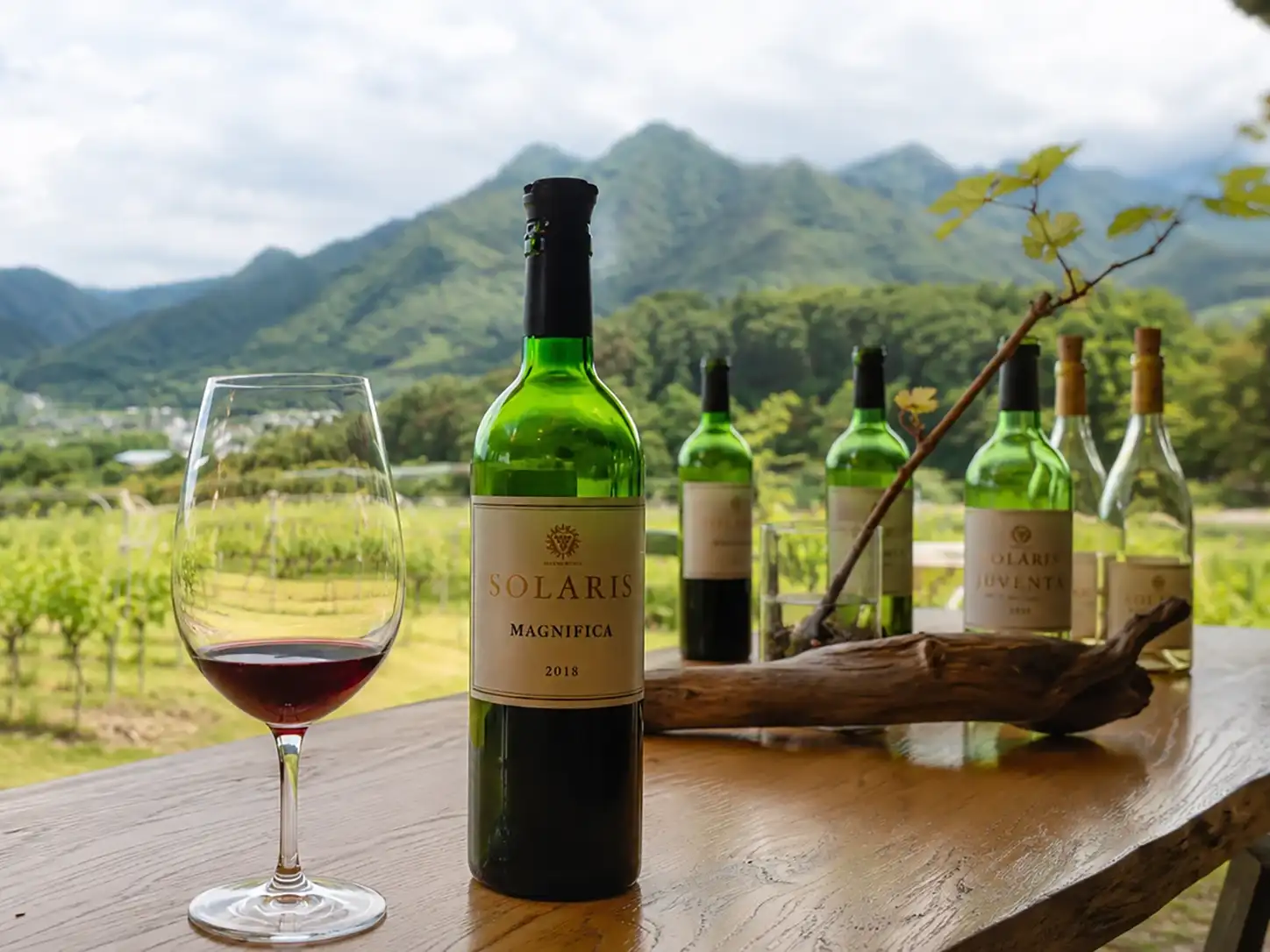
Japanese red wine tasting with Manns Solaris Magnifica, with vineyards and mountains beyond.
Japanese red wine often surprises people more than the whites do.
I see this regularly when tasting wine with visitors in Yamanashi. Many arrive expecting Japanese wine to be sweet, very light, or perhaps interesting mainly because it was made in Japan. Muscat Bailey A is usually the first red to change that expectation. Black Queen can change it again. Then a good Nagano Merlot, Cabernet Sauvignon, or Pinot Noir shows just how wide the category has become.
There is no single Japanese red-wine style. Some reds are bright, fruity, and easy to drink. Others are dark, spicy, tannic, or capable of serious aging. Japan also has its own hybrid varieties alongside Cabernet Sauvignon, Merlot, Pinot Noir, Cabernet Franc, Malbec, Petit Verdot, Barbera, and other European grapes.
For me, that variety is what makes Japanese red wine interesting. You can taste familiar grapes in an unfamiliar environment, then move to varieties such as Muscat Bailey A, Black Queen, Yama Sauvignon, Kai Noir, or Yamabudō that tell a more specifically Japanese story.
This guide focuses only on that red-wine story: the grapes worth knowing, where they grow, how the wines actually taste, and some of the bottles and styles that have stood out to me over years of tasting Japanese wine. For the larger national picture, see the Japanese Wine Guide and the Japanese Wine Regions guide.
What Japanese Red Wine Is Really Like
I would be careful about describing all Japanese reds as simply “light.” Many are lighter than the big, heavily extracted reds visitors may know from warmer parts of the world, but light does not mean simple.
The better word is often balanced.
Fresh acidity appears frequently. Alcohol can be moderate. Tannins are often controlled rather than aggressive. Fruit may be bright instead of jammy, and oak normally works best when it supports the wine instead of covering it.
That makes many Japanese reds very comfortable to drink with food. It also means they can be easy to underestimate if you approach every glass looking for maximum body, oak, alcohol, or concentration.
There are exceptions. Some of the better Cabernet Sauvignon, Merlot, Petit Verdot, and Bordeaux-style blends being made in Japan now have considerable depth and structure. Nagano in particular has given me some reds that I would happily put beside serious wines from much better-known regions.
But even at that level, I usually find a certain freshness running through the wine. That is part of what keeps Japanese red wine interesting to me.
Japanese Red Grapes Worth Knowing
Muscat Bailey A is the obvious place to start, but it should not be the place where the discussion ends. Japan has a much more interesting collection of red varieties than most visitors realize.
Muscat Bailey A
Muscat Bailey A is still Japan’s most important red identity grape. It was developed by Zenbei Kawakami at Iwanohara in Niigata from Bailey and Muscat Hamburg and has become the red variety most closely associated with Japanese wine.
What I like about Muscat Bailey A is its range. It can be very fruity and uncomplicated, but that is only one expression. I have tasted stainless-steel versions that keep the fruit bright and clean, oak-aged examples with considerably more depth, and blends where it becomes part of something more structured.
When I introduce it during tastings, guests are often surprised by how enjoyable it is. Strawberry and red-berry fruit can be quite obvious, but good dry examples are not sugary wines. They can be light, fresh, gently spicy, lower in alcohol than many international reds, and extremely easy to drink.
I personally like Muscat Bailey A when the fruit is allowed to remain clear. Too much oak can hide what is interesting about it. A clean stainless-steel example is often the best way to understand the grape first.
It is important enough to have its own dedicated guide, so rather than repeat the whole subject here, see the Muscat Bailey A guide for a deeper look at the variety.
Black Queen
Black Queen is one of my favorite Japanese red grapes because it tastes so different from Muscat Bailey A.
Zenbei Kawakami created Black Queen from Bailey and Golden Queen. The berries are very dark and thick-skinned, and the wines can have much deeper color, firmer acidity, more tannin, and a spicier character than people expect from Japanese red wine.
At its best I find dark berries, black currant, cherry, spice, and a strong acidic backbone. It sometimes reminds me a little of why I enjoy Malbec—not because the two grapes taste the same, but because Black Queen can have that combination of dark fruit, color, spice, and personality.
Haramo and Kizan have produced some of the Black Queen wines I have enjoyed most. Haramo’s version in particular shows how the variety can have plenty of character without becoming heavy.
Guests often react strongly to Black Queen as well. It does not taste like what they imagine a Japanese red should taste like. That surprise is part of its appeal.
Yama Sauvignon
Yama Sauvignon is another grape I think deserves much more attention. It is a Japanese crossing of the native wild Yamabudō vine and Cabernet Sauvignon.
I think of it as a brighter, lighter relative of Cabernet Sauvignon rather than as a replacement for Cabernet. It can have dark color and Cabernet-like structure, but the fruit is often more vivid and the wine can feel fresher and less heavy.
Sanyo Wine produces Yama Sauvignon from vineyards around Makioka, and that is probably my favorite area for the grape. I find those wines particularly expressive. Yama Sauvignon grown in Fuefuki can be very good too, but it comes across differently.
There are also newer plantings farther south in the Hayakawa Valley. Haramo has sourced Yama Sauvignon from there, which makes the grape interesting to follow because we are beginning to see how different parts of Yamanashi can change its expression.
In blends at Sanyo, I find Yama Sauvignon can add darker color, fruit, spice, and a little more body without making the wine feel cumbersome. It is also enjoyable on its own.
Kai Noir
Kai Noir is a Japanese crossing of Black Queen and Cabernet Sauvignon. The parentage makes sense when you taste what the grape can contribute: color, acidity, darker fruit, and enough structure to work well in blends.
I have enjoyed Kai Noir at Sanyo Wine and from other Yamanashi producers. It is not a grape most overseas visitors have heard of, and even in Japan it is not something you see everywhere. For me that makes it more interesting rather than less.
It is another good example of why Japanese red wine should not be reduced to Muscat Bailey A plus a few European varieties.
Harmo Noir
Harmo Noir is one of those grapes that even many people who drink Japanese wine have never encountered. The name is pronounced more like “Armo Noir,” and Haramo Wine grows it in Katsunuma and bottles it under its own label.
It is a crossing of Cabernet Sauvignon and Zweigelt. The examples I have tasted can show bright red fruit, smoke, peppery spice, fresh acidity, and noticeable but not overwhelming tannin.
It is not an important grape because of volume. It is important because wines like this show how much experimentation exists inside Japanese wine once you look beyond the main varieties.
Neo Alicante
Neo Alicante is another uncommon Japanese hybrid that I encounter particularly through Haramo Wine.
I find it more useful in blends than as a grape people need to chase by itself. At Haramo it can work especially well alongside Black Queen, softening some of Black Queen’s harder edges and helping give the finished wine a rounder feel.
This kind of blending is easy to overlook when discussing Japanese wine by grape name alone. Some of the most interesting reds are not about showcasing one famous variety. They are about understanding how several locally adapted grapes work together.
Yamabudō
Yamabudō, Japan’s wild mountain grape, matters for a different reason.
I would not present it as the center of modern Japanese fine red wine, but it has real historical and cultural importance. It is native to the Japanese landscape, it has long been used in different forms, and it also sits behind modern varieties such as Yama Sauvignon.
Yamabudō wines can be deeply colored and noticeably acidic, with a wild berry character that feels very different from conventional European reds. Even when it is not the wine I would choose first for a guest, it belongs in the Japanese red-wine story.
Other Rare Red Grapes Found in Japan
There are several other grapes worth knowing, although I would not give each of them the same importance as Muscat Bailey A, Black Queen, or Yama Sauvignon.
Bailey Alicante A
Bailey Alicante A was another of Zenbei Kawakami’s crosses, made from Bailey and Alicante Bouschet. Its deeply colored flesh made it useful for adding color as well as character to Japanese red wine.
It is much rarer to encounter now than Muscat Bailey A, which is exactly why I think it is worth mentioning. These older Japanese crossings are part of the bridge between the difficult early history of grape growing in Japan and what the industry has become today.
Cabernet Lion
Cabernet Lion is another unusual Japanese-developed variety, created from Koshu Sanjaku and Cabernet Sauvignon.
It is difficult to find and is certainly not a grape most visitors will encounter casually. That rarity is part of its value in a guide like this. It shows how Japanese growers and researchers have repeatedly tried to combine familiar wine-grape characteristics with vines better connected to local growing conditions.
Bijou Noir
Bijou Noir is another rare Japanese red variety that is worth watching. I have tasted very limited examples where the wine showed a surprisingly dark blue-purple color, fresh berry fruit, lively acidity, and plenty of juice and energy.
A barrel-selection example I tasted was produced in only a few hundred bottles. Wines at that scale are a reminder that part of the fun of Japanese wine is finding things that may never reach a large market.
Kyoho: Mainly a Table Grape, but Sometimes Wine
Kyoho needs some qualification. It is overwhelmingly known as a premium table grape in Japan, not as one of the country’s principal wine grapes.
But it is used for wine.
I have tasted Kyoho as a sweet wine and as sparkling wine. Personally, I find the sparkling version more enjoyable because the acidity and bubbles give the very obvious grape fruitiness more lift. Monde Wine in Yamanashi is one producer where I have encountered this style.
I would treat Kyoho as an interesting side road rather than one of the main routes through Japanese red wine, but it belongs in the broader picture.
European Red Grapes Grown in Japan
The other half of Japanese red wine is the way familiar European varieties behave here.
This is where the discussion becomes especially interesting because Japan is no longer simply proving that these grapes can grow. The best producers are showing that certain regions and sites can give them a recognizable Japanese expression.
Merlot
Merlot is probably the international red grape I trust most consistently in Japan, particularly in Nagano.
The cooler mountain climate seems to suit it. I often find Japanese Merlot more restrained than heavy: plum and darker fruit, herbs, clear acidity, moderate body, and tannins that can be firm when young but rarely feel overdone.
Manns has made several Merlots that have stayed in my memory. Older Asama Merlot can be quite reserved and woody, with plum, tomato-leaf and herbal notes. Solaris Chikumagawa Merlot shows a more polished and serious side of the grape. Château Mercian’s Kikyogahara Merlot and Suntory’s Shiojiri Merlot are other examples that have reinforced my opinion that Nagano is one of Japan’s most convincing places for Merlot.
Yamanashi can produce good Merlot as well, including in Katsunuma and elsewhere in the Kofu Basin, but if somebody asked me where I would start with Japanese Merlot, I would point toward Nagano.
Cabernet Sauvignon
Cabernet Sauvignon is grown in Yamanashi and other parts of Japan, but some of the examples that have impressed me most have come from Nagano.
At the higher end, these wines can be a real surprise for visitors who think Japan only makes delicate reds. Good Japanese Cabernet can have black fruit, tobacco, earth, herbs, fine tannin, and enough structure to age, while still retaining the freshness I associate with Japanese wine.
Manns Solaris is particularly useful for seeing how far this can go.
Solaris Magnifica
Solaris Magnifica is one of the Japanese reds I think deserves to be mentioned when discussing the top end of the category.
Manns makes it only in exceptional vintages, selecting Cabernet Sauvignon and Merlot from its top Nagano lots and aging the finished wine for years before release. It is not intended to be an everyday Japanese red.
The examples I have tasted have shown dark fruit, blackberry, tobacco, earthy tones, and a surprisingly delicate balance beneath the concentration. What impressed me was not sheer power. It was how controlled the wine felt.
Magnifica is useful because it breaks another stereotype. Japanese red wine can be light and charming, but it can also be serious, structured, age-worthy wine when the vineyard and vintage allow it.
Solaris Chikumagawa Merlot
Solaris Chikumagawa Merlot shows a different side of the same region. I find it more immediately recognizable as Merlot: balanced, medium-bodied, dark-fruited, and composed rather than oversized.
It is one of the wines that helped convince me that Nagano is not merely a promising Japanese wine region. For red varieties such as Merlot and Cabernet Sauvignon, it is already producing wines with their own identity.
Solaris Juventa
Solaris Juventa is useful for another reason. It shows a more approachable side of the Solaris range.
The versions I have tasted were lighter and easier drinking than Magnifica, with black fruit, peppery spice, some oak, moderate tannin, and a shorter, more immediate finish. It does not need to compete with Magnifica. It serves a different purpose.
Put the two beside each other conceptually and you begin to see the range possible within Nagano alone: an accessible red that can be enjoyed relatively young, site-focused Merlot and Cabernet Sauvignon, and then a wine such as Magnifica at the top.
Cabernet Franc, Malbec, and Petit Verdot
These grapes appear in much smaller quantities, but I pay attention when I find them.
Malbec is one of my personal favorite red varieties anywhere, so I am probably biased, but good Japanese Malbec can be very interesting. Cave Hatano in Nagano is one example I have enjoyed. The combination of dark fruit, freshness, and a cooler-climate feel works well for me.
Cabernet Franc is also grown in small amounts and can make sense in cooler Japanese sites where aromatic lift matters as much as ripeness.
Petit Verdot is planted in Yamanashi, including around Koshu, where it can be used in blends or occasionally bottled more independently. Its color and structure can be useful, especially in years when the fruit reaches good maturity.
Barbera
Barbera is rare enough in Japan that I notice it immediately when I see it.
Kai Winery in Enzan has produced one that I particularly like. The natural freshness of Barbera feels at home in the Japanese context, and it is exactly the kind of unexpected bottle that makes exploring smaller wineries worthwhile.
Pinot Noir
Pinot Noir is one of the most exciting international red varieties to follow in Japan because several regions can produce it, but they do not produce it in exactly the same way.
I have had very enjoyable Pinot Noir from Yamanashi, including Soleil Winery and Domaine Q. Domaine Q also makes a particularly unusual red combining Pinot Noir with Muscat Bailey A, which is the sort of blend you are unlikely to encounter outside Japan.
Nagano Pinot Noir can have more depth while preserving the freshness the variety needs. Examples from producers including Funky Château and Shinshu Takayama Winery have stood out to me.
Then there is Hokkaido. Pinot Noir is one of the grapes that makes the northern island especially interesting. Domaine Takahiko’s wines around Yoichi helped establish just how serious Hokkaido Pinot Noir could be, and producers such as Domaine Yui continue to make the region worth following.
The best Japanese Pinot Noir is not trying to imitate Burgundy bottle for bottle. The attraction is seeing how the variety responds to Japanese sites, especially the cooler climates of Nagano and Hokkaido.
The Main Japanese Red-Wine Regions
Japan has wine production in many prefectures, but for understanding red wine I would start with Yamanashi, Nagano, and Hokkaido. Each contributes something different.
Yamanashi: The Broadest Red-Grape Classroom
Yamanashi is still the best place I know for seeing many parts of the Japanese red-wine story together.
Muscat Bailey A is everywhere, but that is only the beginning. Black Queen, Kai Noir, Yama Sauvignon, Harmo Noir, Neo Alicante, Merlot, Cabernet Sauvignon, Petit Verdot, Pinot Noir, Barbera, and other grapes all appear in the prefecture.
The concentration of small and medium-sized wineries also means you can encounter varieties that would never justify a large commercial planting. Sometimes only a few barrels are made. Sometimes a bottle disappears after one vintage. That small scale is part of the region’s character.
For the broader regional history, vineyard areas, and wine culture, see the Yamanashi Wine Region guide.
Nagano: Where Japan’s Serious International Reds Shine
If Yamanashi gives the broadest introduction, Nagano is where I often look for deeper expressions of Merlot, Cabernet Sauvignon, Malbec, and Pinot Noir.
The vineyards vary considerably in altitude and location, so I would not describe all Nagano wine as one style. But cooler conditions are an important part of what makes the region work.
In my experience, that cooler environment can let red grapes develop flavor without losing the acidity that keeps the wine alive. Some Nagano Merlot and Cabernet Sauvignon have noticeably more body and depth than many visitors associate with Japanese wine, yet they can still remain balanced.
Manns Solaris, Château Mercian, Cave Hatano, Funky Château, and the growing number of smaller Nagano producers show several different sides of this.
For the full regional context, see the Nagano Wine Region guide.
Hokkaido: Pinot Noir and the Northern Frontier
Hokkaido gives Japanese red wine a very different climatic direction.
Pinot Noir is the obvious grape to watch there. The cooler growing conditions suit the variety’s need for freshness, and some of the country’s most sought-after Pinot Noir now comes from the island.
I find Hokkaido particularly interesting because the wine industry there still feels as though it is developing in real time. New vineyards, producers, and individual sites continue to emerge, and the limits of what the region can do are still being tested.
That makes it different from Yamanashi, with its long wine history, and from Nagano, with its established strength in several European varieties.
The Hokkaido Wine Region guide covers that larger regional story.
Japanese Reds That Have Stood Out to Me
I do not think a Japanese wine guide should become a ranking of labels. Production is too small, vintages change, and many bottles disappear quickly. But examples are useful because they make the styles real.
Among wines I have particularly enjoyed are Manns Solaris Magnifica, Solaris Chikumagawa Merlot and several of Manns’ Cabernet Sauvignon and Merlot wines from Nagano; Château Mercian Kikyogahara Merlot; Cave Hatano Malbec; Pinot Noir from Domaine Takahiko, Funky Château, Shinshu Takayama Winery, Soleil Winery and Domaine Q; Yama Sauvignon and Kai Noir from Sanyo Wine; and Black Queen and Harmo Noir from Haramo.
That list is deliberately mixed. Some are expensive, serious wines. Others are small-production bottles that interest me because of the grape or the place. I do not think price is the only useful measure of Japanese wine.
One of the pleasures of drinking wine here is finding a bottle made from a vineyard you drove past that morning, a grape you had never heard of, or a tiny lot that may have produced only a few hundred bottles.
Most Japanese wine is consumed in Japan, and the smaller wines can be particularly difficult to find overseas. That makes tasting them here quite different from working through an international list of famous labels.
What Guests Usually Notice About Japanese Red Wine
After tasting with visitors for years, a few reactions come up again and again.
Muscat Bailey A is often the first surprise. Guests may expect it to be sweet, but a dry version can be bright, fruity, light on its feet, and very easy to enjoy. The relatively gentle tannin and moderate alcohol make it approachable even for people who do not normally choose red wine.
Black Queen gets a different reaction. The darker color, stronger acidity, spice, and firmer structure are not what most people expect after tasting Muscat Bailey A. It immediately shows that Japanese hybrid grapes do not all lead to the same style.
Yama Sauvignon is another grape guests tend to enjoy. It has enough Cabernet character to feel somewhat familiar, but it is usually brighter, fruitier, and lighter than the Cabernet Sauvignon they expected.
Pinot Noir from Yamanashi, Nagano, and Hokkaido can also be a surprise, especially for visitors who had no idea Japan was producing serious Pinot at all.
Perhaps the biggest change comes when someone tastes a higher-end Nagano Cabernet Sauvignon or Merlot. That is often the moment the conversation shifts from “this is good for Japanese wine” to simply “this is a good wine.”
How I Would Taste Japanese Red Wine
If you are new to Japanese reds, I would not begin with the biggest or most expensive bottle.
Start with a clean, dry Muscat Bailey A. That establishes the lighter, fruit-driven side of the category.
Then try Black Queen. The jump in color, acidity, spice, and structure makes the differences between Japanese-developed varieties immediately obvious.
After that, Yama Sauvignon or Kai Noir makes sense because both connect Japanese hybrid development with Cabernet Sauvignon.
Then move into the European varieties: Nagano Merlot, Cabernet Sauvignon, and Pinot Noir from Nagano or Hokkaido.
If you can finish with something such as a top Solaris red, you will have moved through a surprisingly wide spectrum without needing to leave Japanese wine.
That progression tells the story better than simply lining bottles up by price.
Japanese Red Wine and Food
One reason I enjoy Japanese reds is that they are often easier to put on the table than their specifications suggest.
Muscat Bailey A works well when a dish needs fruit and freshness rather than heavy tannin. Yakitori, pork, grilled chicken, mushrooms, and dishes with a slightly sweet-savory sauce can all make sense.
Black Queen has enough acidity and darker character to handle richer foods. I like it with grilled or roasted meat, lamb, strongly flavored vegetables, and dishes where some spice in the wine is useful.
Merlot and Cabernet Sauvignon naturally open the door to beef and more substantial dishes, while Pinot Noir can be very flexible with duck, mushrooms, grilled fish, and lighter meat dishes.
The important point is not that Japanese red wine only belongs with Japanese food. It does not. The advantage is that freshness and moderate structure make many of these wines unusually adaptable.
Japanese Red Wine Is Still Evolving
This may be the most important thing to understand about the category.
Japanese red wine is not finished.
Growers are still learning which grapes work best in which valleys, elevations, exposures, and soils. New vineyards are appearing. Older hybrids are being reconsidered. European varieties are moving into cooler or higher sites. Pinot Noir is developing quickly in Hokkaido. Nagano continues to strengthen its reputation for Merlot and Cabernet Sauvignon. Yamanashi still produces an extraordinary mixture of traditional, hybrid, experimental, and international grapes within a relatively small area.
That means today’s hierarchy may not be exactly the same ten years from now.
For somebody who likes wine, that is a good thing. There are still discoveries to make.
Japanese Red Wine FAQ
What is the main Japanese red wine grape?
Muscat Bailey A is the most important Japanese red identity grape. It is widely grown, particularly in Yamanashi, and can range from simple fruity wines to dry, oak-aged, and more serious expressions.
Is Japanese red wine sweet?
Not necessarily. Many of the Japanese reds I taste are dry. Muscat Bailey A in particular can smell very fruity, which sometimes makes people expect sweetness before they taste it. Sweet red wine does exist, but it is only one part of the category.
Which Japanese red wine should I try first?
I would start with a dry Muscat Bailey A, then Black Queen if you can find one. After that, try a Nagano Merlot or Cabernet Sauvignon and a Japanese Pinot Noir. That gives a much better picture of the category than judging Japanese red wine from one bottle.
Where is the best red wine made in Japan?
There is no single answer. Yamanashi gives the broadest introduction to Japanese-developed red grapes and has the country’s deepest wine culture. Nagano is particularly strong for Merlot, Cabernet Sauvignon, and other European varieties. Hokkaido is increasingly important for Pinot Noir and cool-climate reds.
Does Japan grow Cabernet Sauvignon and Merlot?
Yes. Both are grown in Japan, with particularly serious examples coming from Nagano. They are also grown in Yamanashi. Merlot has become one of the most convincing international red varieties in Japanese wine, while the better Cabernet Sauvignon can have considerably more depth and aging potential than many first-time visitors expect.
For visitors who want to experience some of these wines directly in Yamanashi, our private Yamanashi wine tour provides the practical tasting side of the story, while this guide remains focused on the wines themselves.
Final Thoughts
I do not think Japanese red wine needs one simple definition.
Muscat Bailey A can be light, bright, and almost effortless to drink. Black Queen can be dark, acidic, spicy, and surprisingly forceful. Yama Sauvignon combines the wild side of Japanese viticulture with Cabernet Sauvignon. Rare grapes such as Kai Noir, Harmo Noir, Bailey Alicante A, Cabernet Lion, and Bijou Noir keep the domestic story interesting.
Then Merlot, Cabernet Sauvignon, Pinot Noir, Malbec, Petit Verdot, Cabernet Franc, and even Barbera show what happens when familiar European grapes meet Japanese vineyards.
Yamanashi, Nagano, and Hokkaido each take that story in a different direction.
For me, that is the real appeal. Japanese red wine is not interesting because it is an imitation of wine from somewhere else. It is interesting because, after enough time in the glass, the best examples begin to make sense as wines from Japan.