


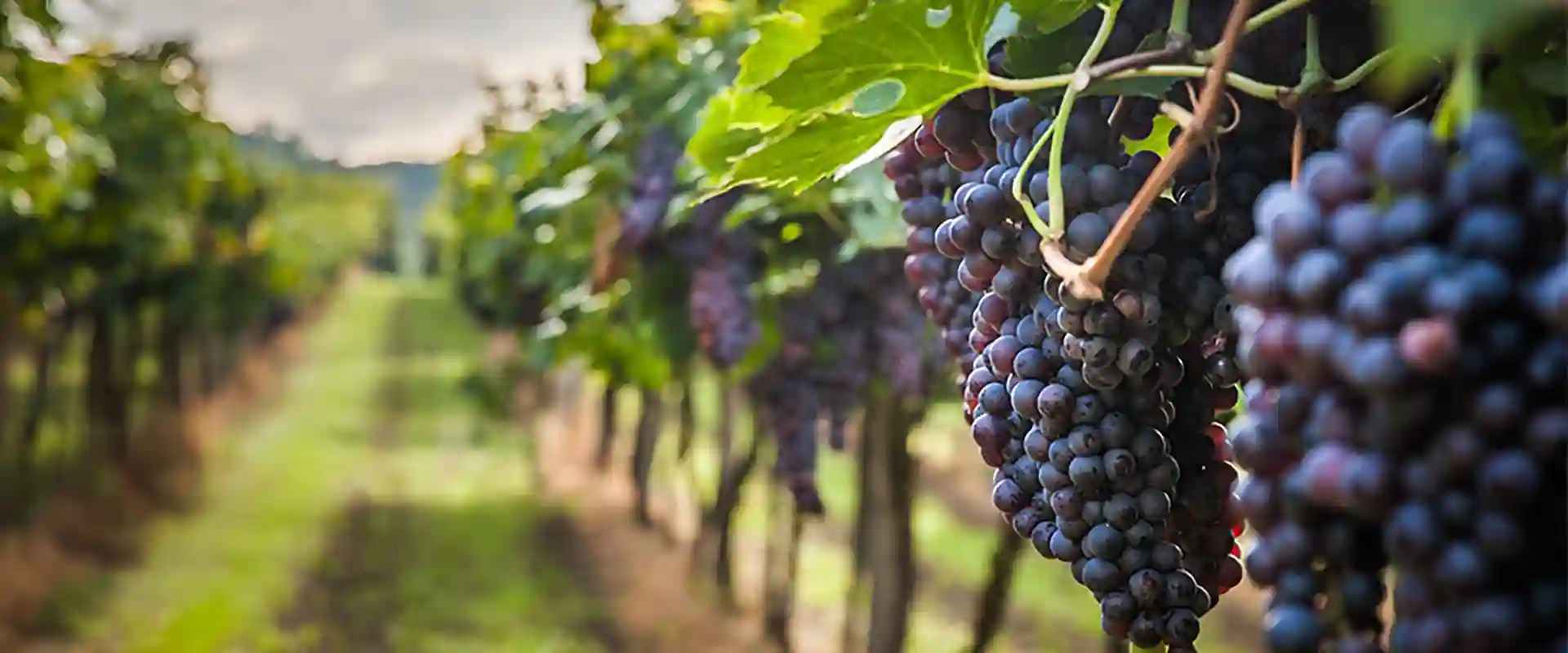
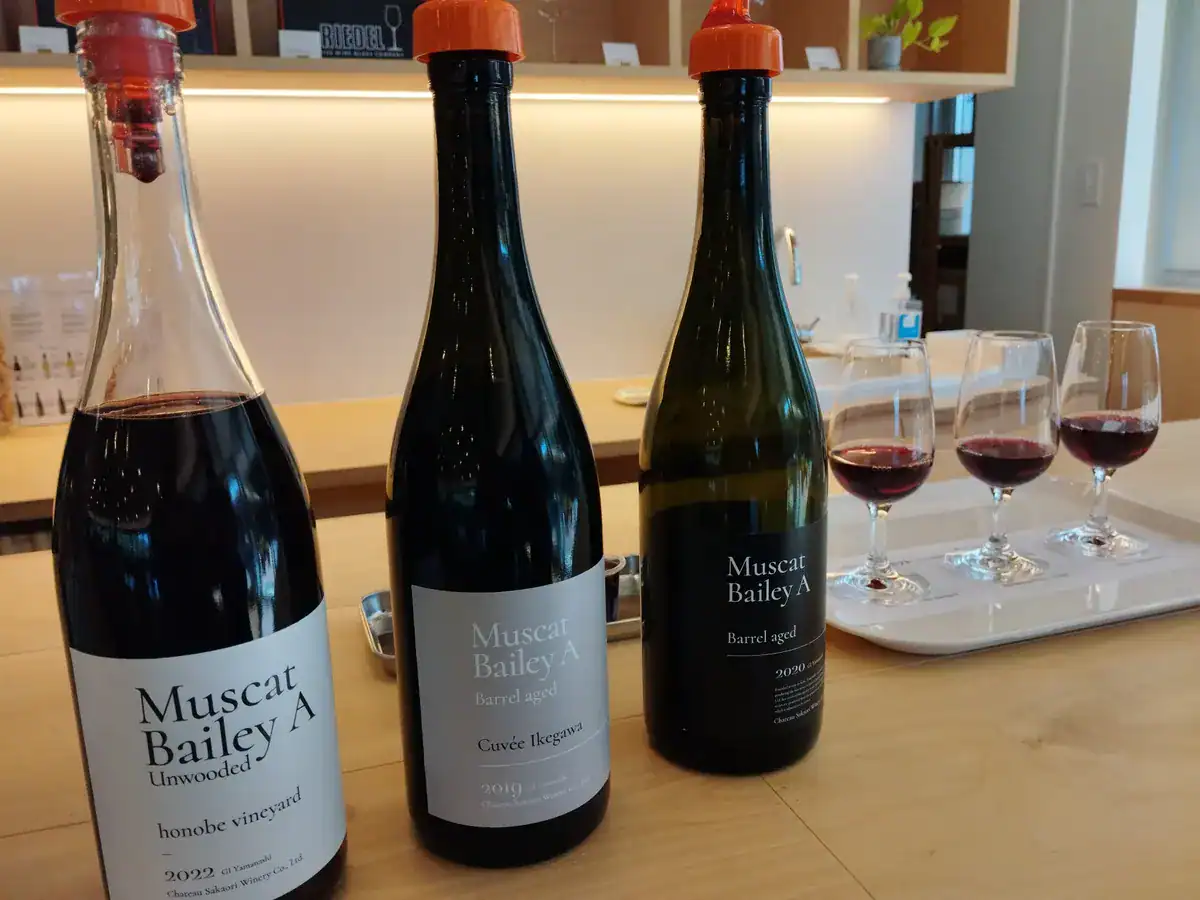
Comparing unwooded and barrel-aged Muscat Bailey A at Château Sakaori shows how differently the same Japanese grape can express itself.
Most people I guide in Yamanashi arrive with very little experience of Japanese wine. Some have tried a bottle in a hotel, restaurant, or specialty wine shop. Many have never tried it at all.
The assumptions are often similar: Japanese wine will probably be sweet, the range will be small, and Koshu and Muscat Bailey A are about all there is. Some guests are interested because the wine is Japanese, but they are not yet convinced it can be seriously good.
I do not try to talk them out of those ideas before we start. It is much more useful to pour the wine.
Usually the picture changes quite quickly.
A dry Koshu can be the first surprise. Muscat Bailey A can smell very fruity and still finish dry. Then somebody tastes Chardonnay, Sauvignon Blanc, Merlot, Black Queen, Yama Sauvignon, Pinot Noir or another variety they did not expect to find here.
That is how I approach Japanese wine when guiding guests with Winery Tours Japan. I am not trying to make people memorize every grape grown in Japan. I want them to taste enough different styles and flavor profiles to see how versatile Koshu, Muscat Bailey A and other Japanese wines can be, then decide for themselves what they actually enjoy.
Table of contents
- Japan’s climate matters before the wine reaches the glass
- Start with Koshu, but compare it
- Muscat Bailey A: fruity does not mean sweet
- Japanese white wine goes well beyond Koshu
- The Japanese reds are where things get especially interesting
- Familiar red grapes do not always taste familiar in Japan
- The older sweet-wine image of Japan did not come from nowhere
- Japanese wine makes sense at the table
- How I actually introduce Japanese wine in a tasting
- Older bottles and tiny production runs are part of the experience
- There is no single taste of Japanese wine
Japan’s climate matters before the wine reaches the glass
One thing that is easy to miss when talking only about grape varieties is how demanding the Japanese growing season can be.
We have the early-summer rainy season, hot and humid summers, and another wet, typhoon-prone period later in the season. Rain, humidity, disease pressure and fruit cracking can all become serious problems.
A famous international grape is not automatically a good choice just because it performs well somewhere else. Growers and breeders here have always had to think about whether a variety can actually cope with Japanese conditions.
Muscat Bailey A is a good example. It was developed in Japan and is notably resilient to disease, moisture and cold. Other Japanese-developed crossings also reflect the long effort to find grapes that can perform reliably here.
That does not mean every wine grape in Japan was bred specifically for the climate. Chardonnay, Merlot, Cabernet Sauvignon, Pinot Noir, Sauvignon Blanc and many other international varieties are also grown successfully. The point is that climate suitability matters greatly, and the right grape in the right place can be very different from what a visitor expects.
Start with Koshu, but compare it
Koshu is usually where I begin, but I do not like introducing it with one glass and saying, “This is what Koshu tastes like.”
It is much more useful to compare.
When the wines are available, I often start with two stainless-steel Koshu wines from different vineyards. After that I introduce an oak-fermented or barrel-aged example.
The first two let people notice differences between vineyards without oak being the loudest thing in the glass. The third shows how much the same delicate grape can change once oak enters the picture.
That simple comparison often teaches more than a long explanation.
It also shows why I like guests to try different styles rather than one supposedly representative bottle. If somebody tastes only one Koshu, they can easily assume that is what the grape always tastes like. Put three quite different Koshus side by side and the versatility becomes obvious.
My own preference is usually stainless-steel Koshu. I like the cleaner view of the grape and the vineyard.
Oak can be excellent with Koshu, but I think it has to be handled carefully. Too much and the subtle character of the wine can disappear behind the barrel.
One Koshu I particularly like is Aruga Branca Issehara from Katsunuma Jyozo. I often get a distinctive green-apple character from it, and the Issehara vineyard is one I hear spoken about with unusual respect among winemakers in the valley. Aruga Branca Issehara 2023 also won gold at the Vinalies Internationales 2025 in France, the first Koshu to receive a gold medal at that competition.
Older Koshu is another interesting comparison, although I would not make it the starting point for somebody new to the grape.
A 2013 Koshu from Manns is one of the aged examples I remember particularly well. Over the years I have also tasted much older Koshu, including wines going back to around 2000.
Personally, I usually enjoy Koshu most somewhere around two to five years old. Carefully stored older bottles can soften and become more mellow, but age by itself does not automatically make the wine better.
For the grape’s history, production and wider styles, see the Koshu wine guide. Sparkling Koshu has enough character of its own that I cover it separately in the Koshu sparkling wine guide.
Muscat Bailey A: fruity does not mean sweet
Muscat Bailey A is probably the second grape I use most often to change somebody’s expectations.
The aroma can be very fruity. Strawberry, red fruit and sometimes a slightly confectionery character can make a first-time drinker assume the wine will be sweet before it reaches the mouth.
Then they taste it and find that it can be completely dry.
That distinction between fruitiness and sweetness is important in Japanese wine. I see people confuse the two all the time.
When possible, I use a similar comparison to Koshu: two stainless-steel Muscat Bailey A wines, ideally from different vineyards or producers, followed by an oak-aged example.
I like using stainless-steel examples because they make it easier to follow the grape itself and the differences between sites. But overall, when the oak is well balanced, I generally prefer the extra depth and body it can give Muscat Bailey A.
I have had stainless Muscat Bailey A from Katsunuma Jyozo that I particularly enjoy, especially because it lets the grape show clearly. But with a well-made barrel-aged Muscat Bailey A, I like the added body and depth as long as the oak does not overpower the fruit or take away the grape’s natural lightness.
One barrel-aged Muscat Bailey A I think is especially good is MGVs B153 Katsunuma-cho Hikima 2018. It was made from 100% Muscat Bailey A grown in MGVs’ single Hikima vineyard in Kami-Iwasaki, Katsunuma. The winery restricted the crop heavily before harvest, and only 1,186 bottles were produced.
It was fermented in stainless steel and then barrel-aged. For me, it is an excellent example of what oak can do with Muscat Bailey A when the balance is right: the wine has more body and a longer finish, but it still keeps the lightness I like in the grape.
That wine is a good example of why I often prefer Muscat Bailey A with some well-judged oak. It can gain body and complexity without becoming heavy. I still like stainless examples, especially for comparison, but I would rather judge the wine in front of me than decide in advance how the grape should be made.
This is another variety where one bottle can give the wrong impression. Muscat Bailey A can be bright and light, deeper and more structured, stainless, oak-aged and sometimes sparkling.
I do not tell guests which version is the “correct” one. I want them to see what the grape can do.
Japanese white wine goes well beyond Koshu
Koshu is the obvious starting point, but Japanese white wine is much broader than that.
Chardonnay is a good example.
I am not normally a big Chardonnay drinker when the wine is very buttery, heavy or aggressively oaked. In my experience, many Japanese Chardonnays I encounter are brighter and lighter in style, with less of that heavy buttery character. I often find them more inviting for that reason.
Haramo is a good local example of how much range one winery can have. It is well known for Koshu, but it also produces estate Chardonnay and works with several different red grapes and blends.
In Nagano, I particularly like Manns Shinano Riesling and Sauvignon Blanc. Those wines are useful because they remind people that an international grape does not have to taste exactly like the version they know from another country.
Shinano Riesling itself is a Japanese-developed crossing of Chardonnay and Riesling. It is another example of Japan taking familiar material and doing something locally specific with it.
Kai Blanc is also worth knowing about. It is a Yamanashi-developed crossing of Koshu and Pinot Blanc. I would not tell a first-time drinker that they need to hunt it down before they can understand Japanese wine, but if it is on the tasting table, I think it is worth trying.
That is how I feel about many of the less common Japanese crossings: try them when the opportunity appears rather than turning a tasting into a checklist.
The Japanese reds are where things get especially interesting
Muscat Bailey A gets most of the attention, but several other red grapes and crossings make Japanese wine much more interesting than people expect.
Black Queen is one I enjoy a lot.
Haramo makes a Black Queen that I like, and so does Kizan. Black Queen can have a sharper edge, and I have tasted it in blends where Petit Verdot helps make the finished wine feel softer and rounder.
Black Queen also sometimes reminds me of Malbec, which is my favorite red wine overall. I am not saying Black Queen should taste like Malbec. It is simply a connection my palate makes sometimes, and it is one of the reasons I enjoy showing it to people.
At Kizan I have even seen Black Queen used for grappa. Those are the small details that make Japanese wineries interesting to visit: the same grape does not always end up in the kind of bottle you expect.
Haramo is interesting for a similar reason. Alongside Koshu and estate Chardonnay, it works with grapes such as Black Queen, Petit Verdot, Merlot, Yama Sauvignon and Harmo Noir in different wines and blends. I like its Harmo Noir as well.
Yama Sauvignon is another Japanese red I particularly enjoy. It is a crossing of Yama Budo and Cabernet Sauvignon, and I often find a recognizable Cabernet-like character in it, but in a brighter, lighter form that I find easier to drink on its own than a very heavy Cabernet.
Sanyo Winery in Makioka makes one of my favorite examples. Makioka is an old grape-growing area of the valley and has been known for good fruit for a long time. I have also come across Yama Sauvignon from Fuefuki, and the variety has been introduced in Hayakawa as well, but for my palate the Makioka expression is the one I like best.
That is only my opinion. I would rather let somebody taste the wines and make up their own mind.
I have also enjoyed Bijou Noir from Château Mercian. Kai Noir is another Yamanashi-developed red that occasionally appears.
The point is not to collect obscure grape names. It is to realize that Japan has its own red-wine vocabulary as well as familiar international varieties.
Familiar red grapes do not always taste familiar in Japan
The other surprise for many guests is how much is being done with international red grapes.
Merlot is one of the clearest examples. I have had some very good Manns Merlot from Nagano, including wines from its better vineyard sites there. Grace Winery Cabernet Sauvignon is another wine I enjoy.
Pinot Noir is a grape I return to often.
I particularly like Château Mercian’s Hokushin Pinot Noir Cuvée Akio from Nagano. I also like Pinot Noir, Syrah and Merlot from Soleil Winery in Yamanashi.
Domaine Q is another personal favorite. The winery has worked with Pinot Noir in Yamanashi for a long time, inspired from the beginning by the ambition to make a Pinot Noir with the quality and seriousness associated with Romanée-Conti. That was an inspiration, not a collaboration with Domaine de la Romanée-Conti.
One Domaine Q wine I especially enjoy is Rouge Q, an unusual blend of Muscat Bailey A and Pinot Noir. I like the idea behind it as much as the wine itself: a grape strongly associated with Japanese wine sitting beside Pinot Noir in the same bottle.
Then there is Malbec.
Malbec is difficult to find in Japan, which makes it more interesting to me because it is my favorite grape overall. One Japanese example that has stayed with me comes from Hatano-san at Cave Hatano in Nagano. The production was very small, and I thought the wine was excellent.
Personally, I would like to see more Malbec grown here.
That is not a prediction about where Japanese wine is going. It is simply my reaction to one of the better Japanese Malbecs I have tasted.
The older sweet-wine image of Japan did not come from nowhere
When visitors tell me they thought Japanese wine was sweet, I understand where the idea comes from.
Japan has a long history with table grapes and North American-derived varieties such as Delaware, Niagara, Concord and Campbell Early. Kyoho and other table grapes also belong to the broader grape culture here even though they are not all North American varieties.
Many wines I personally encounter from this side of Japanese wine are much sweeter than the dry Koshu, Chardonnay or reds I normally prefer.
Those wines are generally not my style. I tend to think of many of them more as dessert wines or very fruity drinking wines.
But I also do not want to replace one stereotype with another.
Not every wine from these grapes is sweet, and fruity or grapey aromas do not automatically mean there is a lot of residual sugar. Haramo’s Adirondack red, for example, can smell very strawberry-like while tasting dry.
That brings us back to the same lesson as Muscat Bailey A:
Aroma, fruitiness and sweetness are not the same thing.
The older sweeter side of Japanese wine is real, but it does not define what Japanese wine is today.
Japanese wine makes sense at the table
Most Japanese wine is still consumed here in Japan, which is one reason many foreign visitors arrive having never tried it before. I would not put an exact percentage on that without a current verified figure, but Japanese wine remains much more of a domestic experience than an export one.
For me, a lot of Japanese wine also makes the most sense with food. The lighter structure of many of the wines I pour works naturally with Japanese meals rather than overpowering them. Dry Koshu can be very good with grilled fish, sushi or sashimi; lighter reds can work with yakitori and grilled meats; and seasonal grilled vegetables are an easy match with several white and red styles.
Many of the lighter Japanese wines we taste are around 11–12% alcohol rather than being especially powerful. Guests from overseas often tell me they like that, particularly with lunch or in the middle of the day, because the wine feels easier to drink with a meal.
In summer, I also like Japanese wine slightly chilled with an afternoon barbecue. A cool Koshu or a lighter red with grilled meat and seasonal vegetables can be very refreshing when the Yamanashi sun is hot.
That is another reason I do not think Japanese wine needs to be approached as a ranking exercise. Sometimes the wine that makes the most sense is simply the one that fits the food, the weather and the moment.
How I actually introduce Japanese wine in a tasting
I do not follow one rigid tasting order all day. What is available changes by winery, vintage and season.
What I do try to do is give guests enough contrast to notice something for themselves.
I like people to try a wide range of styles and flavor profiles so they can see how versatile Koshu and Muscat Bailey A can be, then move into other whites and reds.
With Koshu, I might pour a stainless wine from one vineyard, then another stainless wine from a different vineyard, then an oak-fermented or barrel-aged Koshu.
With Muscat Bailey A, I may do something similar.
Later we might taste Chardonnay, Shinano Riesling, Sauvignon Blanc, Black Queen, Yama Sauvignon, Merlot, Cabernet Sauvignon, Pinot Noir or something completely unexpected depending on the wineries that day.
The first question is not:
“Which one is best?”
It is:
“What changed?”
Did the fruit become clearer?
Did the acidity feel different?
Did the oak make the wine broader, or did it hide something?
Can you tell which wine feels more delicate?
Is a fruity aroma making you expect sweetness that is not actually there?
I have my own preferences, but I never try to convince a guest that a particular wine is the best or that they are supposed to like it.
My job is to introduce the wine, explain what is different about it, and give people enough variety to make up their own mind.
Sometimes a guest loves a wine that would not be my first choice. Sometimes we agree immediately. Both are fine.
In my experience, every guest I have guided has found something they liked or at least something they found genuinely interesting.
That is why I do not think “What is the best Japanese wine?” has one useful answer.
A better starting point is to taste a few well-chosen contrasts and see where your own palate takes you.
Older bottles and tiny production runs are part of the experience
Another thing that surprises people is scale.
I have tasted wines from Japanese producers where the entire run was only a few hundred bottles. I have encountered private releases around 100 bottles and wines made from only one or two barrels.
I have sometimes opened wines from tiny private runs of only a few hundred bottles, and in a few cases probably one of the last bottles still remaining.
That does not make a wine good by itself. Small production is not a quality guarantee.
But it changes the experience, and it helps explain why some very good Japanese wines are difficult to encounter outside Japan.
Older wines can be similar. A winery may have a few bottles tucked away, or a back vintage may appear that you would never find in a normal shop.
This is where local tasting becomes interesting to me. You are not only tasting a grape variety. Sometimes you are tasting a tiny piece of one vineyard, one vintage or one winemaker’s experiment that may never be repeated in exactly the same way.
There is no single taste of Japanese wine
After years of guiding tastings in Yamanashi, this is probably the biggest thing I want first-time drinkers to understand.
Japanese wine is not one style.
It includes delicate dry whites, sparkling wines, aromatic wines, lighter reds, structured reds, sweet wines, international grapes, Japanese-developed crossings and bottles made in quantities so small that most people outside the region will never see them.
Some I like very much. Some are not my style at all.
That is normal.
The useful question is not simply, “Is Japanese wine good?”
Taste several very different examples and ask which Japanese wine you like.
For the bigger national picture, the Japanese wine regions guide explains where the main wine regions fit together. For producers, see the Japanese wineries guide. For Yamanashi specifically, the Yamanashi wine region guide gives the wider regional context.
If you want to experience these comparisons in the valley rather than only read about them, the one-day private Yamanashi wine tour explains the tour itself. You can also return to Winery Tours Japan for the main tour information.