


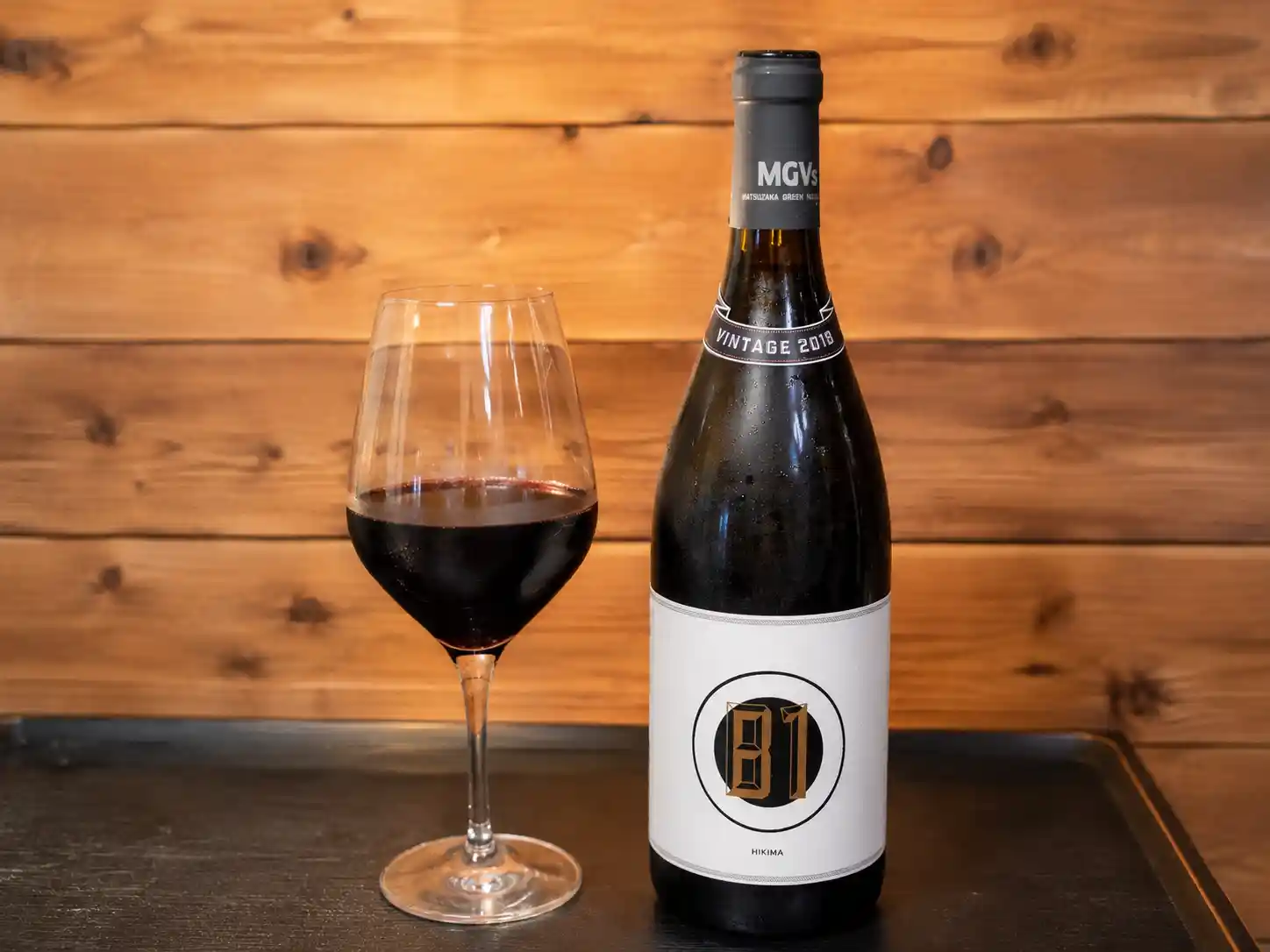
MGVs Muscat Bailey A with a glass of red wine in Yamanashi.
Muscat Bailey A is one of the Japanese red wines I pour most often for visitors, and it is also one of the grapes that changes people’s expectations of Japanese wine very quickly.
Many guests expect it to be sweet before they taste it. The strawberry and red-fruit aromas can certainly give that impression, but many of the Muscat Bailey A wines I enjoy are completely dry. Good examples can be fresh, bright and easy to drink, while others can be deeper, oak-aged, blended, sparkling or capable of becoming softer and more rounded with age.
That range is why I think Muscat Bailey A deserves its own guide. It is not simply a light fruity red grape. Vineyard location, vintage and winemaking can change it considerably, and tasting several versions side by side is one of the best ways to understand what Japanese red wine can be.
This page focuses specifically on Muscat Bailey A. For the wider picture of Japan’s red grapes, including Black Queen, Yama Sauvignon, Pinot Noir, Merlot and Cabernet Sauvignon, see my Japanese Red Wine Guide.
What Is Muscat Bailey A?
Muscat Bailey A is a red wine grape developed in Japan by Zenbei Kawakami at Iwanohara Vineyard in Niigata. He created it in 1927 by crossing Bailey with Muscat Hamburg while working to develop wine grapes better suited to Japanese growing conditions.
That history matters. Muscat Bailey A was not imported as a finished answer from another wine country. It came out of the problem of making wine in Japan, where humidity, rain, disease pressure and very different regional climates can make grape growing difficult.
Muscat Bailey A eventually spread well beyond Niigata and is now grown across several Japanese wine regions. It was also registered with the International Organisation of Vine and Wine, or OIV, in 2013.
For me, though, its importance is easier to understand from the glass than from its history. It gives Japan a red grape with a recognizable character of its own.
What Muscat Bailey A Actually Tastes Like
Strawberry is probably the aroma most often associated with Muscat Bailey A, and sometimes it is very obvious. Raspberry, cherry and other red-fruit notes are also common. Some wines can have a floral quality, while others move toward darker berries, herbs, spice and more savory aromas.
But I would not define Muscat Bailey A simply by a list of fruit aromas. The structure matters just as much.
Many examples have lively acidity, moderate body and relatively gentle tannins. That combination makes the wine approachable without necessarily making it simple. It can be enjoyable on its own, easy to put with food and comfortable to taste relatively early in the day without exhausting the palate.
Most importantly, fruity does not mean sweet. I find this is one of the most useful things to show visitors. A Muscat Bailey A can smell strongly of ripe berries and still taste dry, fresh and quite clean.
Stainless Steel or Oak? I Like Both
I often introduce Muscat Bailey A by pouring a stainless-steel version and an oak-aged version. It is a simple comparison, but it tells you a great deal about the grape.
Personally, I usually lean toward stainless steel when I want to understand Muscat Bailey A itself. Without too much oak around it, the fruit, acidity and more delicate character of the grape can come through very clearly.
Most of my guests tend to prefer the stainless expression as well. They often comment on how fruity and distinctive it is, while also being surprised that the wine is dry.
That does not mean I am against oak. A well-balanced barrel-aged Muscat Bailey A can be excellent. The key for me is that the oak should support the wine rather than cover it. When wood becomes the first thing you taste, some of the delicate character that makes Muscat Bailey A interesting can disappear.
When the balance is right, however, barrel aging can add spice, texture and depth while leaving the fruit recognizable underneath.
Muscat Bailey A Wines That Have Stood Out to Me
I do not think this should be turned into a ranking of the “best” Muscat Bailey A wines. Production changes, vintages change and small Japanese wines can disappear quickly. These are examples I have tasted that helped me understand different sides of the grape.
Manns Muscat Bailey A 2023
One of the recent Manns Muscat Bailey A wines I particularly enjoyed was the 2023 vintage. It was a very well-made, balanced wine rather than a wine trying to impress through weight.
On the nose I found medium-plus intensity with blackcurrant, blackberry, cherry and dried herbs. It was dry, with medium-plus acidity, medium body, relatively gentle tannins and 12% alcohol. The palate followed the nose quite closely and the finish was fairly short.
What I liked was how easily everything fitted together. It was clearly Muscat Bailey A, but the darker fruit and herb character showed a side of the grape that is easy to miss if you only associate MBA with strawberries.
It is also the kind of wine I would happily drink with BBQ or grilled meat.
Manns Chikumagawa Muscat Bailey A 2023
Manns Chikumagawa Muscat Bailey A 2023 is another excellent example, but what interested me most here was the sense of place.
Manns has been exploring the potential of Muscat Bailey A in the Chikuma River area of Nagano, including trellised vineyards around Komoro. This is useful because Muscat Bailey A is so strongly associated with Yamanashi that it can be easy to overlook what the grape can do elsewhere.
In the Chikumagawa wine I felt the terroir came through particularly clearly. The fruit was still recognizably Muscat Bailey A, but it felt less like a generic varietal expression and more connected to the vineyard and region.
That is one of the directions I find most interesting for the grape: not simply trying to make “better Muscat Bailey A,” but discovering how Muscat Bailey A changes from one Japanese site to another.
For more on the region itself, see my Nagano Wine Region guide.
Château Mercian 2008 Muscat Bailey A
An older Château Mercian Muscat Bailey A from 2008 gave me another useful lesson: Muscat Bailey A does not necessarily have to be drunk only for young, bright fruit.
The wine still had brightness, but age had made it noticeably rounder and softer. The youthful edges had relaxed without the wine becoming dull.
I would not say that every Muscat Bailey A should be kept for many years. Most are enjoyable for their freshness. But a good older bottle can show another side of the variety, particularly when it has been made with enough balance from the beginning.
MGVs B553 Muscat Bailey A Red
MGVs B553 is useful when I want to show that Muscat Bailey A can also move toward a deeper and more concentrated style.
Compared with a simple stainless-steel expression, there is more extraction, more color and a stronger influence from maturation. It shows that the grape can take a more ambitious winemaking approach without automatically losing its identity.
Again, balance is what matters to me. I do not need Muscat Bailey A to become a Cabernet Sauvignon substitute. I would rather the extra structure reveal another part of MBA than bury it.
Muscat Bailey A in Blends
Some of the most interesting Muscat Bailey A wines I have tasted are blends.
Grace Wine’s Yamanashi de Grace is a good example. Muscat Bailey A forms part of a blend with Bordeaux varieties including Merlot and Cabernet. What I like about this type of wine is that MBA can contribute freshness and fruit while the other grapes add additional structure and depth.
Château Katsunuma’s Muscat Bailey A and Black Queen combination is another style I enjoy. Black Queen can bring darker color, acidity and spice, while Muscat Bailey A keeps the wine approachable and fruit-driven.
Domaine Q has made one of the more unusual combinations I enjoy: Pinot Noir with Muscat Bailey A. On paper they might seem like strange partners, but that is exactly why it is interesting. Both can bring freshness and fragrant fruit without requiring enormous weight.
These wines are useful reminders that understanding a grape does not mean insisting that it must always be bottled alone.
Muscat Bailey A Can Also Be Sparkling or Rosé
Still red wine is only part of the Muscat Bailey A story.
I have also enjoyed it as sparkling wine. Examples from Takahata Winery, Château Mars and Manns show how well the grape’s bright fruit can work with bubbles. Sparkling MBA can be particularly easy to enjoy because the freshness of the wine keeps the fruit from becoming too heavy.
Rosé is another natural direction. I have tasted interesting examples from Olifant, produced through Sasaichi, as well as Spring Wine and Suntory. These are not necessarily the wines most international visitors will encounter first, but they help show how adaptable the grape is.
I would rather see producers explore these different expressions than force Muscat Bailey A into one fixed definition of what a serious red wine is supposed to look like.
Yamanashi and Muscat Bailey A
Yamanashi remains one of the most useful places to understand Muscat Bailey A because so many producers work with it and because the wines can vary considerably even within a relatively small area.
I encounter it in Katsunuma, Enzan and other parts of the Kofu Basin in everything from straightforward stainless-steel wines to oak-aged versions, blends and small experimental releases.
That concentration is useful when tasting. Instead of judging the grape from a single bottle, you can compare different vineyards and producers on the same day. When I do that with guests, the idea that Muscat Bailey A has one simple flavor disappears very quickly.
The broader history and geography of the prefecture are covered separately in my Yamanashi Wine Region guide. Keeping that regional story separate allows this page to stay focused on the grape itself.
How I Introduce Muscat Bailey A During a Tasting
I normally do not begin by giving guests a long explanation of Muscat Bailey A. I would rather let them taste it.
If possible, I like to start with a clean stainless-steel example. That gives the clearest first look at the fruit, acidity and relatively gentle tannin.
Then I will pour an oak-aged version if one is available. Guests can immediately see what the barrel changes: usually more spice, texture and depth, but sometimes less of the fresh fruit that defined the first glass.
If there is a good blend, an older vintage or a sparkling MBA available, that can come later. By that point the guest is no longer asking, “What does Muscat Bailey A taste like?” They are beginning to ask why these Muscat Bailey A wines taste different from each other.
That is a much more interesting conversation.
I also find Muscat Bailey A works well relatively early in a tasting day. Its freshness and moderate structure make it easier on the palate than beginning with a heavy, tannic red.
What Visitors Usually Think of It
The reaction I hear most often is some version of, “I thought Japanese red wine would be sweet.”
Muscat Bailey A is very good at challenging that assumption because the aroma can be openly fruity while the actual wine remains dry.
Guests also tend to like how approachable it is. The tannins are often less aggressive than in many Cabernet-based reds, the fruit is easy to recognize and the wine does not need enormous alcohol or body to have character.
When I pour stainless and oak versions together, both usually have supporters, but more guests seem to come back to the stainless wine. I think the cleaner fruit profile makes the grape easier to understand on a first tasting.
This is also why Muscat Bailey A is such a useful bridge into the wider world of Japanese wine. It feels different enough to be distinctly Japanese, but it is still easy for someone unfamiliar with Japanese wine to enjoy.
What Food Goes With Muscat Bailey A?
Muscat Bailey A is one of the easiest Japanese reds for me to put with food because it usually has enough acidity to stay fresh and enough fruit to be friendly without requiring a very heavy dish.
BBQ is an obvious match. I like it with grilled wagyu, grilled beef, chicken and other grilled meats. A hamburger works very naturally too, particularly with a dry fruit-driven MBA where the acidity keeps the combination from becoming heavy.
A roast-beef sandwich is another pairing I enjoy. There is enough red-wine character for the beef, but the softer tannins generally do not overpower the bread, vegetables and condiments.
I would not restrict it to meat. Muscat Bailey A can work with fish, particularly when the preparation has some grilling, seasoning or sauce rather than being extremely delicate.
Greek salad is surprisingly comfortable with a lighter MBA too. Tomato, herbs, olives and feta give plenty of flavor, while the freshness of the wine keeps the pairing lively.
I also enjoy it with Mexican-style tortillas, pizza and pasta. Those are not traditional Japanese pairings, but that is part of the point. Muscat Bailey A does not need to be treated as a curiosity that only belongs with Japanese food.
Its light, approachable profile makes it one of the reds I can fit into a meal without having to design the entire meal around the wine.
Why Muscat Bailey A Matters to Japanese Wine
Muscat Bailey A matters because Japan did not simply adopt it from another wine culture. It was developed here, adapted here and has continued evolving through Japanese vineyards and wineries.
More importantly, producers are still finding new ways to work with it.
There are clean stainless-steel wines that emphasize the grape itself. There are barrel-aged wines, serious blends, sparkling wines, rosé, older vintages and site-driven examples from areas such as the Chikuma River Valley in Nagano.
That diversity is much more interesting to me than trying to decide whether Muscat Bailey A can imitate Pinot Noir, Gamay, Cabernet Sauvignon or anything else.
The grape is most convincing when it is allowed to be Muscat Bailey A.