


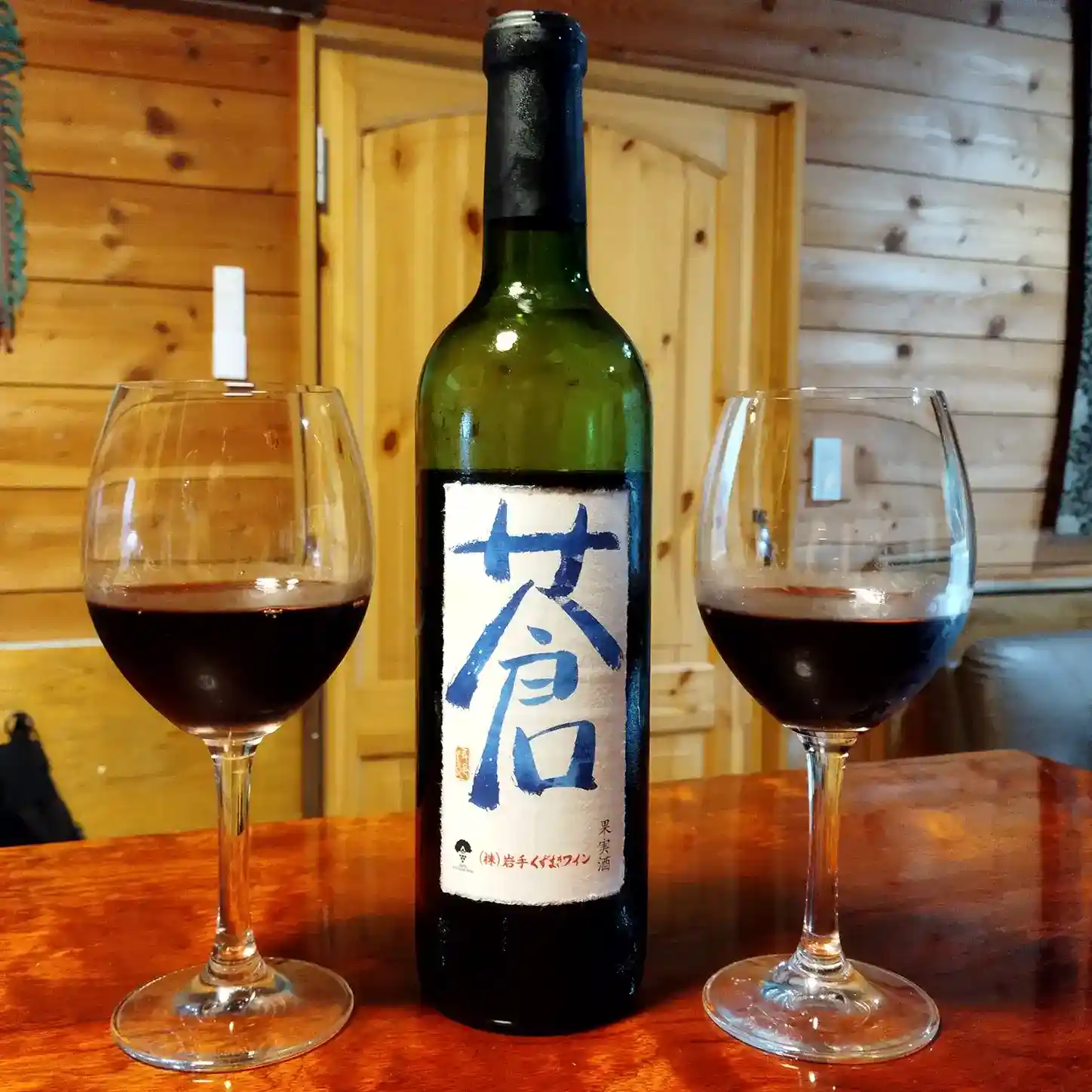
Kuzumaki Wine Blue-Ao-Red (蒼-あお-・赤), a dry red from Iwate made from the Yama Budo hybrid Little Prince. I particularly enjoyed its ripe-fruit aroma, earthy character and bold but balanced profile.
Yama Budo, also written Yamabudou, is Japan’s wild mountain grape. It is very different from better-known Japanese wine grapes such as Koshu and Muscat Bailey A, and for me it represents another side of Japanese wine that is easy to miss if you only look at the major wine regions and international grape varieties.
Yama Budo is the Japanese mountain grape Vitis coignetiae. It grows naturally in Japan and is used both directly for wine and in the breeding of mountain-grape hybrids. It is particularly important in northern Japan, including Iwate, where producers have spent decades developing Yama Budo and related varieties into distinctive regional wines.
I have tasted several wines connected to Yama Budo, including pure mountain-grape wines and wines made from Yama Budo-derived varieties. What I find interesting is that they share a certain wildness and strong natural acidity, but they can still be very different from one another in aroma, body and sweetness.
What Is Yama Budo?
Yama Budo literally means “mountain grape.” The species usually meant by the name is Vitis coignetiae, a wild grape native to Japan and other parts of northeastern Asia.
In Japan, it is closely associated with forests and mountainous areas rather than the conventional vineyard landscape most people picture when they think about wine. Its naturally strong acidity, deep pigmentation and concentrated fruit character give winemakers something quite different to work with.
This is why I think Yama Budo deserves to be understood separately from the better-known Japanese wine grapes. Koshu has its own long connection with Yamanashi, while Muscat Bailey A developed into one of Japan’s signature modern red-wine grapes. Yama Budo comes from a different direction: a wild mountain grape that has gradually found a place in modern Japanese wine.
If you want the wider picture of Japanese reds, see our Japanese Red Wine Guide.
Yama Budo and the Development of Japanese Wine
Yama Budo has long grown wild in Japan’s mountainous regions, but its modern role in winemaking developed much later. In Yamanashi, official wine history records wine being made from Yama Budo and Koshu in 1870, during the early development of Japan’s modern wine industry.
In northern Japan, particularly Iwate, Yama Budo later became important not only as a wild fruit but as a regional wine grape and breeding resource. Producers such as Kuzumaki Wine have helped turn that local mountain-grape tradition into a distinctive part of modern Japanese wine.
For me, that history is especially interesting because Yama Budo survived as a distinctly Japanese plant resource and gradually found a place in modern winemaking on its own terms. Rather than simply following European grape traditions, producers have continued working with a grape that is naturally connected to Japan’s mountains and regional agriculture.
Why Iwate Matters for Yama Budo Wine
If you are interested in Yama Budo wine today, Iwate is one of the regions worth paying attention to. The grape and its descendants have become part of the identity of wine production in northern Iwate, where the cool climate and mountainous landscape provide a very different setting from Yamanashi’s main wine areas.
This regional difference is one of the things I enjoy about Japanese wine. Travel from one part of Japan to another and the varieties, climate and local wine culture can change considerably. Yama Budo gives Iwate something genuinely connected to its own landscape rather than simply another version of an international grape variety.
Our Japanese Wine Regions Guide covers the broader regional picture across Japan.
Kuzumaki Wine and the Yama Budo Revival in Iwate
One of the important producers connected with Yama Budo in Iwate is Kuzumaki Wine in Kuzumaki Town.
The modern wine project in Kuzumaki began after then-mayor Gintaro Takahashi proposed developing wine from local mountain grapes in 1979. Over the following years, the town worked to establish grape growing and wine production as a local industry, and Kuzumaki Wine was founded in the 1980s.
Yama Budo has remained central to that story. Kuzumaki has worked not only with mountain grapes themselves but also with varieties developed from Yama Budo lineage, creating wines suited to the cool conditions of northern Iwate.
I think that is an important part of why Kuzumaki matters. Preserving a native grape is one thing, but turning it into wines that people actually want to drink takes growers, winemakers and years of practical experience. The wines I have tasted show how much range there can be within the mountain-grape family.
The Kuzumaki Wine I Tasted: Blue-Ao-Red
The Kuzumaki wine I tasted was Blue-Ao-Red (蒼-あお-・赤), a dry red with 12% alcohol made entirely from Little Prince, a mountain-grape hybrid with Yama Budo ancestry.
What stood out to me first was the aroma. It had a sweet, ripe-fruit character that reminded me somewhat of Muscat Bailey A, although the wine itself was dry. I picked up ripe berry aromas together with a more earthy character that reminded me of dried flowers and concentrated fruit.
On the palate I found it medium-bodied, with firm acidity and a good concentration of fruit. The dried-fruit character gave it more earthiness, while the acidity kept everything balanced. There was still something slightly wild about it, which I liked, but it never became harsh or difficult to drink.
I was surprised by how inviting and bold the wine was for something descended from a wild mountain grape. It had plenty of personality but still felt balanced and approachable. I enjoyed it with steak and grilled vegetables, where the ripe fruit, acidity and earthy side of the wine worked particularly well with the grilled flavors.
For me, this was the kind of bottle that makes Japanese wine interesting. It was not trying to taste exactly like Cabernet Sauvignon, Pinot Noir or another familiar international red. It had its own character and a clear connection to the mountain-grape tradition of northern Japan.
Two More Yama Budo Wines I Tasted
I have also tasted Yamabudou Wine (山ぶどうワイン) and a drier Yamabudou Wine Classic (山ぶどうワイン クラシック). Tasting them side by side gave me a better sense of just how much the style can change even when Yama Budo remains at the center of the wine.
The regular Yamabudou Wine had a distinctive first impression that I can only describe as slightly herbal and almost medicinal in character. It was not unpleasant; it felt more like part of the wild personality of the grape. There was noticeable sweetness, but it was matched by very strong acidity, so the wine never felt flat or heavy.
The acidity continued right through the finish, and I could also feel the tannin becoming more noticeable as the wine opened up. It had more body than I expected and felt quite substantial for a wine made from a mountain grape.
The Yamabudou Wine Classic showed a different side of the same style. It was finished drier, and I found the acidity more integrated and balanced. That made it easier to imagine drinking with a meal rather than on its own.
Of the two, the Classic would probably be my choice when I wanted a dry red with food. The regular version showed more of the unusual sweet-and-acid contrast that makes Yama Budo distinctive, while the Classic felt cleaner, drier and more naturally suited to savory dishes.
Tasting these alongside the Kuzumaki Blue-Ao-Red also reinforced something for me: Yama Budo should not be thought of as one single flavor. The grape and its hybrids can produce wines ranging from ripe and fruity to earthy, firmly acidic, tannic or distinctly dry.
Pure Yama Budo and Yama Budo Hybrids
It is useful to understand the difference between pure Yama Budo and varieties descended from it.
Pure Yama Budo wine is made from the mountain-grape species itself, Vitis coignetiae. Winemakers and grape breeders have also developed Yama Budo hybrids, combining mountain-grape genetics with other grape material to create vines with different growing and wine characteristics.
The Little Prince variety used in the Kuzumaki Blue-Ao-Red I tasted belongs to this second group. So although the wine has a direct connection to Yama Budo, it should not be described as a 100% pure Yama Budo wine.
Other Yama Budo-derived varieties also form part of modern Japanese wine. A well-known example is Yama Sauvignon, which has Yama Budo in its parentage and has developed its own identity as a Japanese red-wine grape.
What Does Yama Budo Wine Taste Like?
There is no single Yama Budo taste. Pure Yama Budo, different hybrids, growing conditions, ripeness and winemaking choices can all change the finished wine considerably.
From the examples I have tasted, strong acidity is one of the most consistent characteristics. The wines can also show deep color, ripe fruit, earthiness, tannin and sometimes a slightly herbal or wild edge.
The aroma can sometimes seem sweeter and riper than the wine tastes. That was something I noticed especially in the Kuzumaki bottle. Its ripe berry aroma reminded me a little of Muscat Bailey A, but once I tasted it, the wine was clearly dry, with firmer acidity and a more earthy character.
The pure Yama Budo wines I tasted showed another side of the grape. One combined sweetness with very strong acidity and a more distinctive wild character, while the Classic version was noticeably drier and more food-friendly.
I would not try too hard to force Yama Budo into a familiar European comparison. Part of its appeal is that it can have its own balance of ripe fruit, acidity, earthiness, tannin and structure.
Yama Budo Wine Styles Today
Modern producers work with Yama Budo and Yama Budo-derived varieties in several different ways. Depending on the grape and producer, the wines can include dry reds, sweeter styles, rosé and sparkling wines.
This range shows how much work has gone into understanding the grape. Strong natural acidity can be challenging, but it can also give winemakers freshness and structure to work with. Different approaches to ripeness, blending, fermentation and aging can produce very different results.
That is one reason I would rather taste these wines producer by producer than assume all Yama Budo wine will follow the same style. The examples I have tasted have ranged from sweeter, firmly acidic mountain-grape wine to a drier food-friendly Classic style and the medium-bodied, ripe and earthy Blue-Ao-Red made from the Little Prince hybrid.
Yama Budo Producers Around Japan
Iwate has an important place in the modern Yama Budo story, but it is certainly not the only part of Japan where winemakers are working seriously with mountain grapes. What makes this grape especially interesting to me is how differently it is handled from one region and producer to another.
Ina Wine Kobo — Nagano
In Nagano, Ina Wine Kobo has experimented with small-production mountain-grape wines, including its Op.11 2015 Yama Budo Wine. Rather than trying to force the grape into a conventional European red-wine style, the winery has treated the naturally high acidity and individual character of its mountain grapes as part of the wine’s personality.
I find that approach interesting because Yama Budo itself can vary considerably. Wild and locally selected mountain grapes are not always as uniform as established commercial wine varieties, so different fruit can give a winemaker quite different material to work with. That variability is part of what makes small Yama Budo wines worth seeking out.
Hakusan Winery — Fukui
Hakusan Winery in Fukui is another producer that has built much of its identity around Yama Budo. It works with both wild mountain grapes and Yama Budo-derived varieties, including wines where the grape’s naturally high acidity is allowed to remain an important part of the finished style.
I tasted Hakusan Yama Budo Wine Barrel 2021, made from 100% wild Yama Budo. My impression was a dry, medium-bodied wine with very strong acidity, but there was plenty of fruit behind it. The sourness was definitely part of the wine’s character rather than something hidden by the winemaking. It felt lively, fruit-forward and distinctly different from a conventional Japanese red.
The wine is barrel aged, which I think works particularly well with a grape this acidic. With time and oak, some of that sharpness can become rounder while the mountain-grape character remains recognizable.
Hiruzen Winery — Okayama
Farther south, Hiruzen Winery in Okayama shows that Yama Budo is not only a northern-Japan story. The winery has spent decades cultivating locally selected mountain grapes and makes both red and rosé wines from 100% Yama Budo, as well as wines involving Yama Budo-derived varieties.
Hiruzen is particularly interesting because growing a wild grape commercially is not as simple as taking vines from the mountains and planting a normal vineyard. The winery spent years selecting suitable local vines and adapting the way they were cultivated to Hiruzen’s climate and heavy winter snow. The result is a genuine regional wine culture built around the native grape rather than simply a limited experimental bottling.
Tokachigaoka Winery — Hokkaido
Hokkaido offers another variation on the mountain-grape story. At Tokachigaoka Winery in Otofuke, the winery grows cold-hardy Japanese varieties including Kiyomai, which was developed from Kiyomi and Yama Budo ancestry.
Its Otopuke Roman KIYOMAI 2025 is therefore not a pure Yama Budo wine, but it belongs in this story because it shows how valuable mountain-grape genetics have been in creating varieties suited to difficult northern growing conditions. The wine has an attractive sweet-and-sour fruit character, floral aromas and refreshing acidity, with barrel aging adding more depth.
This is one of the things I like about following Yama Budo through Japanese wine. Sometimes you encounter the wild grape itself, and sometimes its influence appears in varieties that have been bred specifically for Japanese climates.
MAOI — Hokkaido
Also in Hokkaido, MAOI produces a very different example with its MAOI Yama Budo. This is a pure mountain-grape wine rather than a hybrid, using Yama Budo fruit from northern Japan.
The attraction here is the grape’s naturally powerful structure. Yama Budo can bring deep color, high acidity, noticeable tannin and dark wild-fruit character, giving the wine enough weight to work with richer foods such as grilled meat and game. Bottle age can also soften the edges without completely removing the distinctive mountain-grape personality.
Yama Budo Is Not One Wine Style
Looking at these producers alongside Kuzumaki makes one thing very clear: there is no single formula for Yama Budo wine.
In Iwate, I have tasted the ripe, earthy and medium-bodied character of Kuzumaki’s Yama Budo-derived Blue-Ao-Red. Hakusan’s pure Yama Budo showed me a much sharper, drier and more strongly acidic side of the grape. Elsewhere, producers are making rosé, barrel-aged wine, sweeter expressions and wines from hybrids created specifically for Japan’s colder regions.
That range is one of the main reasons I find Yama Budo interesting. The wild grape gives winemakers strong acidity, distinctive fruit and plenty of personality, but what eventually reaches the glass depends greatly on where it is grown and what the producer chooses to do with it.
For the broader regional picture, see our Japanese Wine Regions Guide.
Why Yama Budo Matters in Japanese Wine
What interests me most about Yama Budo is that it gives Japanese wine something genuinely local. It comes from a wild grape connected to Japan’s mountains, and its modern wine story has developed through regional growers and producers learning how to work with that material.
Japan can make excellent wine from international grapes. I have tasted Japanese Merlot, Cabernet Sauvignon, Pinot Noir and Chardonnay that I would happily drink again. But Yama Budo represents a different side of the industry because its identity begins with the Japanese landscape itself.
The wines I have tasted also convinced me that Yama Budo has more range than I first expected. It can be sweet or dry, lighter or more substantial, strongly acidic, earthy, fruity or distinctly wild depending on how it is grown and made.
My View After Tasting Yama Budo Wines
Actually tasting several Yama Budo wines made the subject much more real for me. Before that, it was easy to think of the mountain grape mainly as an interesting native variety. In the glass, the differences between the wines were much more obvious.
The Kuzumaki Blue-Ao-Red gave me ripe berry aromas, a touch of Muscat Bailey A-like sweetness on the nose, earthiness and a medium-bodied, dry finish. The pure Yamabudou Wine showed stronger acidity, more body and a distinctive herbal, almost medicinal edge, while the Classic version felt drier, more balanced and easier to pair with food.
That variety is exactly why I think Yama Budo is worth knowing. It is not one fixed wine style. It is a Japanese mountain grape with its own character, its own regional history and enough range for different winemakers to take it in very different directions.
For anyone exploring Japanese wine beyond Koshu and Muscat Bailey A, Yama Budo is one of the grapes I think deserves attention. Its importance is not about becoming Japan’s largest wine category. It is about growers and winemakers continuing to develop something that has a genuine connection to the mountains and regional wine culture of Japan.